I never thought that on an ordinary Thursday I would run into the self-proclaimed "queen of mangú."
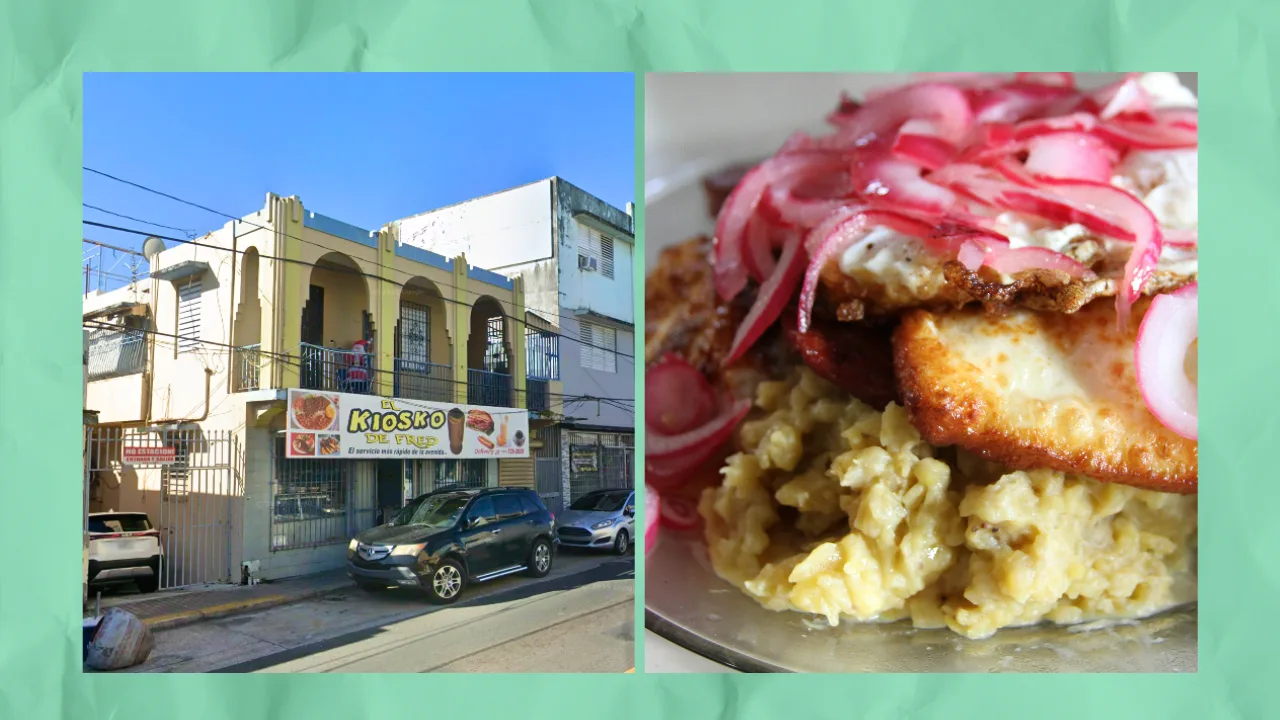
It's three in the afternoon and I set out to find a good "tres golpes" along Avenida Borinquen, in Barrio Obrero, with the goal of returning to work on a full stomach and trying, for the first time, that staple of Dominican culture. After a quick Google search, I found one of more than twenty businesses near Sagrado that serve mangú: El kiosko de Fred. I walk nearly seven minutes, arrive at the welcoming space, and notice a large decorative pilón at the entrance and another at the end of the hallway. I know I've come to the right place.
I naturally expect someone named Fred to wait on me, but the scene is different.
I approach a woman behind the counter and ask: "Do you still have mangú available at this hour?" What I didn't expect was to come face to face with the "queen of mangú," as she introduced herself.
My question came from the assumption that, in its origins, mangú is a breakfast dish. Chef Radaysa Astacio points out, however, that there is no set time to eat it in the Dominican Republic, though she has noticed that "Puerto Ricans prefer it for lunch."
After doña Lucía's reply (a pseudonym), I have no doubt I'm about to enjoy something of real standing. Mangú, also known as mangusi, is, according to Astacio, a portion of green plantain served with fried egg, salami and fried cheese.
📍 A mangú tour of San Juan
Click the yellow icons for information about each place.
When I tell Lucía it's my first time trying mangú, she reacts warmly and without hesitation. Her expression says it all. And so, in under two minutes, she serves me a plate with mangú, steak and chicken breast, and puts it in the microwave. It may not be the traditional tres golpes, but it is one of the possible protein combinations that can accompany the main event.
"Tell me later if you liked it," she says, as if she's already sure I'll be back for more. I settle in. Straight ahead hangs a painting of New York in the '40s. To my right, a woman exclaims, "ay, ¡qué jartera!" I look over and see, above her table, plates on the wall that colorfully depict the coconut palms of the Dominican Republic. My plate arrives.
A woman walks in and tells Lucía, in a playful tone, "I just came to pay you." The "queen of mangú" appears to extend credit to her customers, a sign of a generous nature.
By the time I finish my plate, I understand the woman's exclamation. While I wait to pay, the fullness starts turning into drowsiness. Lucía notices, and from behind the counter she laughs and says: "You didn't tell me if you liked it."
"If you'd seen how I left my plate, you wouldn't even have to ask," I answer.
A downpour hits just as I'm heading out. Now, with a full stomach, wet hair and a good food story, I head back to work.
This content was translated with the assistance of Artificial Intelligence (AI).