As breadfruit production declines and imports rise, some companies are betting on innovation with the crop, a fruit with history and export potential. ,
What's happening? Local entrepreneurs have found growth opportunities in breadfruit, both in growing it and in creating derivative products, developing new culinary creations beyond the classic tostones or breadfruit mofongo.
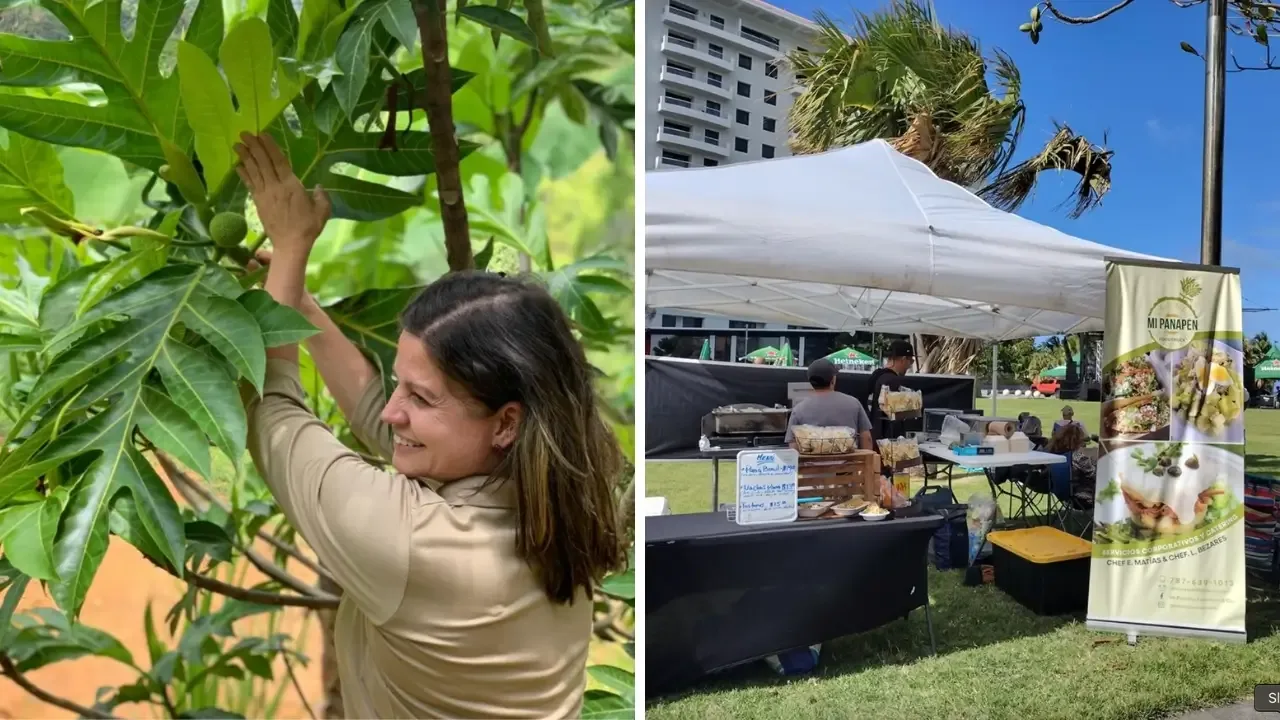
Marisol Villalobos, CEO of Amasar, and Edgardo Matías, co-founder of Panapén & Co., agree that this fruit, also known as panapén or mapén and native to New Guinea and the Indo-Malay region, has a lot of potential. Matías sources the fruit year-round, and Villalobos highlights its nutritional value: high in fiber and suitable for people with diabetes.
Why does it matter? Even though breadfruit production in Puerto Rico fell 94.9% between fiscal years 2013 and 2023, according to data from the Department of Agriculture (DA), and imports are already 42 times greater than local production, these entrepreneurs show that Puerto Rican creativity has no limits and that it is possible to find locally grown breadfruit.
El cultivo de la pana
We spoke with Villalobos and Matías about their businesses, the benefits of breadfruit and its productive potential.
Production down, breadfruit imports up
Breadfruit production fell from 5,480 quintales (548,000 pounds) in fiscal year 2013 to 280 quintales (280,000 pounds) in 2023, a decline of 94.9%, according to Department of Agriculture data. In 2023, it represented $32,000 in gross agricultural income, according to the agency.
Between 2022 and 2023, production dropped 3.45%, from 290 to 280 quintales. The steepest drop came after Hurricane María: a decline of 94.1%. Breadfruit production went from 4,730 quintales in fiscal year 2017 to just 280 quintales in 2018.
Producción de pana o panapén en Puerto Rico
e importaciones del fruto
Breadfruit imports also saw notable changes: they were nonexistent between 2013 and 2015 (0 quintales), rose to 157 quintales in 2016, and reached 11,951 quintales in 2023, an absolute increase of 11,951%. That means imports in 2023 were more than 42 times greater than local production that year. They came from the Dominican Republic and represented nearly $1.2 million in imports, according to data from the Junta de Planificación.
Between 2022 and 2023, imports increased 31.57%.
Where is breadfruit grown in Puerto Rico?
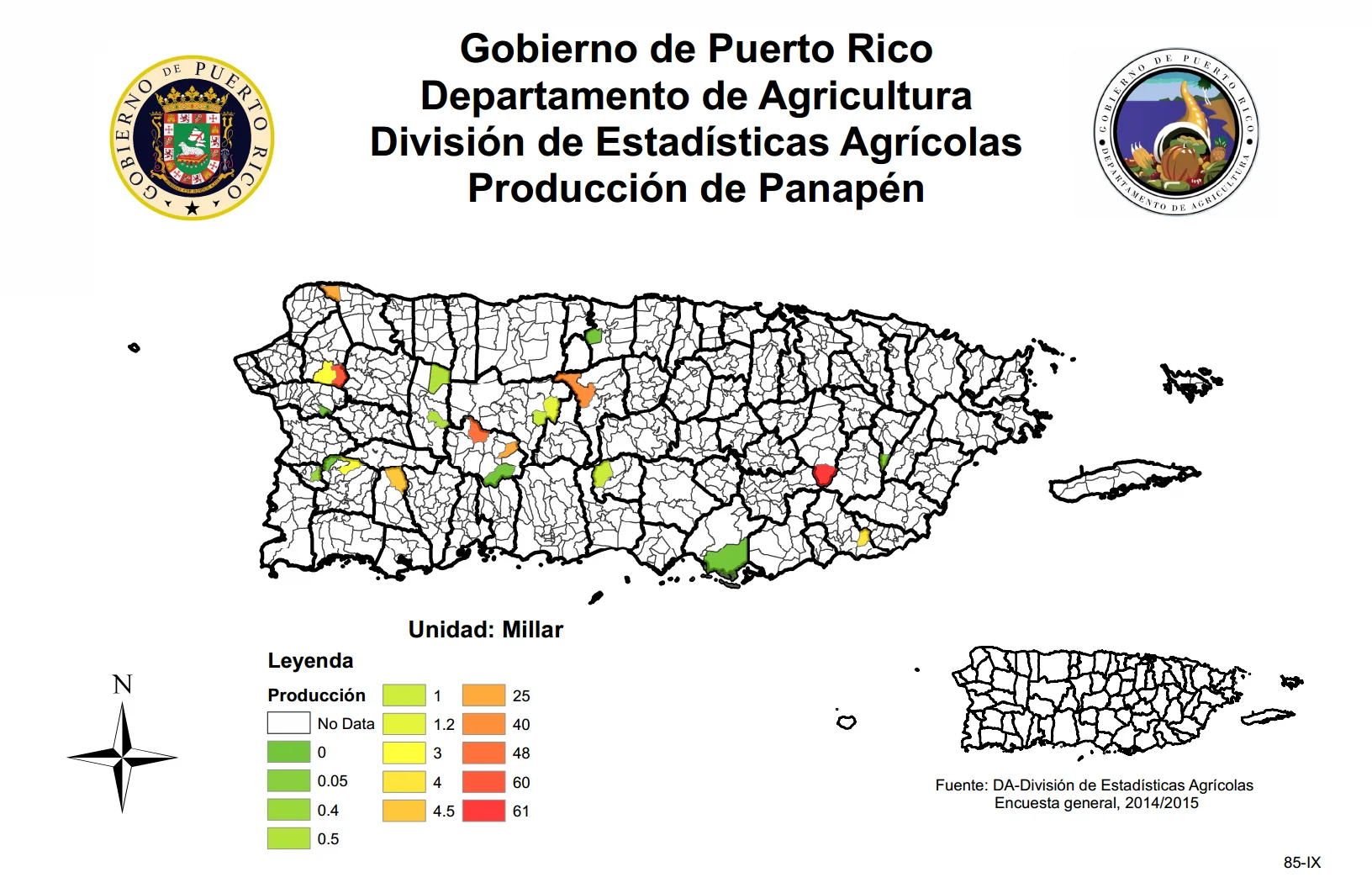
Most breadfruit production in Puerto Rico, according to DA data provided to Platea, is concentrated in Caguas, Moca, Lares, Adjuntas, Utuado and Ciales. There are also crops in Isabela, Hormigueros, San Germán, Manatí, Villalba, Salinas, Patillas and Juncos.
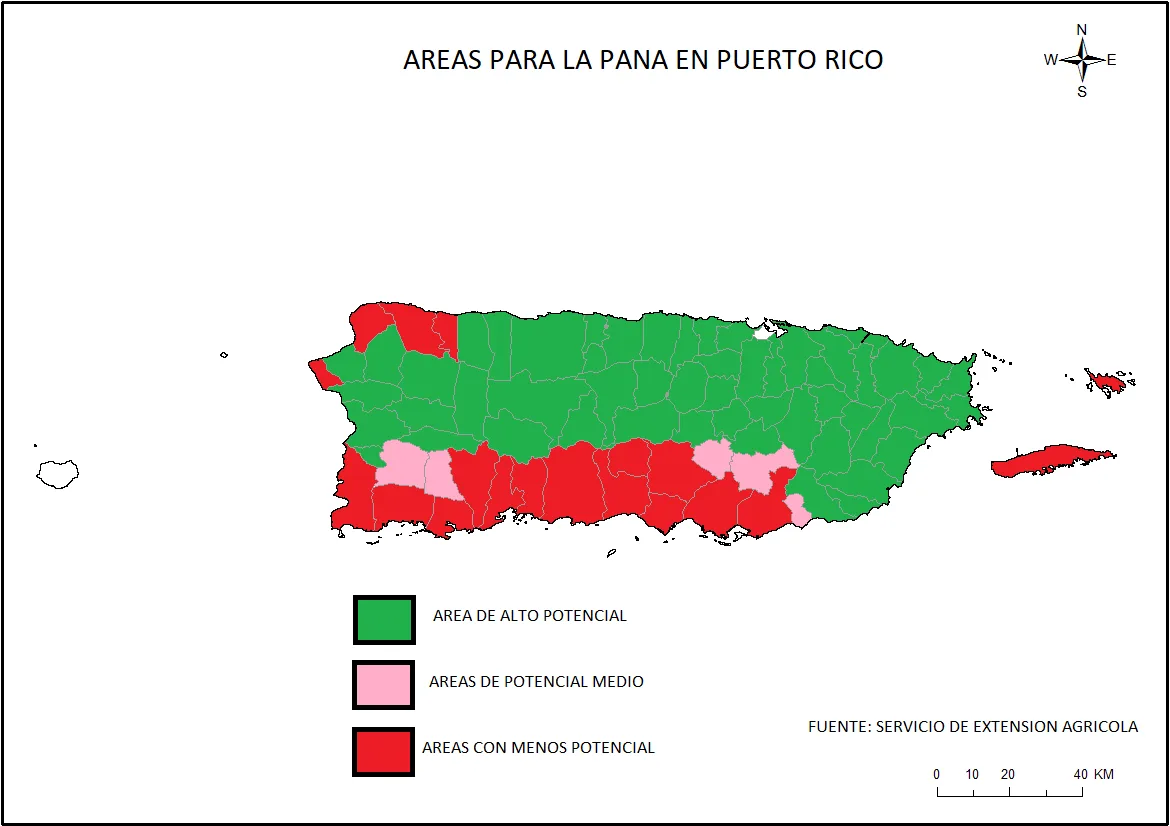
It is, however, a crop with the potential to be grown across most of the island, particularly in the central, northern and eastern zones of Puerto Rico, according to data from the Servicio de Extensión Agrícola.
Production could be higher. For chef Edgardo Matías of PanaPen & Co., it is possible that DA data do not capture the full breadfruit production in Puerto Rico, since not all producers are registered as bona fide farmers with the agency and some farms are also not counted because they grow more than one crop.
Breadfruit
Panapén
Mapén
Mazapán
Pan de Dios
Buenpán
Frutipán
Breadfruit (in English)
Castaña de masa
Amasar: breadfruit flour for pancakes, cakes and more
Amasar was founded as an agricultural venture in 2016 with a farm of breadfruit trees and others in Jayuya, and it was not until 2018 that it launched its first product: a breadfruit flour mix for making pancakes.
Her story, however, begins much earlier, when microbiologist Marisol Villalobos and her husband, chemical engineer Jesús Martes Cordero, moved to Milan, Italy, in 2014, where he had a job offer at a pharmaceutical company. "My godmother sent me a breadfruit to Italy because it was the one thing I couldn't find there," Villalobos recalled, describing what sparked her idea.
Shortly after, she visited her cousin in Spain and told her about the breadfruit. Her cousin mentioned she had a farm with breadfruit trees in Utuado, and they began planning a business centered on the fruit, along with a way to return to Puerto Rico and her farm in Jayuya.
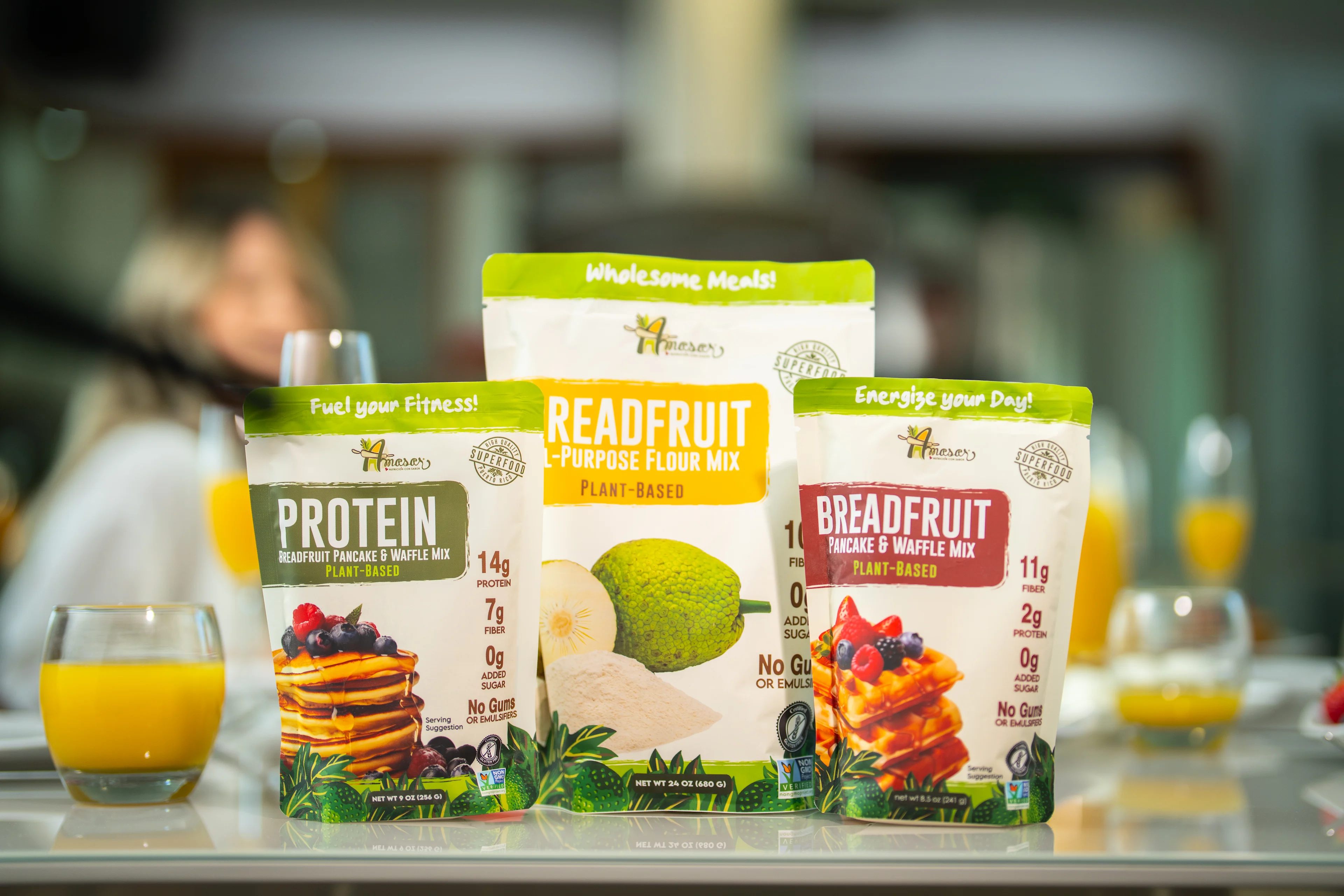
That is how the idea for breadfruit flour came about. It is gluten-free. Amasar makes it by dehydrating the fruit, which allows it to be ground and combined with other ingredients for the company's three products:
All-purpose breadfruit flour (similar to wheat flour, but gluten-free),
Breadfruit flour pancake and waffle mix, and
High-protein pancake and waffle mix.
They are also developing five other products, including a breadfruit brownie mix, a muffin mix, and a breadfruit and oat breakfast cream.
"We are the first manufacturer in Puerto Rico certified gluten free ever, first and only," Villalobos said. Other certifications include Caribbean Kosher Certified, Non-GMO Project Verified and Certified B Corporation (for good business practices).
In 2022, they received a SOFI Award for best new breakfast product, based on flavor, packaging, ingredients and quality, becoming the first breadfruit product to receive this award from the Specialty Food Association. They also received the Golden Ticket from KeHE, a healthy-products distributor in the United States, which opened the door to exporting to states including Florida, New York, Michigan, Illinois and Pennsylvania.
In early August, they appeared at several Chamberlin's stores in Florida, offering tastings of their products.
"Everything you can do with (wheat) flour, you can do with breadfruit flour. Everything you can do with potatoes, you can do with breadfruit," said Marisol Villalobos, CEO of Amasar, who noted that her product can be consumed by people with diabetes and users of GLP-1 medications (for diabetes and obesity).
They started by processing 10,000 pounds of breadfruit in their first year, sourced from various local farmers, and now process "almost 90,000 pounds," the entrepreneur said. "I have 550 breadfruit trees" on her farm, along with cacao, guaraguao and other trees.
Mi PanaPen & Co.: from a food truck to a restaurant
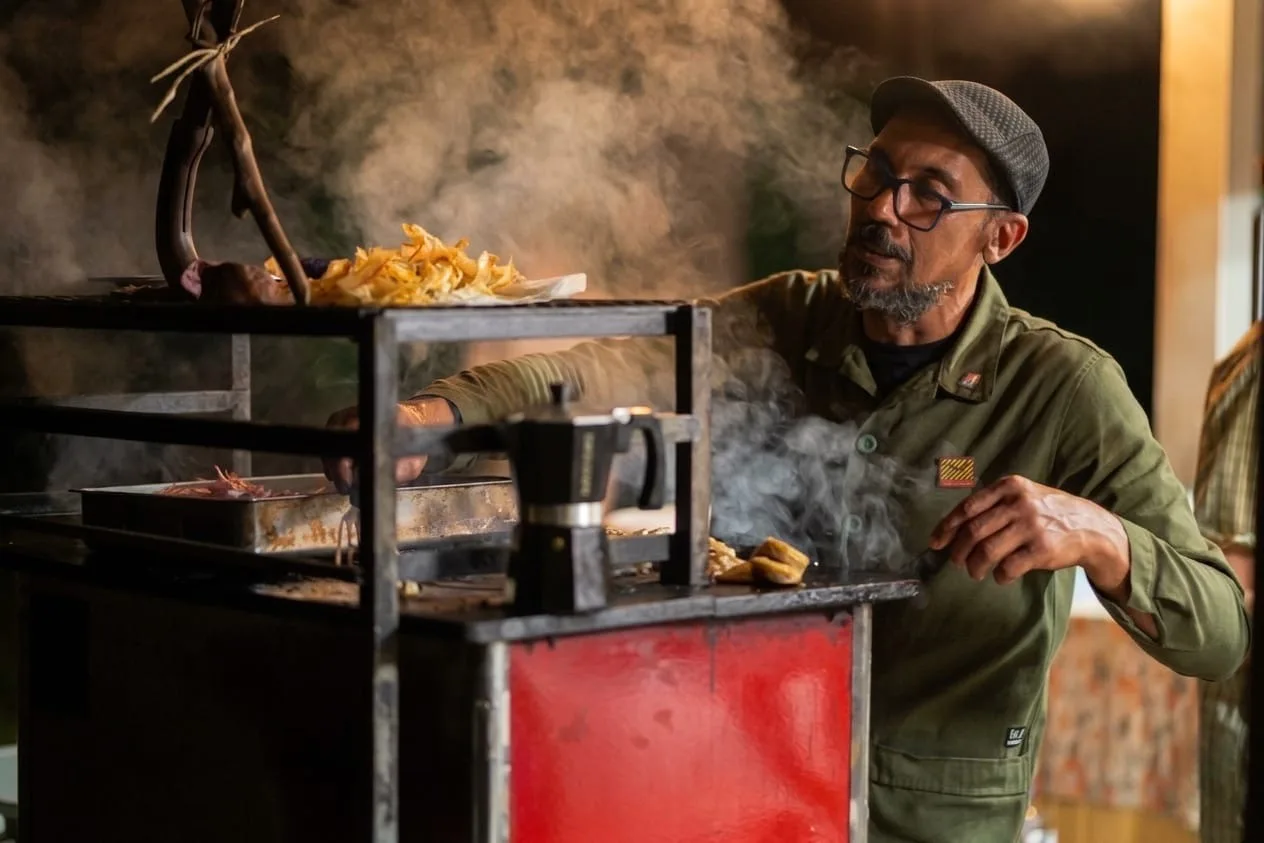
What began seven years ago as Mi PanaPen Foodtruck became, in early August, Panapén & Co., a culinary venture with breadfruit as its main ingredient. From operating a food truck and taking part in festivals and events, they will now have a restaurant at calle Acosta #50 in Caguas and will open Sept. 24, chef Edgardo Matías, co-founder of the venture, told Platea.
It all started more than 15 years ago, when Matías was in college studying telecommunications and marketing and would get together with friends to cook. They began experimenting with ingredients and created a breadfruit pizza dough.
Shortly after, he did market research on breadfruit and realized that "nobody was working with breadfruit in Puerto Rico, they were going to waste in people's backyards, and that's how it all started: we began doing research, we began cooking," said Matías, who later studied culinary arts.
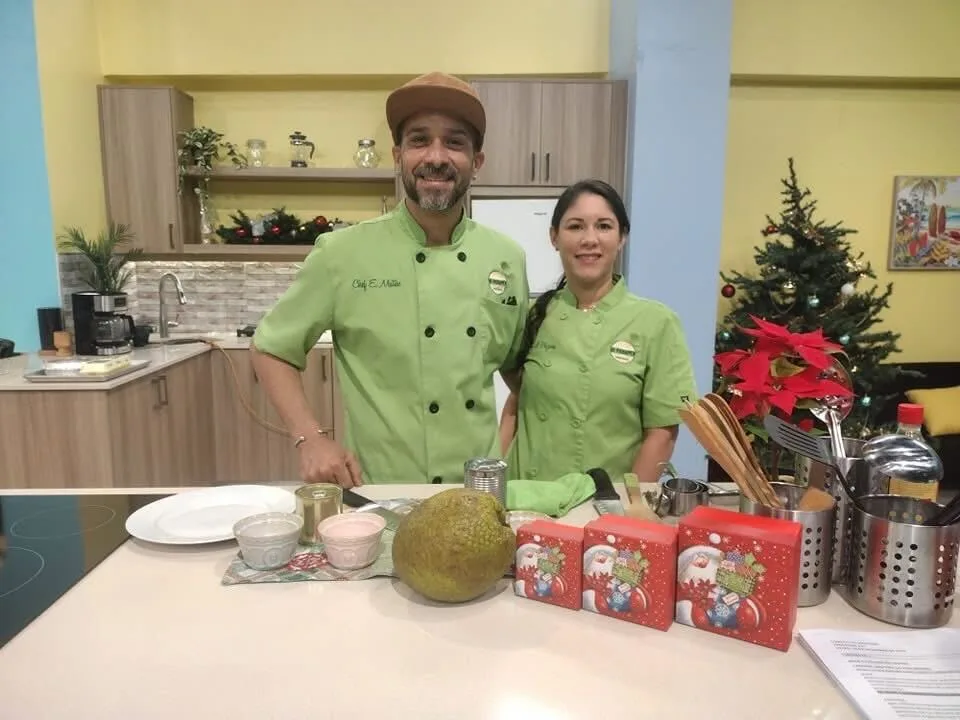
Together with his wife, chef and co-founder of Panapén & Co., Lianete Bezares, they developed the concept, which includes more than 20 products made with breadfruit, among them tacos, nachos, pasteles, fillings, panapurrias, panalaítos, flan, crème brûlée and ice cream. "The idea is to let the world know that breadfruit isn't just for tostones or stew," the entrepreneur said.
Panapén & Co. uses "an average of 100 to 150 breadfruits per week." In addition to growing them on a small scale, it sources from more than 30 farmers around the island.
"We use the skin, we use the heart of the breadfruit. In our product, the breadfruit is never wasted... Believe it or not, breadfruit is available in Puerto Rico all year long," said the chef, who also studied agriculture with El Josco Bravo.
A new venture. After winning the Golden Ticket from Walmart Puerto Rico, Mi PanaPen hopes to bring its breadfruit nachos and tacos to store shelves in the coming years, Matías said.
For the chef, breadfruit "is the future of gastronomy and the future of food sovereignty."
At the Agricultural Experiment Stations (EEA) around Puerto Rico. If they don't have them available, they may be able to propagate them if you place an order.
Jardines Eneida in Cabo Rojo
Challenges and opportunities in breadfruit production in Puerto Rico
Villalobos and Matías agree that breadfruit has many growth opportunities, both as a crop and for creating derivative products.
Opportunities. In addition to Amasar and Mi PanaPen, the Utuado-based company EntrePanas bakes breads and croutons with breadfruit flour, which demonstrates the fruit's flexibility and versatility.
Year-round crop. Although breadfruit has two main harvest seasons, a smaller one between February and April and a more abundant season between June and September, Matías said he can find breadfruit all year long. "If there's none in Aguadilla in winter, I'm sure I'll find some in Yabucoa," he said.
A fruit with great benefits. Villalobos noted that breadfruit is "a superfood" because "it contains all the nutritional groups," is high in fiber and "has all 20 amino acids, including nine essential ones." "All the benefits it has are incredible," she added.
A new breadfruit growers' organization is formed. Villalobos said that Agropana, Inc. was recently created, an organization that aims to bring together all breadfruit producers in Puerto Rico, one where "we promote and advance all the needs, concerns and benefits for breadfruit growers."
Several breadfruit entrepreneurs are active. "There are more than 200 farmers working with breadfruit. There are five companies working with specific products in different towns," Matías said.
Challenges. However, as with other agricultural crops, breadfruit also faces several challenges. Among them, the fact that agricultural production costs are high, Villalobos said.
"Labor is expensive," said the entrepreneur, another challenge facing agriculture in Puerto Rico.
Difficult to export. You would have to compete with countries like the Dominican Republic, which produces more and at a much lower cost, Villalobos said.
More government incentives could help. For Matías, the government could provide greater support for breadfruit cultivation. "What we need most is for them to speed up the process of acquiring small plots of land," he said.
Difficulties with statistics. Because not all breadfruit producers are certified farmers, we may not have more precise data on how much is being grown, Matías said.
When: Aug. 29-31, 2025
Where: Loma de la Niña Mariana, Luz A. Vega Rodríguez, Bo. Mariana en Humacao
What: Food, music, crafts and more
How did breadfruit arrive in Puerto Rico?
Breadfruit's arrival in the Caribbean has a colonial backdrop. It was English colonists who brought breadfruit from Tahiti, in the Pacific, to the Caribbean, to islands such as Jamaica and Barbados, in the late 18th century, as an alternative to feed enslaved people following the independence of the 13 American colonies, which had supplied much of what was consumed in the region.
At that time, it was given the name breadfruit because of the smell the fruit gave off when roasted.
A story fit for film. The details of the expedition were recounted by French writer Jules Verne in the book Los amotinados del Bounty (1879), named for the English ship that sailed to the Pacific to collect the fruit the local population ate, with the intention of bringing it to the Caribbean. The ship's crew mutinied, and Captain William Bligh was left adrift with a few sailors before being rescued years later by another English vessel.
Another novel, by Charles Nordhoff and James Norman Hall, Mutiny on the Bounty (1932), also tells the story.
Several films recount it as well, among them Mutiny on the Bounty (1962), starring Marlon Brando, Trevor Howard and Richard Harris.
Its arrival in Puerto Rico. Food historian Cruz Miguel Ortiz Cuadra recounted in the documentary Nación en Resistencia that breadfruit reached the Island from those English islands, and explained that the fruit was not accepted by enslaved people, who saw the change in diet as something imposed on them. That is why breadfruit is not consumed as widely in other Caribbean islands, and in Cuba, for example, it is used as animal feed.
"In the Puerto Rican case, the plantations and haciendas were not as strict about the provision grounds (plots where enslaved people on haciendas could grow food), so, given that you didn't have the option of a reliable crop to feed yourself, breadfruit came to be accepted and is a safe source of food," said Ortiz Cuadra, who highlighted the large number of recipes that exist using the fruit in Puerto Rico.
This content was translated with the assistance of Artificial Intelligence (AI).