Now that the 20th Legislative Assembly is underway, here is how this branch of government works and how you can get involved
.
Much is said about the Legislature of Puerto Rico. Some highlight its importance as one of the constitutional powers, while others question its effectiveness.
By constitutional mandate, as one of the three branches of government alongside the Executive and the Judiciary, it has the power to pass laws and resolutions, remove officials from office, and investigate matters of public importance, among many other functions. Notable examples of high-profile investigations include the inquiry into the events at Cerro Maravilla (1983) and the purchase of COVID-19 tests (2020).
It is also the preeminent political forum, where debate takes place daily and where representatives and senators elected by the people have a prime opportunity to stand up for their constituents.
Although each chamber and each committee has its own rules, legislative power derives from the Constitution.
The basics
It is a two-chamber system, with 27 senators and 51 representatives, though its composition can change under the minority clause, as in this four-year term. The current Legislature has 28 senators and 53 representatives.
Each chamber will have at least 11 at-large senators and representatives. There can be situations in which legislators are considered independent, meaning they are not part of a delegation. This term, Eliezer Molina won a seat as an independent at-large senator.
Each chamber will have a president, vice presidents, spokespersons and alternate spokespersons for each delegation. Other important figures include the Sergeant at Arms, the secretaries and the administrators.
Legislators can override the governor's veto of a measure.
The Senate is responsible for evaluating and ultimately confirming or rejecting most Executive branch appointments. Some nominations, such as those of the Secretary of State and the Comptroller, require the approval of both chambers.
Two other important offices are part of the Legislature: the Oficina de Servicios Legislativos (OSL), which provides research, legal advice and bill drafting services to legislators and the public, and the Superintendencia del Capitolio, the entity authorized to purchase real estate and responsible for the maintenance, construction and upkeep of the Capitol and its surroundings.
The committees
The day-to-day work of the Legislature takes place in committees, and there are three types: permanent, special and joint committees. The House currently has 48 committees, while the Senate has 35, according to their websites.
Permanent House Committees (2021-2024)
Total committees: 38
Treasury and Budget
Oversees the fiscal situation, budget, General Fund revenues and special funds.
Government
Handles the creation, modification, performance and elimination of government agencies.
Health
Oversees public policy on health services, disease prevention and treatment.
Housing and Urban Development
Handles public policy on housing, infrastructure and urban development.
Agriculture
Oversees the development of the agricultural industry, mechanization and product marketing.
Economic Development, Planning, Telecommunications, PPP and Energy
Handles economic development, telecommunications, energy and public-private partnerships.
Legal Affairs
Oversees the judicial system, the practice of law and legal services.
Education, Arts and Culture
Handles the public education system, educational services and cultural development.
Transportation, Infrastructure and Public Works
Oversees transportation systems, roads and public works.
Constitutional and Electoral Affairs
Studies proposed constitutional amendments and electoral matters.
Internal Affairs
Manages the internal structure and procedures of the House.
Calendars and Special Debate Rules
Sets the special rules for legislative debates.
Anti-Corruption and Public Integrity
Investigates and prevents corruption in public service.
Youth Affairs
Addresses policies for youth development and well-being.
Women's Affairs
Promotes gender equity and women's rights.
Labor Affairs and Pension System
Addresses labor matters and the transformation of the retirement system.
Municipal Autonomy
Oversees municipal decentralization and regionalization.
Social Welfare and Persons with Disabilities
Addresses social services for vulnerable populations.
Tourism and Cooperativism
Oversees tourism development and the cooperative movement.
Consumer Rights and Banking Affairs
Protects consumer rights and oversees the insurance industry.
Public Funds Oversight
Oversees the use of state and federal public funds.
Small and Medium-Sized Businesses
Supports the development of SMEs and simplifies the permitting process.
Natural Resources and Environment
Protects natural resources and promotes recycling.
Federal and International Relations
Manages relations with the U.S. and veterans' affairs.
Public Safety
Oversees public order and technological development.
Recreation and Sports
Promotes sports and recreational activities.
Emergency Response
Coordinates disaster preparedness and recovery.
Development – Capital City
San Juan, Aguas Buenas, Bayamón, Cataño and Guaynabo.
Development – North Region
Barceloneta, Manatí, Vega Baja, Vega Alta, Dorado and surrounding municipalities.
Development – Northwest Region
Camuy, Hatillo and Arecibo.
Development – West Region
Aguadilla, Mayagüez and surrounding municipalities.
Development – Southwest Region
Guánica, Yauco, Ponce and surrounding municipalities.
Development – South Central Region
Villalba, Juana Díaz, Coamo and surrounding municipalities.
Development – Southeast Region
Cidra, Cayey, Caguas and surrounding municipalities.
Development – East Region
San Lorenzo, Juncos, Las Piedras, Humacao and Naguabo.
Development – Northeast Region
Trujillo Alto, Carolina, Loíza, Canóvanas through Culebra.
Ethics
Oversees the conduct of House members.
Community Impact
Addresses the socioeconomic development of communities.
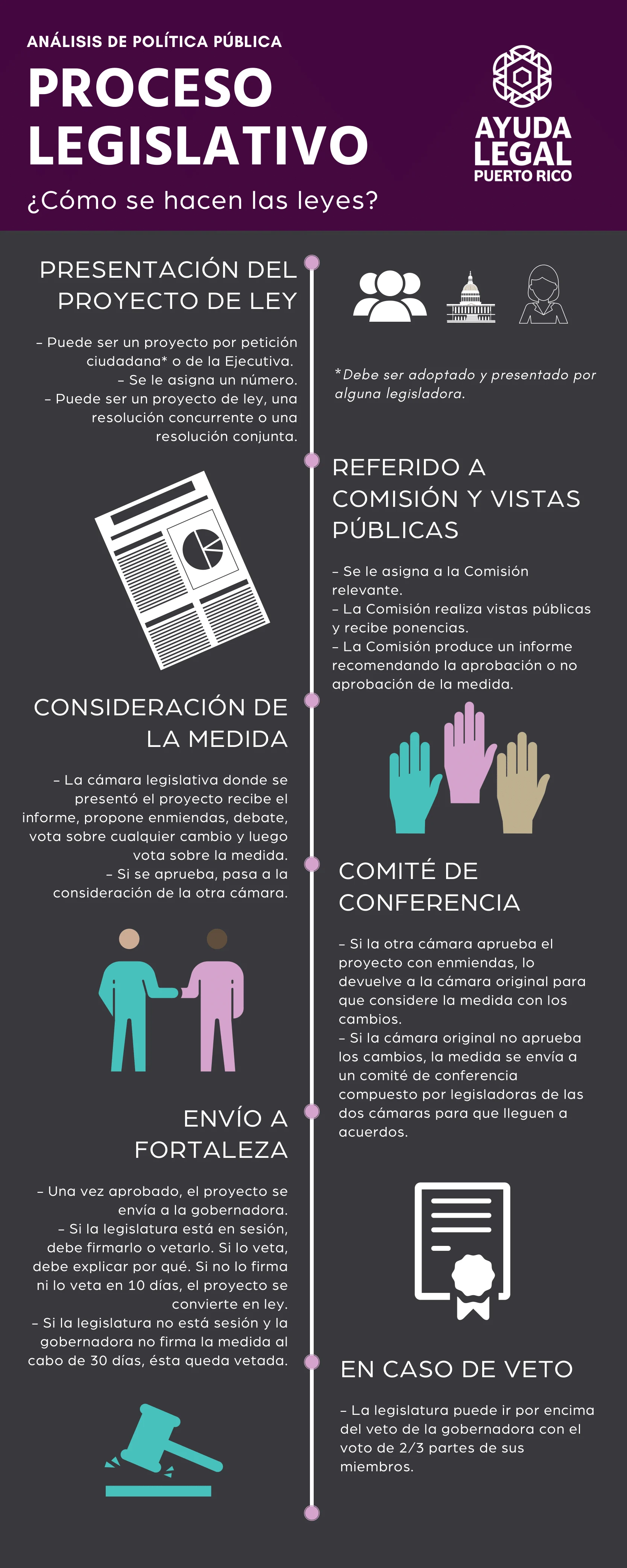
Committees serve several functions, the main ones being conducting investigations and evaluating legislative measures, whether introduced by the executive branch, legislators themselves, or the public through what are known as citizen-petition measures.
Measures can reach a final floor debate through reports informed by the work done and comments received at public hearings, or through a discharge process, in which the legislative president decides, with the full chamber's authorization, to relieve a committee of a measure so it goes directly to floor debate.
This infographic from Ayuda Legal PR summarizes the process:
Manuel Torres Nieves served as Senate secretary for 12 years and is an expert in parliamentary procedure. In an interview with Platea, he noted that, while a lack of awareness about this constitutional branch is widespread among the public, it is becoming more accessible. He mentioned, for example, visits to the Capitol and the broadcast of public hearings and sessions on television and the internet.
The Oficina de Servicios Legislativos, for example, coordinates talks on how to draft measures and other legislative procedures. Its website also offers documents and guides for public participation.
Another resource is the Sistema SUTRA, from the OSL, with a catalog of all measures filed by four-year term.
"Each branch has different responsibilities, though they are intertwined. Public policy is set in the Legislative branch. Even though the governor has authority through executive orders, if he wants to turn an idea into law or solve a problem through legislation, he has to go to the Asamblea Legislativa."
– Manuel Torres Nieves, former Senate secretary
Torres Nieves recalled that any citizen can visit a legislator at their office to bring a concern that can become an investigation or, with recommendations, a bill.
There is also the mechanism of a bill by petition, which refers to instances in which the legislator receives the measure already drafted.
"We need to keep promoting transparency," he insisted.
The most common legislative mechanisms are bills, resolutions, joint resolutions and concurrent resolutions.
Bill: creates, amends or repeals laws.
Resolution: expresses the legislative body's position on a given topic. It can also be used to order committee investigations, to request action from the body, or to express congratulations, condolences or opposition. It does not require the governor's signature.
Joint resolution: must pass through both legislative chambers and is only valid if signed by the governor. It has a limited duration and is used, among other things, to appropriate funds, including the budget, and to direct a public agency to carry out a specific action.
Concurrent resolution: can be used to reflect the Legislature's position on a given topic and is the required mechanism for proposing amendments to the Constitution.
The legislative session
Some may think that the chambers of the legislative bodies become chaotic during debate or that there is no order. The truth is that the parliamentary process is well defined and led by the president or presiding officer.
What is the president responsible for?
Deciding any parliamentary or procedural dispute that may arise.
Appointing committee chairs and their members.
Referring measures to committees.
Signing contracts.
Deciding which measures will be taken up on a given session day, with the support of their advisory staff.
Only the sitting president is authorized to open the session each day. After that, an exchange takes place with another important figure: the Majority Floor Leader.
Ángel Matos García held that majority floor leader position during the previous four-year term in the Cámara de Representantes. The now-former legislator was responsible for maintaining, in each session, a constant exchange with the presiding president.
Everything began with the reading of the Calendar, and once it was read, Matos was responsible for calling each measure for discussion.
"That's when debate opened. I would look around to see who wanted a turn," he said.
Matos described to Platea the work of the floor leader's office as a "24/7" job and recalled how many times his office had to correct all kinds of errors in the reports.
"Sometimes haste is a poor adviser," he said, noting that the processes require time and attention to detail to avoid mistakes. "The weekly agenda is set by the president in relation to the discussion of topics," he added.
"There was a weekly meeting with the president and their advisers. In the meantime, I had to make sure the committees were producing their reports, holding public hearings and meeting information requests," he said.
This content was translated with the assistance of Artificial Intelligence (AI).