We explain what the Donald Trump administration has proposed regarding the Federal Emergency Management Agency and its possible impact on Puerto Rico.
—
What is happening? The hurricane season has already begun, and Puerto Rico faces a new wave of uncertainty over possible changes to the federal agency responsible for emergency management since President Donald Trump took the reins of the federal government in January.
President Donald Trump and Secretary of Homeland Security Kristi Noem have detailed their plans to eliminate FEMA "as it exists today" and reduce the amount of federal funds that states and territories affected by disasters receive, a decision that would directly affect Puerto Rico.
During her visit to Puerto Rico in March, Noem, whose department oversees FEMA, said she will evaluate how the federal government can reduce some of the agency's permits and requirements "to make sure that people receive the help they need and that was promised to them."
Why does it matter? States and Puerto Rico rely heavily on FEMA for both preparedness and recovery. After hurricanes Irma and María, and the earthquakes of 2019 and 2020, FEMA awarded more than $23 billion in funds for recovery. Since 2018, there have been 15 emergency or major disaster declarations in Puerto Rico for the earthquakes in the south of the island, Hurricane Fiona, the pandemic and other incidents.
The most recent major disaster declaration was on Nov. 27, 2024, for damage from Tropical Storm Ernesto. At that time, 26 municipalities were added. Gov. Jenniffer González said in February of this year that the order was extended to 12 more municipalities. FEMA has not updated the data on its website to reflect the extension.
Map published by FEMA of the municipalities included in the major disaster declaration on Nov. 27, 2024.
To understand what these changes would mean in the event of a future disaster in Puerto Rico, we spoke with Ninotchka Rojas, director of the Resiliency Law Center at the Universidad de Puerto Rico School of Law; Michael Prasad, regional president of the International Association of Emergency Managers; and Frances Colón, a researcher on the International Climate team at The Center for American Progress.
What has the Trump administration proposed?
Trump has said he wants to gradually eliminate FEMA after this hurricane season and transfer responsibility for response and recovery to the states.
"We want to get away from FEMA and bring it to the state level," the president said in May. "A governor should be able to handle it and, frankly, if they can't handle the aftermath, then maybe they shouldn't be governors." Disaster response is already led at the local level and managed by the states, but FEMA supports them by coordinating resources from federal agencies. That is, the agency provides direct household assistance programs and moves money to states to repair public infrastructure.
The president also proposes that the federal government distribute less aid for disaster recovery, and that funds come directly from the president's office. He also wants to raise the requirements for states to access federal disaster assistance.
Zoom in. For a disaster to be officially declared, the damage must exceed a specific amount per person in the affected state or territory, known as the per capita impact (PCI).
For 2025, only disasters with a PCI above $1.89 will be considered major disasters. Although other factors are taken into account in some cases, this is the minimum threshold. This number is adjusted each year. In 2017, for example, the figure was $1.43.
Once the president issues an official disaster declaration, access to FEMA's Disaster Relief Fund is activated, which includes:
Individual assistance, which goes directly to people affected (for example, help with temporary housing or unemployment).
Public assistance, which goes to state, local, tribal or territorial governments for work such as debris removal or infrastructure repair. (The changes the Trump administration is considering for FEMA would affect mainly this second category.)
🔗 Read: How a disaster is declared under the Stafford Act
The Trump administration proposes raising the PCI from $1.89, its current level, to $7.56, which would concentrate federal funds on large-scale disasters and eliminate declarations for smaller ones.
In Puerto Rico, for example, qualifying for funds after a storm, flood, earthquake or other disaster would become much harder, as the federal government raises the threshold that defines what counts as a disaster and what does not.
The administration has also created the new FEMA Review Council, chaired by Noem and Defense Secretary Pete Hegseth. The council is expected to recommend, in the coming months, a drastic reduction of the agency and a sweeping overhaul of its operations.
The proposed changes come as FEMA has lost more than 20% of its full-time staff through layoffs and incentivized departures under the Department of Government Efficiency (DOGE). An internal FEMA review, obtained by CNN, warns: "As FEMA transforms to operate with a reduced presence, the intent for this hurricane season is not clearly defined. Therefore, FEMA is not prepared."
How could this affect Puerto Rico?
FEMA has been the target of criticism, contributing to the common saying "only the people save the people".
A report found that more than $11 billion of those funds were still awaiting FEMA approval before the Puerto Rican government could use them.
Another study found that, after Hurricane Maria in 2017, Puerto Rico received significantly less funding than Texas and Florida, which also experienced hurricanes that year.
In addition, the federal government identified mismanagement of approximately $257 million in funds allocated to the Island.
Even so, the agency represents a massive source of funds and personnel that have until now directed their efforts toward restoring projects such as the Pedro Montañez baseball stadium in Cayey, the María Cecilia Franceschi Museum of Art and History in Yauco, the Edificio de los Veteranos in Las Piedras, and island-wide repairs after Maria.
"Now that we have reduced capacity and decisions have been made to cut that capacity, from expertise to programs, funding and resources, I think Puerto Rico and many other places along the coast are at high risk, and I am concerned about the safety of people in those places," Frances Colón, a researcher on the International Climate team at The Center for American Progress, told Platea. "In the case of Puerto Rico, given the evidence we already have of how the Trump administration responds to a large-scale natural disaster, I think we are in a more precarious position than ever."
Trump's proposal to shift responsibility to individual states could be especially problematic in places with limited capacity to manage disasters.
"Dismantling FEMA could bring an even more challenging recovery process for Puerto Rico. The reality is that in Puerto Rico, infrastructure is not being maintained by the government. We see that not only in the electrical system, but also in our roads, in the transportation and public works system, and in government processes."
– Ninotchka Rojas, director of the Resiliency Law Center at the Universidad de Puerto Rico School of Law, in an interview with Platea.
Rojas added: "Leaving it in the hands of the government, we could be looking at a repeat of the mismanagement of funds allocated for the proper processes."
Michael Prasad, regional president of the International Association of Emergency Managers (which oversees Puerto Rico and works with FEMA), also expressed concern about the Island's structural weaknesses.
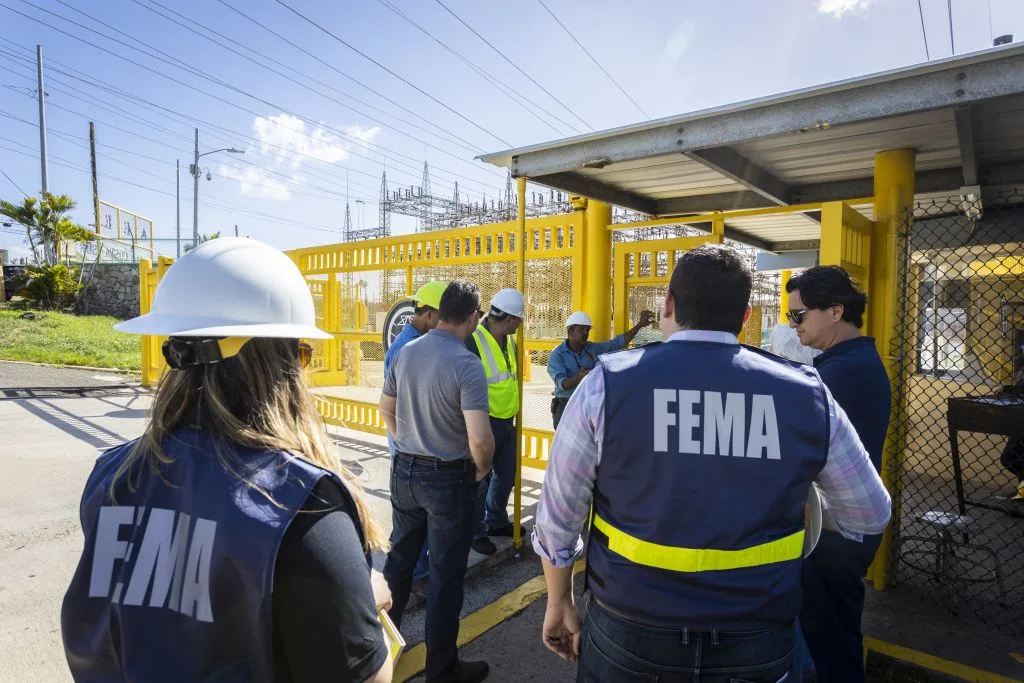
"FEMA cannot fix LUMA," Prasad told Platea, referring to the company that operates the Island's electricity transmission and distribution system. He also pointed out that problems with the drinking water system and telecommunications persist.
Prasad raised concerns about Puerto Rico's ability to self-fund emergency services. Unlike wealthier states, it lacks a solid tax base. "Could they sustain it?" he asked. "It's very different from other states where there might be a large area of wealth that can fund the necessary taxes."
In addition, federal grants for preparedness and mitigation, which fund critical infrastructure and training, could be at risk.
"He [Trump] could change his mind tomorrow," Prasad said. The loss of these grants would be significant, since "one dollar of preparedness saves between 6 and 15 dollars in response," according to the United Nations Office for Disaster Risk Reduction. Among other things, these grants allow for the construction of shelters and the strengthening of municipal capacities.
Looking ahead
For Rojas, with or without the dismantling of FEMA, it is essential to incorporate the voices of those who live through the effects of disasters in Puerto Rico. "Inserting community leaders and grassroots organizations into the processes that truly affect them would be among the first alternatives," Rojas noted. "The government does not necessarily live in, know, or understand the reality that exists in communities. They are not there. Listening to what the recommendations are and what have historically been the stumbling blocks that they have experienced would open the door for other people to offer support and provide a viable space for recovery and reconstruction."
This content was translated with the assistance of Artificial Intelligence (AI).