What happens behind the murals we enjoy around Puerto Rico? Artist Rafael "Rafique" Vega explains his process and what inspires him.
When it comes to Puerto Rican artists and muralists, one name stands out: Rafael Enrique Vega Feliciano, better known as "Rafique."
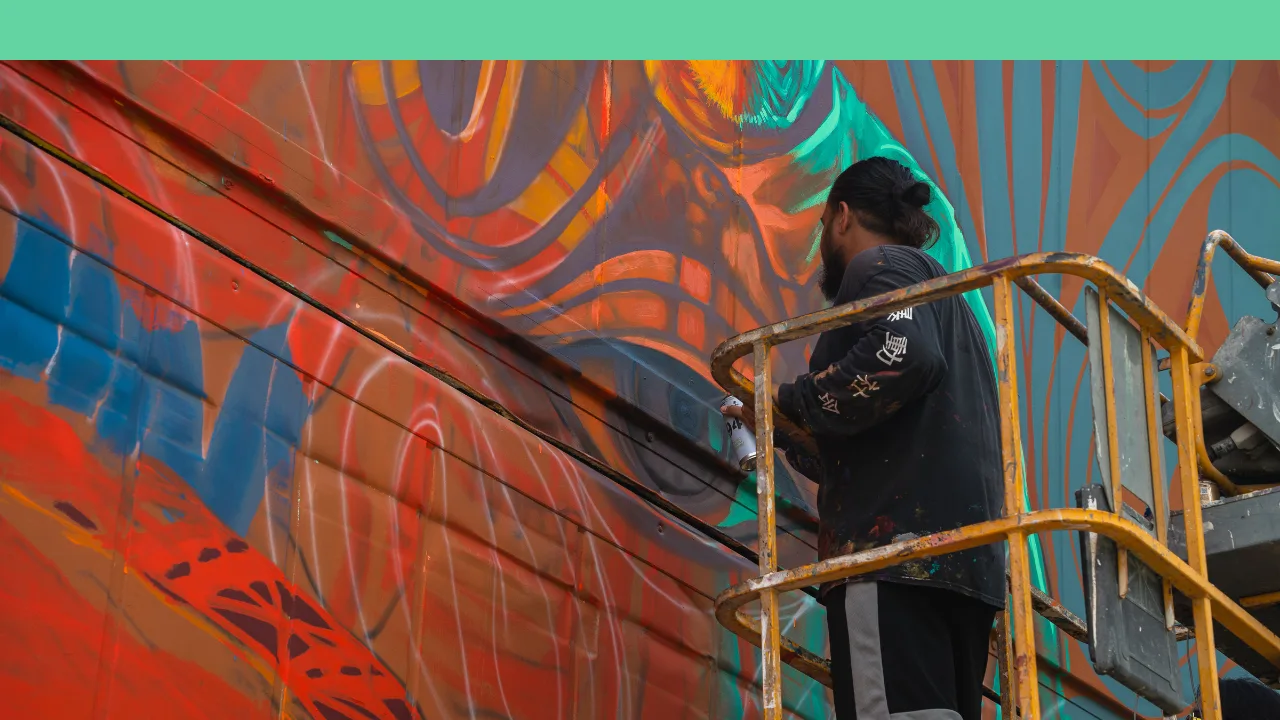
For the 25-year-old artist, the complexity of muralism goes well beyond the finished work on a wall for people to enjoy. He also points out that there is art in delegating, working as a team and keeping an eye on the big picture.
In the process of creating a mural, it is important to delegate and break down the whole so the artist can focus on the details of the work, Rafique said in a recent episode of the Punto Aparte podcast, from Platea.
While he acknowledges that assigning work is not easy, he noted that "because the mural is so large and has so many possibilities, you should always give others the chance to contribute, since this is not a one-hour painting."
Behind the finished work the public enjoys, there is a long and complex process that involves making a sketch, observing, choosing colors, drawing, painting, projecting the image, tracing and a range of other efforts, which is why it requires collective work, the muralist explained.
Inspiration in indigenous culture
Rafique, who is known for depicting the roots of indigenous culture and history in his work, shares that the search for inspiration is part of the artistic process before a piece is made.
"It is a study of indigenous figures, going to museums, looking at ceremonial centers and visiting spaces where there are glyphs. It is always a kind of inspiration drawn from the past, from our roots specifically," Vega added.
Puerto Rico's history in art
Although he specializes in highlighting indigenous culture, he also expresses Afro, European and historical influences in his work.
For example, his most recent piece for Color Caribe 2024 is a portrait of times past. The piece, titled "Altar a la memoria," features the figure of the Puerto Rican jíbaro seated at a table, an image inspired by his own grandfather.
"It is a photo of a jíbaro (taken by Jack Delano). But I always make modifications to the images, and in reality that jíbaro represents my grandfather. Everyone has their own interpretation of the mural, but for me it represents my grandfather, my family together, and that image of the table with the candle and the tool on the wall is something I always remember about him, the way he would sit quietly in his chair wearing a little cap or a pava," Rafique said, referring to the mural.
Meanwhile, the mural "Los Espíritus de la Loma," recognized as the largest in the country, is another of his notable works that highlights part of Puerto Rico's history. The piece depicts pirates, the Autonomous Charter and even basketball icons. According to Rafique, the project stands 30 feet tall and took a year and a half to complete.
"A positive future for murals"
In the artist's view, a few years ago the art of murals and graffiti was not as valued as it is now, and it was common to hear that if you dedicated yourself to painting them, you would not be paid fairly for the work.
"Before, it was more focused on paintings and exhibitions, since graffiti and muralism were seen differently, but now brands, companies and businesses have become interested in supporting local art in Puerto Rico," Vega Feliciano said.
Although homegrown muralism gained momentum on the Island starting in the 1930s, according to what historian Néstor Murray Irizarry noted in a previous interview with Platea, events like Santurce es Ley and Color Caribe have given new life to interest in these paintings.
Murray Irizarry stressed the importance of promoting and preserving this kind of urban art, which "almost always narrates historical events in many cases, customs, traditions."
Don't miss episode nine of our podcast Punto Aparte for more details on Rafique's history and evolution as a muralist.
🎙️ More episodes on YouTube
This content was translated with the assistance of Artificial Intelligence (AI).