The train stopped on May 14 due to a fire and has been operating partially since May 22.
,
What is happening? Tren Urbano will resume service at all 16 of its stations this Friday, July 11, after an explosion and fire at an electrical substation on May 14 disrupted operations, the Autoridad de Transporte Integrado (ATI) announced. The date coincides with the start of Bad Bunny's "No me quiero ir de aquí" residency at the Coliseo de Puerto Rico, when a significant increase in visitors to the area is expected.
According to ATI, work to re-energize the electrical system on the segment between the Bayamón and Martínez Nadal stations is in its final phase. On Wednesday, July 9, adjustments authorized by LUMA Energy will be implemented and the protection system will be certified, while on Thursday the tracks and stations at Bayamón and Deportivo will be energized with additional operational testing.
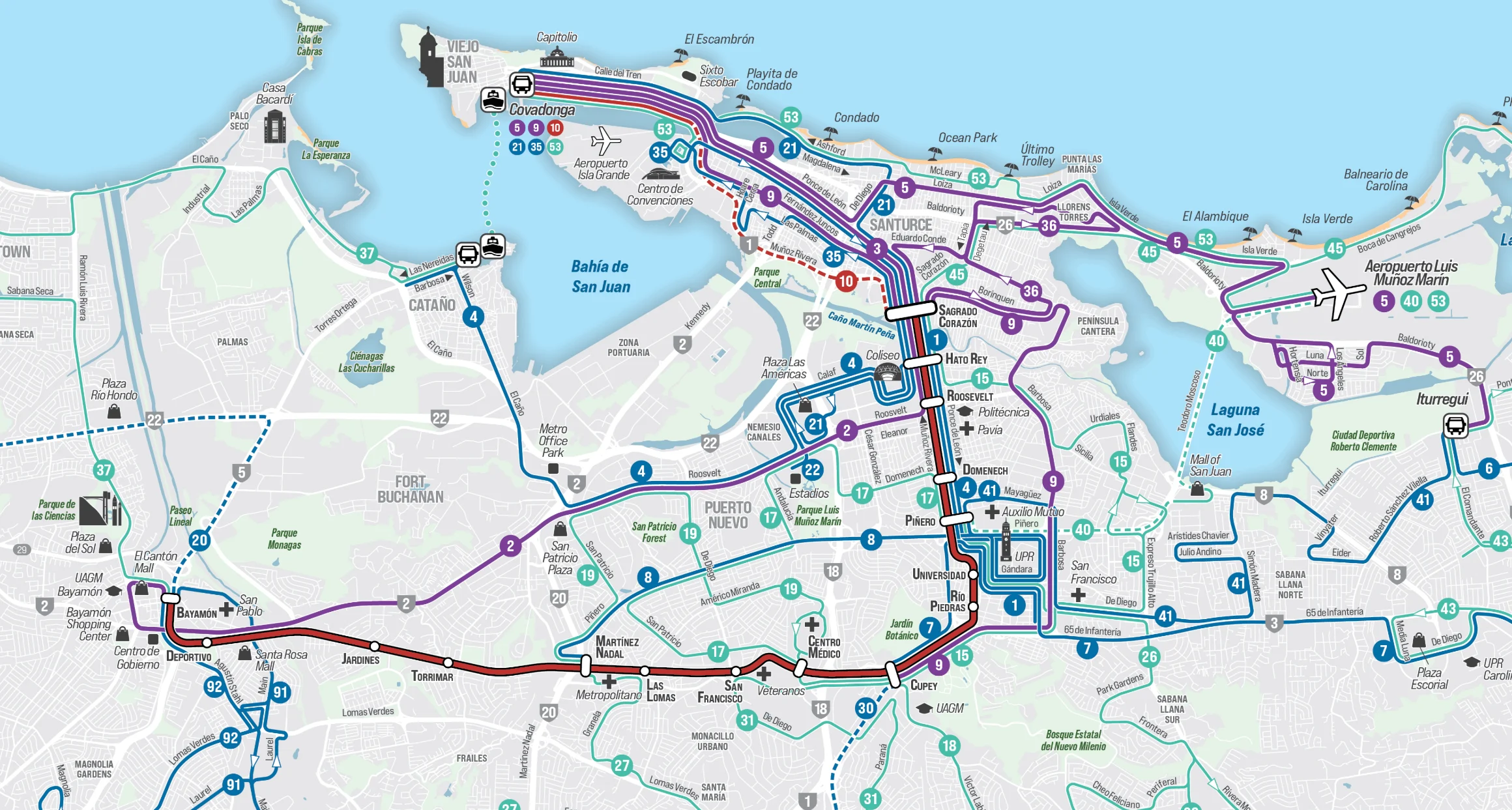
Since May 22, the train had been running partially, and on June 2 one more station was added. From Las Lomas to Bayamón, the stations (Martínez Nadal, Torrimar, Jardines, Deportivo and Bayamón) remained closed, but an intermodal bus system (bus bridges) serving each station was in place.
Regarding mobility in the San Juan area during the Bad Bunny concerts, ATI announced that starting this Friday, July 11, routes T3, E10 and C35 will offer extended service from 5:00 p.m. to 1:30 a.m., including detours toward the Convention District area.
Why does it matter? In the 20 years Tren Urbano has been operating, nothing like this had ever happened, ATI executive director Josué Menéndez pointed out at a public hearing of the House Transportation and Infrastructure Commission held in June. It was an "energy explosion," beyond the fire itself, at traction substation 4 (near the Martínez Nadal station), which powers the train's third rail, causing damage that has cost between $7 million and $8 million in repairs, somewhat more than the $5 million initially estimated.
Damage: The damage was not limited to the substation where the explosion occurred; it also affected cabling and circuit breakers throughout the rest of the system.
Explosion also left customers without power: There was also damage to electrical distribution lines near the train's substation, which triggered contingency measures in LUMA's backup operation to clear the fault. This left 47,000 customers without power in parts of Cataño, Juan Domingo, Bayamón Pueblo and Hato Tejas, confirmed LUMA Energy's director of Stakeholder and Intervenor Affairs, Rebeca Maldonado, at the hearing.
Ridership drops
After eight days out of service, and given the partial operations and uncertainty surrounding the system, peak-hour ridership has dropped from 15,000 to 7,000, the ATI director said. According to him, it was not only the breakdown; it is also normal for ridership to decline during the summer months.
Damage report to be delivered in June: "We have a preliminary report on the matter, but the final report should be ready by the end of the month. That will inform the conversations we will have this coming Friday with LUMA Energy, because the information brought to the hearing today is what we need to complete the final report," Menéndez said.
The preliminary report will be delivered to the Transportation Commission within five business days, on June 11, as requested by Rep. José "Cheíto" Hernández.
Conflicting accounts and lack of communication between ATI and LUMA
The ATI director said that meetings with LUMA have focused on restoring service, particularly on energizing substation 8963 (BPSS #1) in Bayamón, one of the stations that remains closed. At Friday's meeting, they will discuss the May 14 incident, since ATI had not received the information LUMA provided at the public hearing, he added.
ATI's account: According to Menéndez, Tren Urbano's protection systems were activated thanks to the "rapid intervention" of ACI-Herzog, the train's private operator. ACI-Herzog had conducted its last review of the entire train system two weeks before the incident.
LUMA's account: However, the LUMA representative said that the failure in the 480-volt system at the Martínez Nadal substation was not interrupted by ATI's protection network, affecting 13.8-kilovolt and 38-kilovolt distribution lines.
"As a contingency measure, remote backup operation from the LUMA system was required to clear the fault on the 480-volt line. The Bayamón, Hato Tejas and Palo Seco SP breakers operated to isolate the distribution fault in 1 minute and 27 seconds. This failure in the customer's protection left 47,547 LUMA customers without service, including areas such as Cataño, Juan Domingo, Bayamón Pueblo and Hato Tejas," said Maldonado, who denied that the voltage fluctuations were LUMA's fault.
A call to reach agreement: Rep. Hernández asked "that neither of them keep passing the hot potato, because that worries me. For example, if LUMA was involved, it has to make a payment (for the damages). It's not just about knowing who is at fault; it's about what comes next, so at the end of the month we will hold another hearing to find out what really happened."
What happened? A timeline of events
May 14: In the early morning hours, an explosion and fire occur at the Martínez Nadal electrical substation (TPSS44), causing damage throughout the Tren Urbano system and bringing all service to a complete halt. A contingency plan with intermodal buses between stations is not activated, because the ATI director said in a statement that service could partially resume within 24 hours, but later issued another communication indicating that more days would be needed to address the damage.
May 19: The Chamber's Transportation and Infrastructure Commission conducts a site visit to the train to assess the progress of repairs. Details of the damage are disclosed; at that point, estimates put the total at $5 million.
May 22: After days of "intense hours of work," Tren Urbano resumes partial operation at 10 of its 16 stations, between Sagrado Corazón and San Francisco. The intermodal bus protocol is activated between San Francisco and Bayamón, covering the stations that remain closed due to the damage.
The bus bridge service has been activated on previous occasions, most recently in January, when Tren Urbano was out of service for four days due to scheduled inspections.
June 2: The Las Lomas station enters service, bringing 11 of the train's 16 stations back into operation.
June 4: The Chamber's Transportation and Infrastructure Commission holds a public hearing to examine the repairs, and it is revealed that the damage totals $8 million and that ATI and LUMA's accounts differ. The commission asks that a preliminary damage report be submitted, and it is stated that a detailed report will be delivered by the end of June.
June 6: The date scheduled for the meeting between LUMA and ATI to discuss the details of the failure.
June 11: The date by which ATI must deliver its preliminary incident report to the Chamber's Transportation Commission.
Previous accounts of the incident
The fire at the traction power substation may have been caused by a "load transfer by LUMA (Energy)," the private operator of the electricity transmission and distribution system, Rep. José "Cheíto" Hernández, president of the House Transportation and Infrastructure Committee, told Platea on June 2.
LUMA responds. "LUMA has not carried out any manual load transfers this month, none," Hugo Sorrentini, LUMA's director of Media Relations, told Platea at the time.
"The load transfers LUMA carries out are manual load transfers, depending on what the (consumption) scenario looks like during peak hours from 6:00 to 9:00 p.m. Any other load transfer outside those hours was not carried out by LUMA," Sorrentini added, specifying that the substation where the fire occurred "is not LUMA's, it is a private substation belonging to the train."
Sorrentini explained that there are various reasons for load transfers and they are not necessarily related to the transmission and distribution system, which is the one LUMA controls. They can occur "when there is a generation deficiency" in energy, the part of the system LUMA does not manage, he pointed out. "In the case of Wednesday the 14th (of May), it seems to me that it may have been Costa Sur 5, the (unit) that went down abruptly," Sorrentini said.
LUMA has cooperated with the ATI in disconnecting the electrical system so that the necessary repairs can be made safely. They were also involved in the damage assessment, but "I have no information indicating that we had to do any type of work ourselves (LUMA)," Sorrentini said.
What transportation alternatives are available?
There are 5 bus stations, from both the intermodal system and the Autoridad Metropolitana de Autobuses (AMA), that are in operation, the ATI said in a statement.
For route and schedule information, you can access this guide we prepared at PlateaPR for each route, with the available information from the ATI. You can also visit www.ati.pr.gov or ATI's social media accounts: @atidtop on X and Instagram, and ATI-Autoridad de Transporte Integrado on Facebook.
The municipality of San Juan has its own trolley system that can also get you to your destination. Check the stops here. The municipality of Bayamón also has its own transportation system, and you can check here whether it runs along your route.
What happened and what is the main damage?
Fire at the Martínez Nadal substation on May 14. The fire at the Martínez Nadal substation occurred in the early hours of Wednesday. The blaze damaged electrical components essential to the system's operation, affecting a critical area of the power control infrastructure. Technical teams and specialized personnel have been working since the early hours of Wednesday on diagnosing, repairing and inspecting the affected systems and the train's 34 kilometers of track. Burned wiring has been found along the 34 kilometers of track and is being replaced.
Repairs. The ATI reported that the wiring and the main breaker at the BPSS2 substation at the Las Lomas station were replaced in order to energize it. Seven surge protectors or lightning arresters, wiring and other technical equipment were also replaced. The ATI reported that LUMA Energy identified that "there is essential equipment that requires further repair or replacement work, including a main breaker and more than 8 feeders that are damaged or inoperable," the ATI said in a statement.
Damage identified. "The greatest damage identified is between the Jardines and Las Lomas stations, where a complete cable replacement has to be carried out in that area," ATI said. This work is being done by agency staff along with "private operator ACI-Herzog and transportation system safety specialists from different states who came to assist in this process."
"Once we are guaranteed that the system can run without failures and safely, we will begin partial operations in which the train would run between at least 10 of the 16 stations. Likewise, if we manage to energize the stations from Bayamón to Las Lomas and have the elevators and escalators operating, we would be activating the bus bridge protocol to provide service with intermodal buses at these stations," the ATI executive director said.
Eight days without the train: how riders lived it
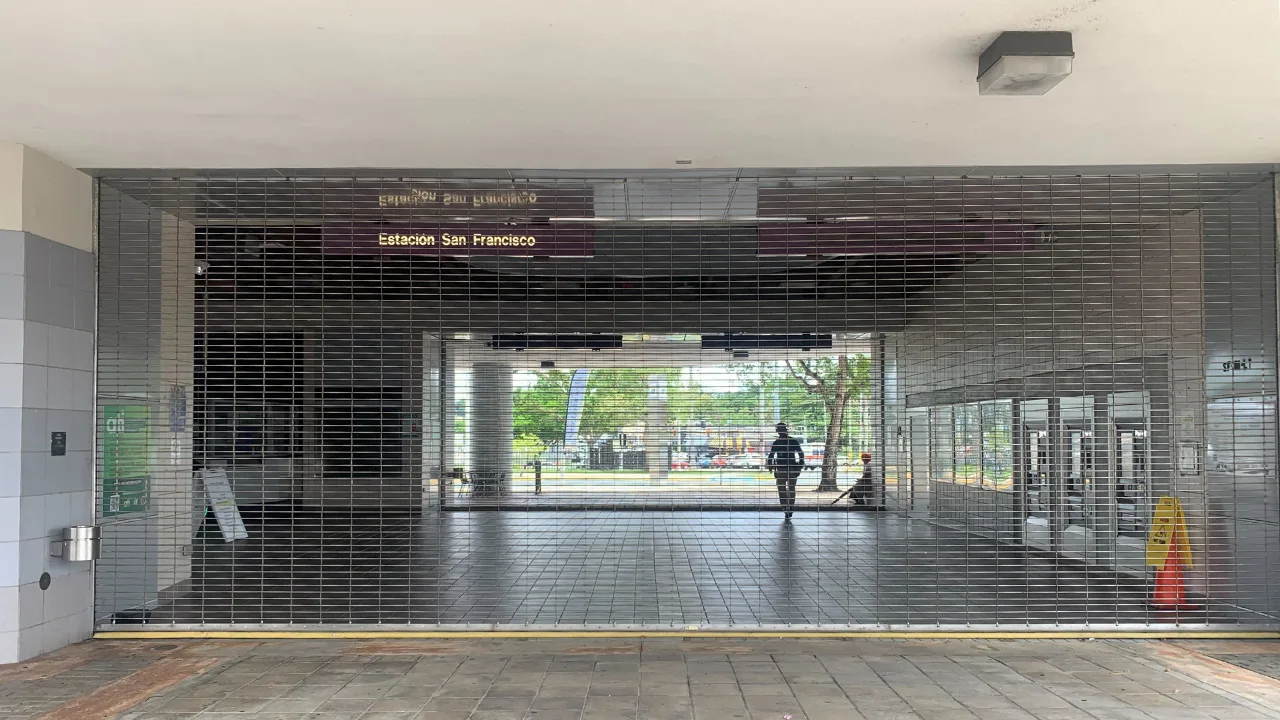
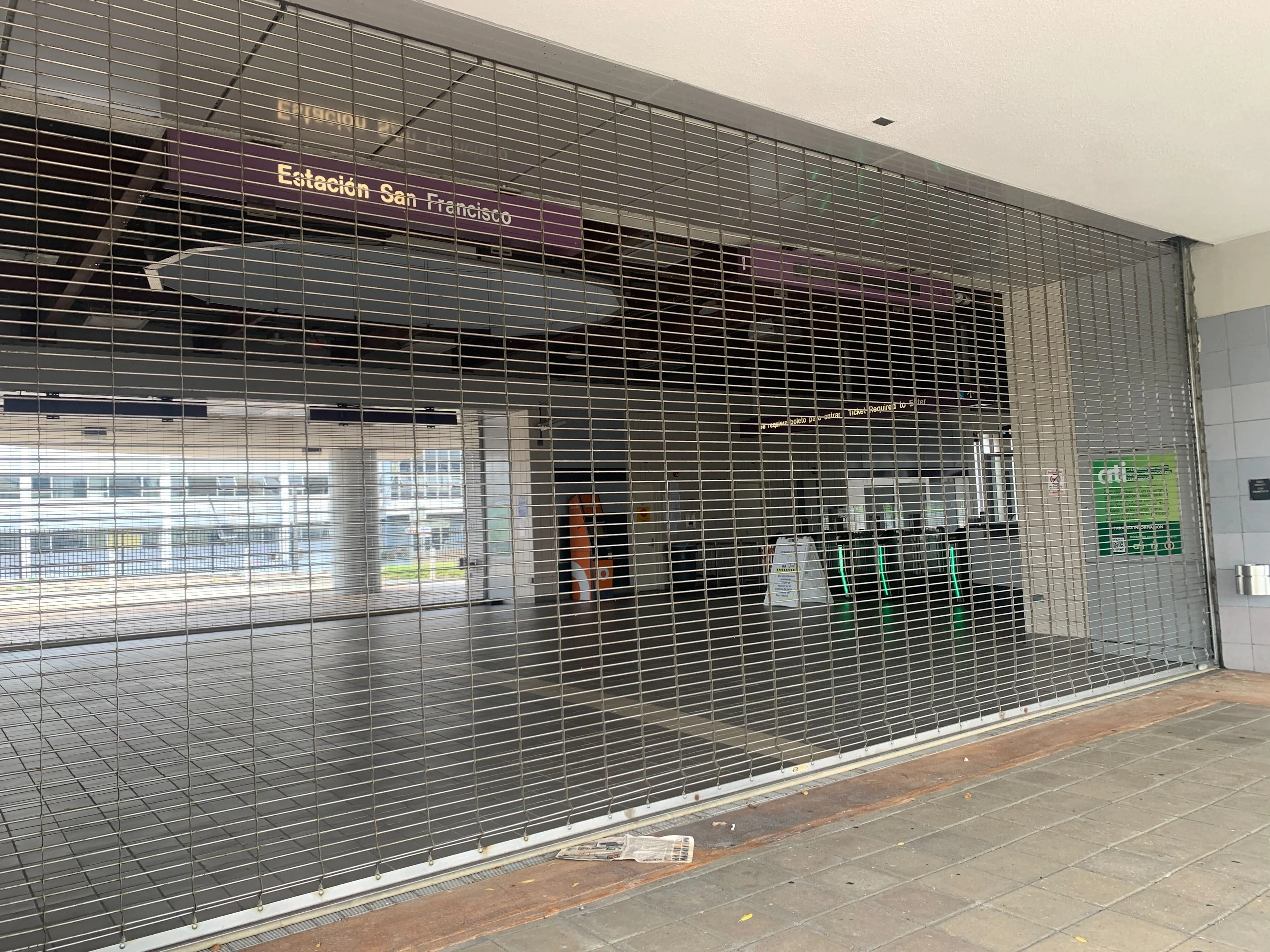
At 1:00 p.m. on Friday, May 16, the gates of the San Francisco station, one of the 16 Tren Urbano stations, remained closed, though some employees could be seen inside the facility.
Sitting in front of the gate was Juan Marrero, who uses the train every day to get to his job in Old San Juan. "My day went dark," he told Platea when he found out the train was not running.
Normally, he takes the train from San Francisco to Sagrado Corazón and from there takes a bus to Old San Juan, but without train service he would have to take three buses to reach his destination, which would double his travel time. "I wouldn't make it to work tomorrow," he said.
"If it weren't for Uber and friends, I wouldn't get there. The train is essential for transportation," Marrero said, as he waited for some friends to pick him up at the station. He limits his use of Uber because, he said, it would be too expensive, and many drivers are reluctant to enter the public housing complex where he lives, which limits his options further.
On social media, several riders have expressed frustration with the Tren Urbano service interruption and with the lack of a bus route running through the train's stations, given the thousands of riders who use the system daily.
Lack of information among employees. Platea asked a Tren Urbano employee what the transportation alternatives were given the lack of service. "I don't have information about the buses," he said. "If there's no power, I can't give you any kind of option. There's no bus terminal here, like at other stations such as Cupey or Sagrado Corazón," he said.
He also could not say when the train would return to service. "They haven't told us."
This content was translated with the assistance of Artificial Intelligence (AI).