By PlateaPR
Photo by: wapa.tv
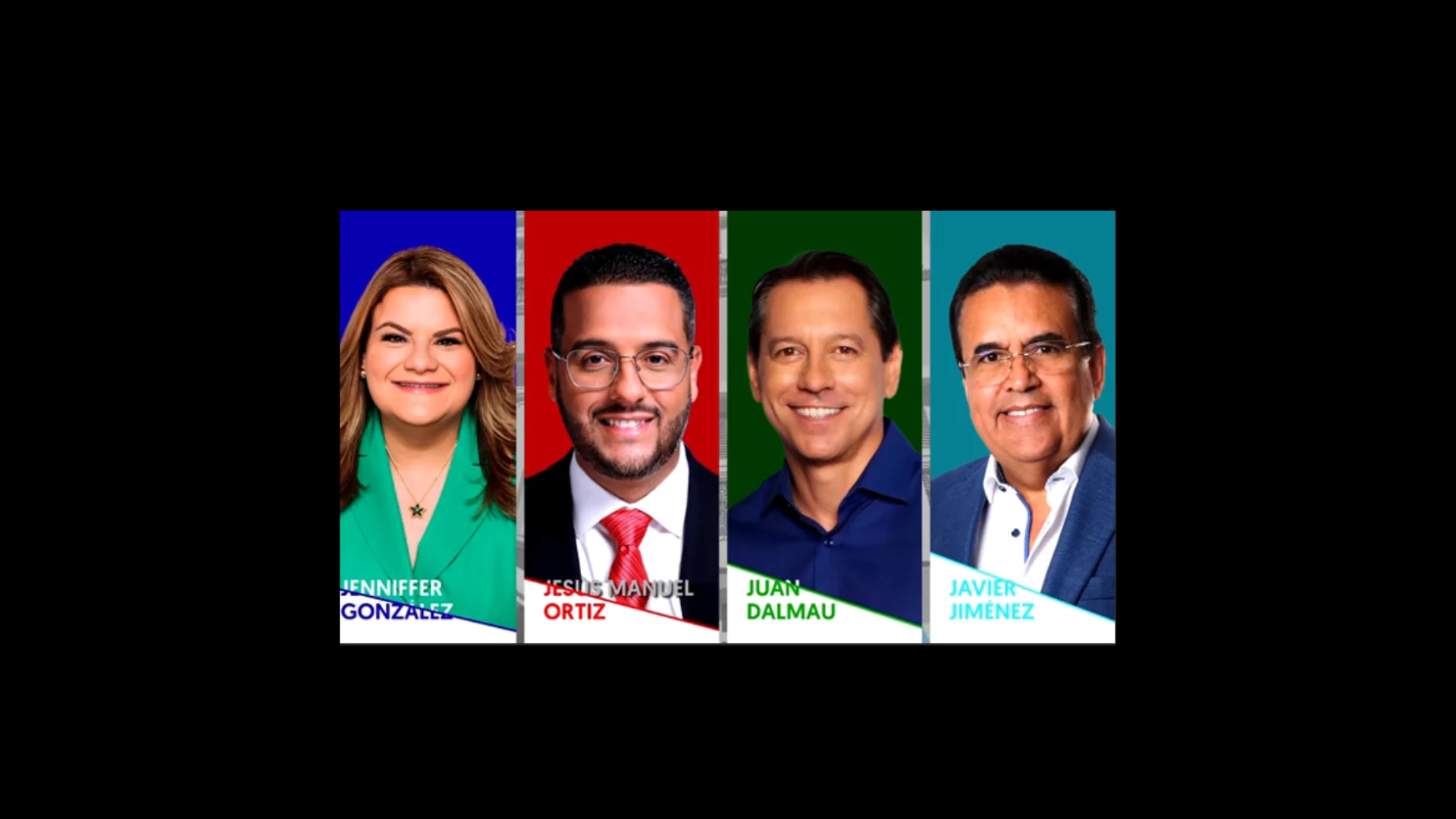
Juan Dalmau, Jenniffer González, Jesús Manuel and Javier Jiménez, the four candidates for governor took part in a debate on Wapa TV and El Vocero, where they tried to convince voters why they believe they are the best option to lead the Island over the next four years, ahead of the November general election.
There, each candidate answered questions from journalists Julio Rivera Saniel, Katiria Soto and Istra Pacheco on topics including health, security, education, the economy, corruption and Puerto Rico's political status.
Did you miss it? Don't worry, here is a summary of their answers:
Juan Dalmau, Partido Independentista Puertorriqueño (PIP – Alianza)
HEALTH: Regarding the proposal to create a National Health Insurance corporation to eliminate private insurers, how would you convince the federal government that your administration could take on that management?
He explained the idea of a Universal Health Plan and the creation of a nonprofit corporation so that health funds would be administered by professionals and patients represented democratically. The plan would be funded with federal and state funds, employer premiums, and the funds would be managed by an autonomous body independent of the government.
SECURITY: How would you address the problem of drug trafficking on the Island, given that the coasts fall under federal jurisdiction?
He proposed building alliances with federal authorities to strengthen what should be a "Caribbean wall," reinforcing state and federal oversight at customs and conducting more specialized inspections of shipping containers, without criminalizing merchants. He also supports treating drug dependency as a public health issue.
EDUCATION: What needs to be done with the Department of Education, given that it is failing students with special education needs and paying daily fines?
He pointed to the problem of politicization in budget management and insisted on decentralizing and giving greater authority to school communities, but not under the IDEAR project, which he believes has replicated the same processes of cronyism.
ECONOMY: What concrete proposal does your government plan offer for economic growth?
He proposed creating a Puerto Rican entrepreneurship company to make doing business on the Island easier in a balanced way, with an emphasis on local business owners while opening the door to local and mixed capital. He stressed the need to cancel the LUMA Energy contract.
CORRUPTION: How do you propose driving a change in behavior in public administration despite the many anti-corruption laws already in place?
He argued that governance must include a merit system and promised to "start at home," stating that the criterion for forming his cabinet would not be based on party affiliation.
STATUS: Do you commit to not using your position as governor, if elected, to push for separation from the United States?
He committed to not imposing his status preference on the people. He proposed a democratic process through a status assembly, selecting delegates from each non-colonial, non-territorial option, and fostering a civil dialogue with Congress to understand the viability, obligations and transitions for each option.
Jenniffer González, Partido Nuevo Progresista (PNP)
HEALTH: Medical plans are not contracting new specialists and are also dropping medications to cut costs. Do you commit to eliminating the discretion of medical plans in these cases?
She committed and said she would confront insurers by creating a division of prosecutors within the Department of Justice to intervene on behalf of patients in those cases.
SECURITY: She proposed removing the Police from the Negociado de Seguridad Pública. Why maintain that structure when unions say it is not working?
He points out that the fiscal plan establishes the bureau, but believes the Police should operate more efficiently. He also considers it crucial to restore agreements with federal agencies.
EDUCATION: He proposes transferring ownership of the Autoridad de Edificios Públicos to the Department of Education and creating a new infrastructure office. Wouldn't that open the door to awarding contracts to inexperienced companies?
He says no, because existing agencies would be used to ensure schools are up to date. He also promises to establish a transparency program for contracts over $500,000, under which the contractors and their shareholders would be made public.
ECONOMY/LUMA: Is he in favor of canceling the contract or not?
He says yes, he is in favor. He proposes an energy "czar" to oversee the cancellation in a way that costs the people of Puerto Rico as little as possible.
CORRUPTION: Does his platform include a specific focus on fighting corruption?
He proposes a lobbyist registry covering not only the legislative branch but also the executive branch, and strengthening laws to recover misused funds.
What is his explanation for the allegations that his cousin, Luis González Ortiz, approved, as a contractor for Recursos Naturales, the boundary survey for the Punta Bandera project in Luquillo just three days before the developer made a donation to his campaign?
He says he was unaware of that information, claims he has no communication with his cousin, and asserts that a campaign donation "does not buy his conscience."
STATUS: Does he reaffirm his belief that a vote for the Alianza could affect the relationship with the U.S.?
He claims that an independence-leaning governor, or one who could push for independence, would put federal funds at risk. He does not explain how.
Jesús Manuel Ortiz, Partido Popular Democrático (PPD)
HEALTH: How can real access to reproductive health services be guaranteed for women, especially in rural areas?
He does not answer specifically. He proposes a retention fund for professionals and a complete restructuring of the licensing process for doctors, to keep more professionals in the system.
PUBLIC SAFETY: How does he propose to address organized crime and gangs?
He proposes simplifying and streamlining the police system, implementing technology to help solve cases and improve officers' working conditions. He pledges to prioritize finding resources to guarantee a dignified retirement for police officers and to use technology to compensate for staffing shortages, so that organized crime can be investigated "more effectively."
EDUCATION: What is his position on charter schools and educational vouchers?
He does not answer directly. "What is working well should be allowed to keep working," he said, and argued that the problem with LUMA Energy affects education because power outages interrupt classes.
ECONOMY: The Fiscal Oversight and Management Board has indicated that the contract with LUMA should not be canceled. What alternative does he propose to improve the energy system?
He insists on pursuing the cancellation of the contract and defending that position in court if necessary.
CORRUPTION: The PPD has faced several corruption cases involving its mayors. What does he propose to prevent the party from being a passive observer in these cases?
He disagrees with the premise and points out that he made sure those implicated would not appear on the ballot. On the party's regulations, he notes that "there is room for improvement."
STATUS: The PPD insists on an enhanced Estado Libre Asociado. Could he explain his proposal?
He does not explain it. He only mentions that "the enhanced ELA includes maintaining American citizenship and our political relationship with the United States."
Javier Jimenez, Proyecto Dignidad (PD)
HEALTH: You proposed financing adult day care centers using Medicaid funds. This would cost about $1.5 billion a year. If the funds are already set through 2027, how would you do it?
We will prioritize the health and care of older adults, directing the funds we obtain through government reengineering.
SECURITY: Given the wave of femicides, your party opposes the gender-perspective educational model. Why, and how do you propose to address these crimes?
He does not answer directly and limits himself to saying that is an incorrect characterization. He argues that a broad approach is needed to address domestic violence without it becoming "a fight between men and women."
EDUCATION: Do you propose any specific educational effort to address problems affecting the 54% of voters who are women?
He proposes promoting "values curricula" that encourage respect between men and women, and insists the approach cannot be seen as a conflict between the two.
ECONOMY: You propose a model that would allow businesses to begin operations and complete permits afterward, as well as certifying architects and engineers to authorize those permits and reducing review times for historic zones. How do you guarantee the protection of the environment and historic heritage with such a flexible model?
He emphasizes that the permitting process prevents new business owners from developing their businesses and creating jobs, and maintains that engineers and architects are qualified to issue permits. He clarifies that if they certify something contrary to the law, they risk losing their licenses.
CORRUPTION: There is a long list of mayors accused of corruption. Would your administration support measures requiring those who steal public money to return it with interest?
He promises to recruit an "army of auditors" to be present constantly in government agencies and municipalities. He argues that requiring corrupt officials to return what they stole does not deter them; what is needed is constant auditing.
STATUS: You have said you support Trump and propose that all parties unite to lobby Washington to resolve the status question. Do you believe that would be enough, and that the issue would be resolved under a Trump administration?
He does not answer the question.
This content was translated with the assistance of Artificial Intelligence (AI).