Chef Josiah Hernández builds his menus at Chef's Garden in Rincón around one principle: if it grows in Puerto Rico, the Antilles or the Caribbean, "no matter how unusual it is," it has a place in his kitchen. That idea led him to seaweed, an ingredient that is abundant along the island's coasts but that almost no restaurant incorporates into its menus.
His drive to source it became the seed of the new Consorcio de Acuacultura Puertorriqueño, created to responsibly integrate seaweed and other sustainable resources into the country's menus, and in doing so support conservation work in marine ecosystems.
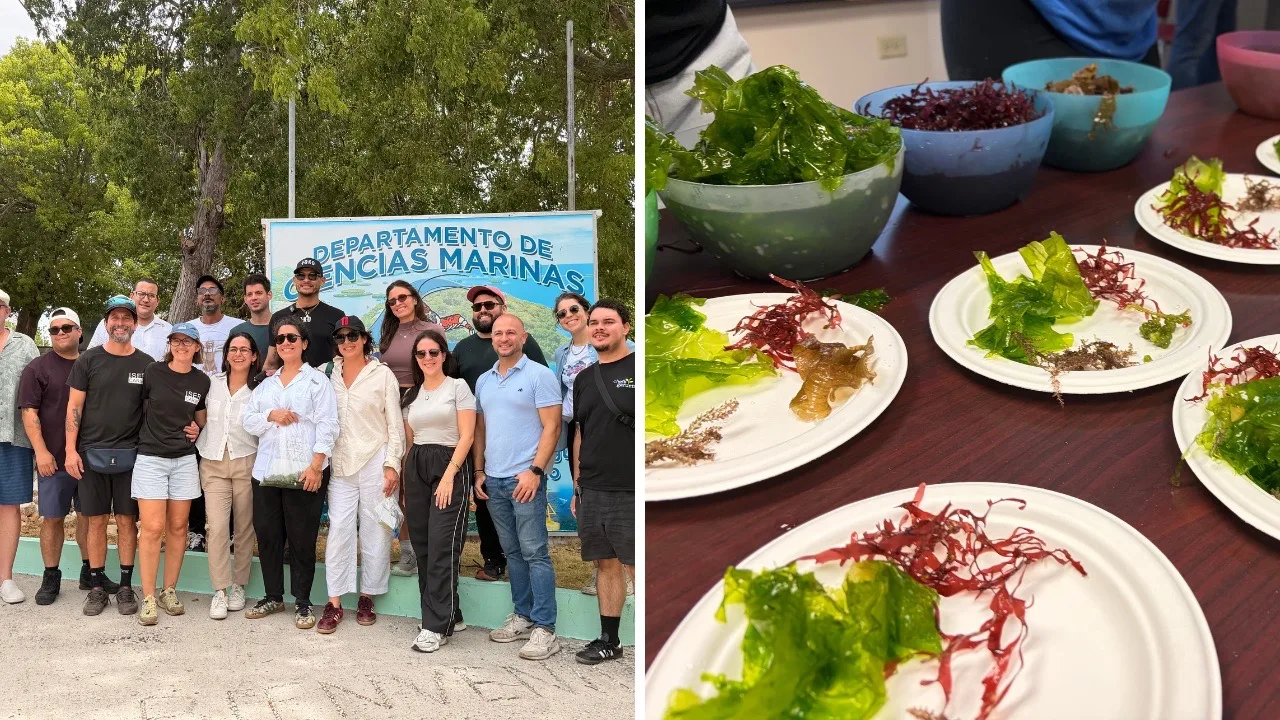
The first step took shape this Monday, July 6, when Hernández and a group of 10 chefs, in collaboration with the Academia Puertorriqueña de Gastronomía (Apuga), met with the team at the Institute for Socio-Ecological Research (ISER Caribe) on Isla Magueyes, in Lajas, to sample and take home varieties that the laboratory cultivates and explore how to incorporate them into their culinary offerings.
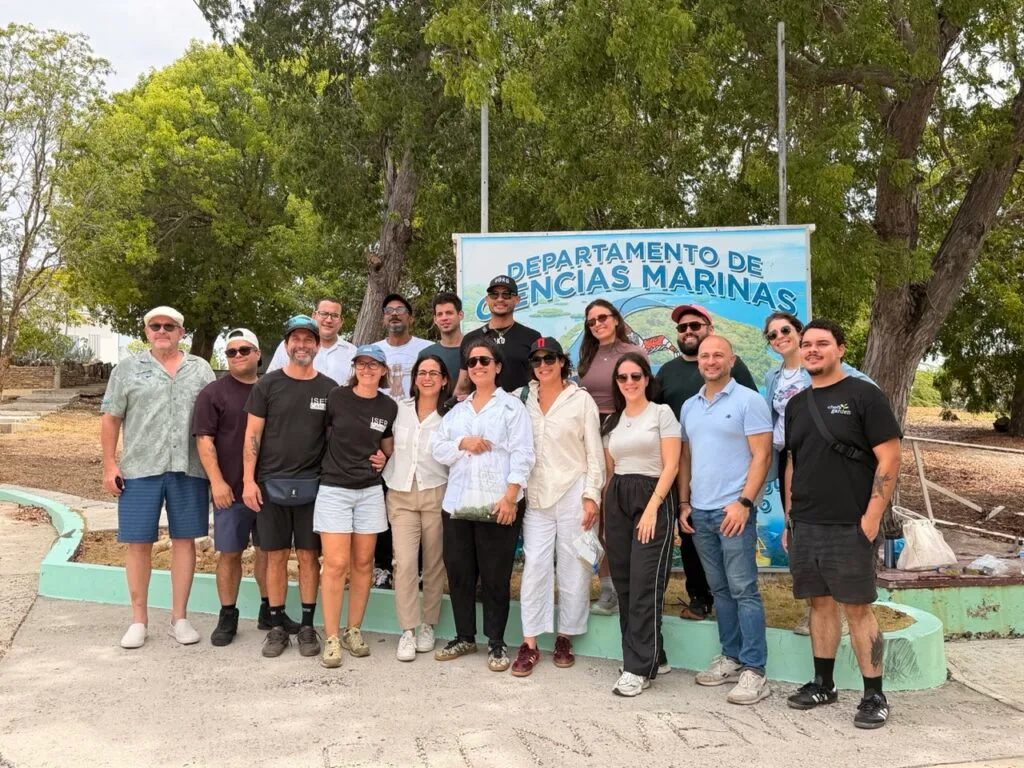
"(With the Consorcio) we propose using seaweed species that are produced here in Puerto Rico and can be distributed to kitchens, while also carrying the message of social responsibility that we in the food industry have toward marine ecosystems," Madelaine Vázquez, executive director of Apuga, explained to Platea during our tour of this island near La Parguera, which is home to the Departamento de Ciencias Marinas of the University of Puerto Rico in Mayagüez.
The idea is for this first phase of the project to function as a pilot. The chefs run tests in their kitchens and document possible uses, while the consorcio analyzes the other links in the chain, including processing, distribution and transportation.
"So it's a matter of scaling it up a bit, always keeping in mind that we want to maintain a controlled scale because this is a natural ecosystem," Vázquez said, noting that the food industry draws heavily on natural resources, making this initiative a way of giving back to the environment through sustainable practices.
"The group of chefs who are collaborating has that awareness, and we know there are many others in Puerto Rico", she added.
Why it matters The consorcio proposes a cycle. The seaweed that ISER Caribe cultivates, a nonprofit founded in 2012 by scientists Braulio Quintero and Stacey Williams and anthropology professor Ryan Mann Hamilton, feeds the sea urchins and crabs that the laboratory raises and releases onto reefs, where that group controls the invasive algae that smothers corals.
Restaurants buying that same seaweed would turn the country's kitchens into a source of income that sustains the cultivation and, with it, the restoration work, at a time when federal funding for environmental research is shrinking.
Zoom in: Discovering the potential
At Chef's Garden, chef Hernández designs a menu that highlights a Puerto Rico ecosystem every three to four weeks. For the marine menus, his goal was to incorporate Puerto Rican seaweed, but he quickly realized how hard it was to find. "Yet Puerto Rico has more than 600 varieties of seaweed or alga," he noted in an interview with Platea.
"I started looking for it on the beaches near our restaurant in Rincón. I found one variety and started using it about 2 years ago, but I kept thinking, I knew there was more," he said.
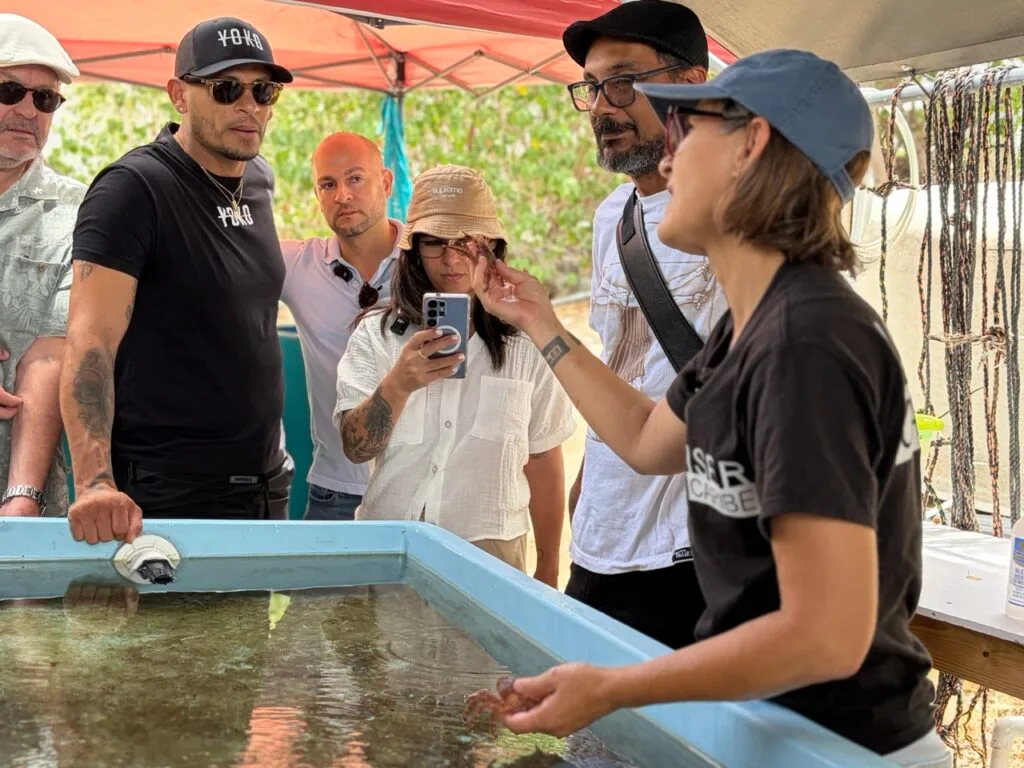
That connection came through the University of Puerto Rico, which put him in touch with ISER Caribe and with Dr. Stacey Williams, who leads the lab's seaweed cultivation project. He brought samples to the kitchen and began experimenting. "I was fascinated, I fell in love," he said.
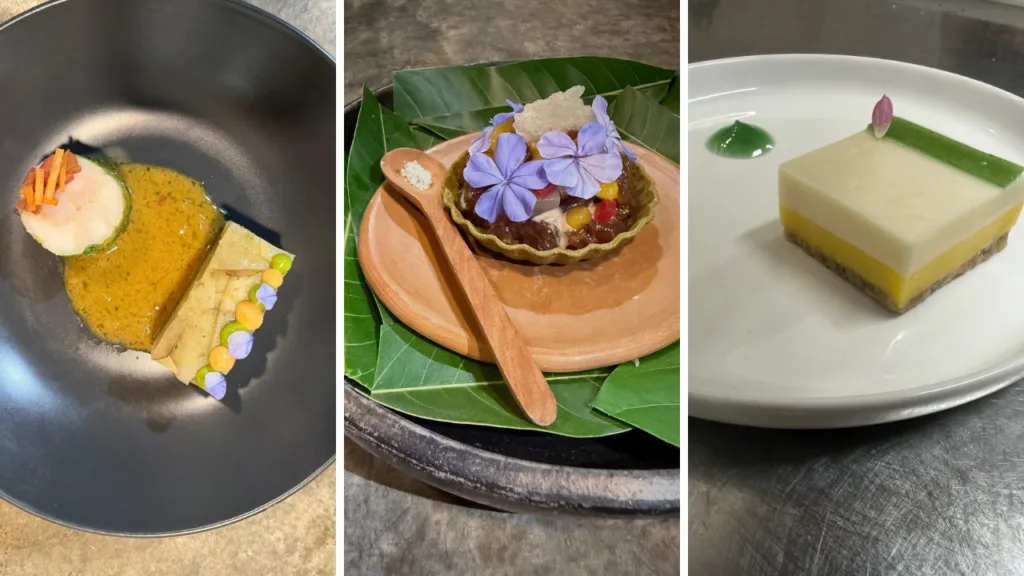
He has been incorporating them into his menu for about six months. He has made foam from lacto-fermented sea lettuce, powders for tart shells, gelatins, dashi-style broths and tiger's milk for ceviche, always chasing the umami these algae contribute naturally. He said "clients have been fascinated."
From there he decided to bring it to other kitchens. "I can't keep this to myself, I have to share it," he told the group of chefs on the small island.
The algae the chefs tried
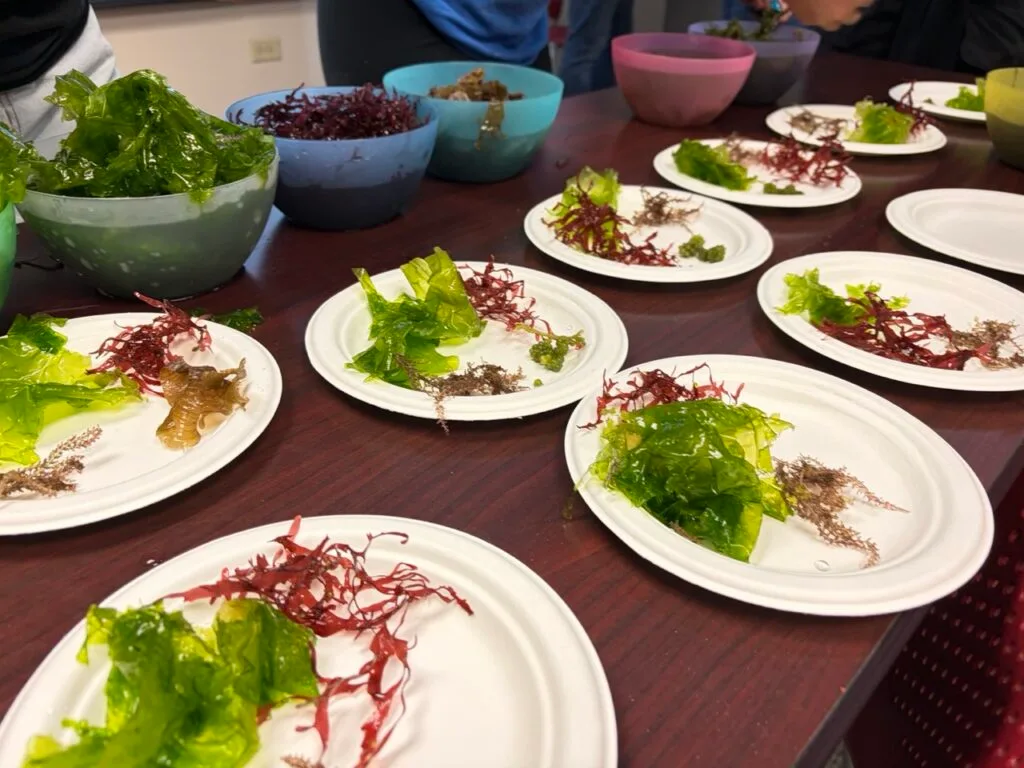
After a tour of the research center, during which the cooks had the opportunity to learn about ISER Caribe's conservation and restoration work, the group tasted five types of algae and microalgae. Among them:
Ulva, or sea lettuce, the central species in the current cultivation project.
Caulerpa, known as green caviar for its texture.
Padina australis, which Hernández has used in his dashi-style broths.
Gracilaria, which contains agar-agar, a plant-based gelatin used in the culinary world as a thickener or stabilizer.
Tetraselmis, a nutrient-rich microalga.
Each chef took samples to experiment with at their restaurant and share the results, with the goal of raising the profile of the lab's work.
The ideas taking shape among the chefs
For chef José Miguel Meléndez, of Yoko and Nuna, discovering that Puerto Rican algae are within reach for his menu has been "like a dream," an answer to what he had seen on trips to Peru, Colombia, Mexico and New York, where he observed a wider availability of marine ingredients that he could not find as easily in Puerto Rico.
How are you imagining these products in your dishes? Platea asked him.
"Even before arriving, my head was already flying in 20,000 pieces. Right now I have some omakases coming up at different restaurants and I was eager to see this and find other ways to use it and elevate the product," he said.
What excites him most is taking these algae out of the Asian framework in which they are typically presented at the culinary level. "It's from here, it's from Puerto Rico. So why can't we integrate this kind of product with the local food here, in a way that has nothing to do with Asian cuisine?" he asked.
For her part, chef Natalia Vallejo, of Cocina al Fondo and winner of the James Beard Award 2023, said she is taking away "a lot of hope that as we keep coming together and organizing, we can accomplish many things.
"This is a project that is part of that, and that has shown all of us chefs today that it is possible, they are making it happen, so now we enter a new path as chefs of starting to explore this wonderful product. I consider it a superfood that can be developed and brought into our kitchens and given value," she said.
There is much still to experiment with, but ideas are already forming in her mind. "I'm already thinking about a seaweed stew with pork cheeks and making some pastelillos stuffed with that," she said.
Josiah Hernandez – The Chef´s Garden
Marielys Hernandez – Awwa / Kummo
José Melendez – YOKO / Nuna
José Alvarez – Andaluz
Gabriel Hernandez – Verdemesa
Natalia Vallejo – Cocina al Fondo
Alexandra Soto – CRUDO Seafood
Sebastian Rosado – Levant
Carlos Portela – Orujo
Ciarán Elliott – 1919
This content was translated with the assistance of Artificial Intelligence (AI).