What's happening? Secretary of Agriculture Irving Rodríguez Torres announced that in August he will introduce, together with House Speaker Carlos "Johnny" Méndez, two new bills aimed at reorganizing and modernizing the Department of Agriculture (DA), in what he described as an attempt to transform the legal, operational and strategic structure of the agricultural sector in Puerto Rico.
The measures will include a consolidation of agricultural laws scattered since 1917, an internal reorganization of the DA, and changes to transfer certain functions to the private sector with the goal of streamlining permits and operations.
They will also include definitions for Denominación de Origen and the 100% Puerto Rico product labels, a plan the official had previewed for Platea in December.
Why does it matter? The proposal comes alongside a shift in the economic narrative around the agricultural sector. Although agriculture officially represents just 0.69%, or $872.7 million, of gross domestic product (GDP), according to data from the Planning Board, the secretary of Agriculture said that when the added value generated by the agricultural industry is included, the real impact is around 7% of the economy.
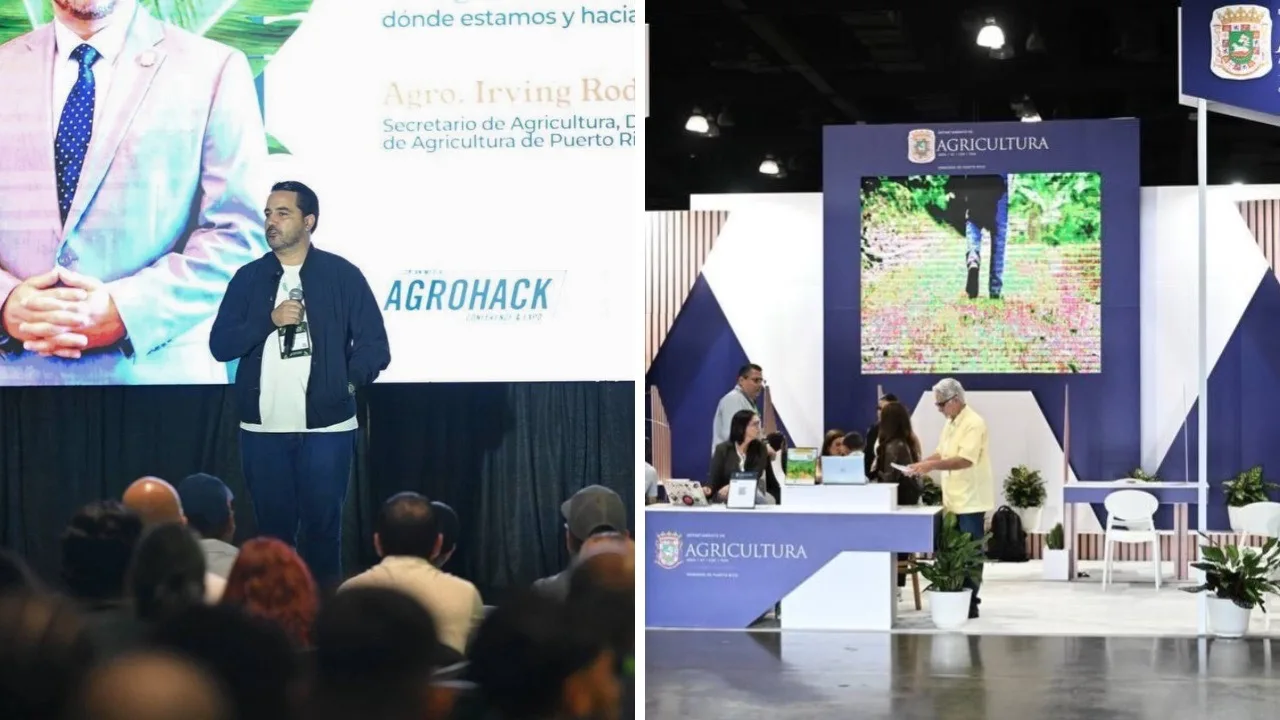
"I'm trying to shift the rhetoric a bit, away from saying we produce 0.8% and toward saying we produce 7%," Rodríguez Torres said at the Agrohack Expo, an agricultural trade fair held May 16 at the Centro de Convenciones.
The official believes that, even though 85% of food is imported, this shift in narrative could drive greater funding allocations to the agricultural sector and a transformation in public policy.
The federal Department of Agriculture includes the following in agriculture and related industries:
Food services and establishments serving food and beverages
Food and beverage retail establishments
Textile, apparel and leather manufacturing
Food, beverage and tobacco manufacturing
Forestry, fishing and related activities
In detail. Rodríguez Torres explained that they are in the process of drafting two bills for "agricultural reorganization" and "agricultural modernization."
"From so many experiences that haven't worked, we are merging, changing, seeing what works, who bears the responsibility and who doesn't," he said.
Currently, the DA operates under a structure made up of:
The DA secretariat, with four assistant secretaries
La Autoridad de Tierras, an independent public corporation in charge of the 132,000 cuerdas of land available through family farms and real estate, and of the Fondo de Innovación para el Desarrollo Agrícola (FIDA), one of its subsidiaries
La Administración para el Desarrollo de Empresas Agropecuarias (ADEA), another public corporation that runs programs such as school cafeterias, farmers markets and marketing operations across eight regions
La Corporación de Seguros Agrícolas (CSA), a third public corporation responsible for insuring investments in farmers.
Rodríguez Torres argued that many of the current structures reflect outdated models and decades of accumulated bureaucracy. That is why public corporations were created that, at times, operate with greater agility and independence than an agency, he said.
"The government of Puerto Rico is very bureaucratic," he said, explaining that ADEA was created precisely to operate with more agility than a traditional department.
What would change
Although he avoided offering specific details before the legislative presentation, he indicated that the reorganization will include:
consolidation of functions,
redefinition of responsibilities,
changes to regulatory processes,
and greater private-sector participation in certain tasks.
According to him, that would allow processes such as permits and services to farmers to move faster. "It's a bill from the House speaker together with this public servant, and we are going to be pushing it," he said.
Denominación de origen
Another major change will be in the area of marketing and promotion, where they hope to create Denominaciones de Origen, a strategy used by several countries around the world to designate certain products developed in a specific region according to defined quality standards.
"There will be brands and there will be a 100% Puerto Rico designation. Seals that we are going to give them so we can identify the 100% Puerto Rico product at the shelf level. The consumer already has to identify our product by its categories," the DA secretary explained.
For the official, "there can be no more hesitation about confusing the consumer with products that come from somewhere else and are not from here. The product from here is healthier, it is better, it has better conditions and we have to identify it at the shelf level."
As he had previously told Platea, the denomination-of-origin brand would include seals in the areas of harvesting, livestock raising and fishing.
What the bills are based on
Rodríguez Torres pointed out that all his initiatives at the DA are based on five pillars:
Converting agriculture into a value-added industry.
The goal is to stop selling only raw materials and move toward processed, differentiated or locally branded products.
"If we are going to compete at the shelf level, we have to add value, competing against products that are not made in the United States, that do not operate under our rules," he said on this point.
Capturing more federal funds.
Agricultura is looking to create a permanent office to help farmers apply for proposals, grants and federal technical assistance. According to the secretary, Puerto Rico "loses a lot of money" due to a lack of technical support.
While the office is being created, a private company "is openly providing accounting, human resources and federal proposal services to farmers. You call the Department and we connect you with them."
Bringing more science and technology to the field.
The DA is betting on tools such as agricultural drones, animal genetics and ruminal boluses (chips) for livestock tracking.
"We study agricultural sciences. There is a science behind growing plants for food," he said.
Creating a clear identity for local products.
Rodríguez Torres acknowledged that in the area of marketing and promotion "we have dropped the ball on that many times."
The agency is looking to launch "100% Puerto Rico" seals and denominations of origin to differentiate local products in supermarkets and restaurants.
Integrating government, universities and farmers.
The changes and the push for the sector are something "the department cannot do alone," he acknowledged. This is where ways of organizing the sector come in, such as cooperatives, associations and others, along with agreements with the Universidad de Puerto Rico, the Universidad Interamericana, the Colegio de Agrónomos and others.
"There has to be an integration of sectors, there has to be dialogue, there has to be a coordinated effort toward maximizing our resources to achieve greater consumption of local products at the shelf level, so that I can then start talking about increases in production," he said.
Another fundamental challenge
Labor for harvesting crops is another challenge still on the table. He used the coffee sector as an example, one to which "I buy the seed, I pay the nursery workers, I give away the tree, I provide fertilizer, I pay the wage subsidy, I give incentives covering up to half the money."
Yet it "has no labor to pick coffee." That would be one of the points to analyze before continuing to invest in agriculture, he said.
What the bill could contain
In the Informe Económico a la Gobernadora y a la Asamblea Legislativa 2025, the Junta de Planificación included clues about what these new bills could contain.
Agrotourism. On one hand, the document argues that the Compañía de Turismo already has an Agrotourism Program "aimed at revaluing agriculture and promoting it as a sustainable framework." The purpose would be to promote the gastronomic offering as a differentiating element through:
Routes of origin (coffee, artisanal cacao, local cheeses and tropical fruits) to position agricultural products "as an integral part of Puerto Rican cultural heritage."
Integrating verifiable local purchasing within the hotel supply chain, so that lodging properties and restaurants use Puerto Rico products consistently.
Using traceability tools (such as QR codes) so consumers can learn the origin, farming practices and history of producers.
Legislation. The document also states that "conducting agricultural business in Puerto Rico is complex," and promotes the creation of "legislation that empowers the DA to:
Offer legal services to farmers,
As well as review the current regulatory framework in order to simplify the requirements applicable to agricultural businesses."
Among the goals, they seek to "reduce the gap between imports and local production, improve food security and mitigate high food prices," as well as stimulate agriculture and sustainable economic development."
🌾 Our agriculture coverage
This content was translated with the assistance of Artificial Intelligence (AI).