What's happening? Three Puerto Rican artists were selected among the 111 participants invited to the 61st International Art Exhibition of La Biennale di Venezia (Venice Biennale), titled In Minor Keys, which opened May 9 and will remain open to the public through Nov. 22 at various venues across the Italian city.
The artists are Sofía Gallisá Muriente, Daniel Lind-Ramos and Natalia Lassalle-Morillo, who participates as a duo with her mother Gloria Morillo. All three live in Puerto Rico and their work resonates with the Island's history and context.
"We're really happy… It's not only a hugely important art platform but a very special biennial project, with a curatorial team that has been wonderful to work with, and they're looking at our work and putting it in dialogue with the work of a lot of artists we admire and respect," Gallisá Muriente told Platea when she learned she had been selected.
"It's an honor to be alongside artists I admire, like Sofía and Natalia. We're talking about one of the most important biennials," Lind-Ramos told Platea.
Why does it matter? The Venice Biennale is the oldest exhibition of its kind. It began in 1895 and alternates each year between art and architecture. This year's edition carries the vision of Cameroonian art curator Koyo Kouoh, who died in May 2025. The exhibition is being presented as she conceived it, with the support of her family and the team she chose to carry it out.
"(Kouoh) is the first Black woman to curate the Venice Biennale exhibition in all these decades of history… It is based on a text she wrote, In Minor Keys, a beautiful text that thinks about how artists respond to the contexts in which we live," Lassalle-Morillo explained.
"Most countries participate through pavilions or in the biennial in some other way. Puerto Rico, not being a country (a sovereign state), this is the way it can participate," Gallisá Muriente pointed out.
Puerto Rico's representation
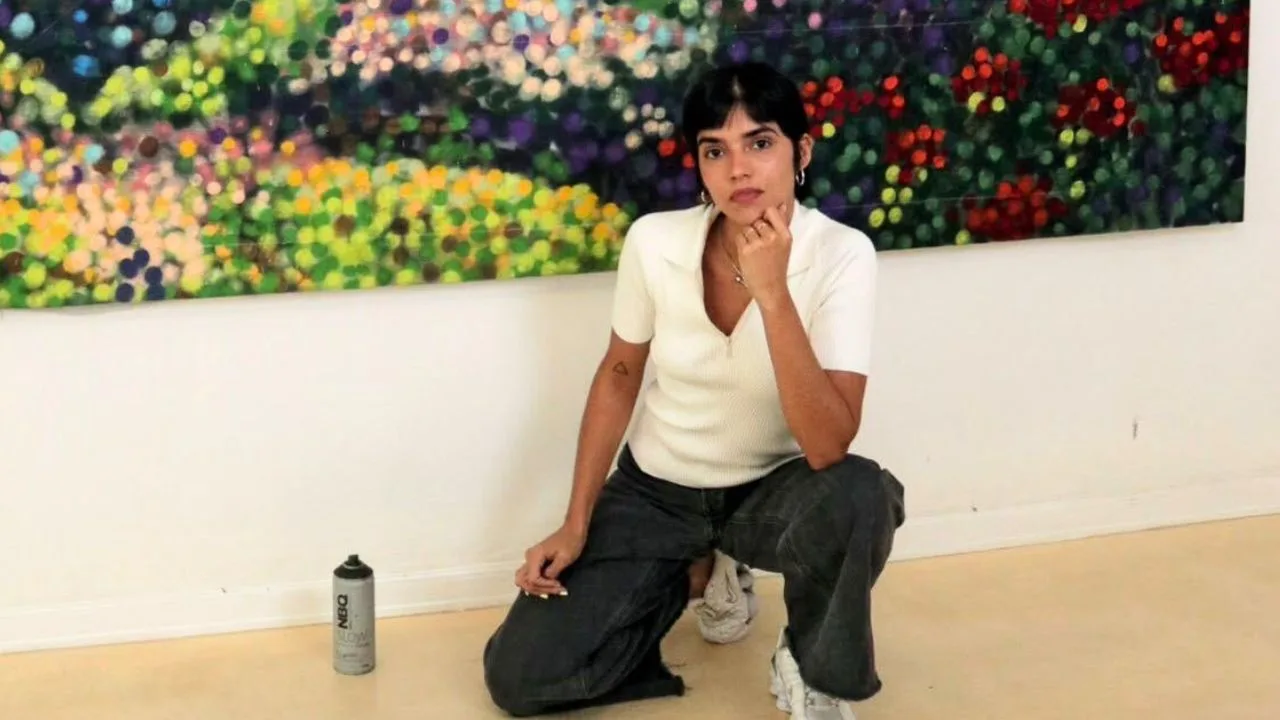
Sofía Gallisá Muriente. Born in Hato Rey in 1986, she is a visual artist whose practice centers on recovering and questioning historical narratives, developing strategies for remembering and reinventing the past. She works with text, image and archival materials, approaching them both as formal tools and as subjects of critical reflection.
How she defines her work. "I studied film and worked in photography and theater. My practice is the result of that. My work is mostly video, films. It has to do with images. I'm frequently interested in memory, history, archival work, but also in recognizing many kinds of archives beyond institutional ones," Gallisá Muriente said.
At the biennial. Gallisá Muriente shows a selection of works under the title Observatorio de Lagunas, in which the word "laguna" means both a body of water and a gap in memory. Among them:
Guaniquilla Luminosa (2023), with images of a cove in Cabo Rojo;
Últimas luces (2024), in which she presents, through images from her late grandmother's home, an "intimate, unstable and partially fictional archive, reminding us that memory is shaped through selection, omission and imagination," as curator Marina Reyes Franco describes it;
Ciné Inútil/Useless Cinema I-IX (2023-2024), with film frames from movies shot by police surveilling left-wing groups.
"I had never felt so proud to participate in an exhibition or in a group of artists. It still amazes me that inside this monumental art event it was possible to experience a tender humanity, a fierce solidarity and a complicity that gave me a new sense of value in what I do, despite the swamp in which we work," Gallisá Muriente wrote on her social media about her experience in Venice.
Current exhibitions:
2025 Milestone Grantees of the Trellis Art Fund
In Minor Keys, Venice Biennale 2026, their works are in the Arsenale
Natalia Lassalle-Morillo. Born in Bayamón, she is an artist and director whose work crosses theatrical performance, experimental film and installation. Her practice, grounded in research and participatory processes, addresses memory and history through collaborative dynamics that invite collective creation.
Lassalle-Morillo appears as a duo with her mother, Gloria Morillo, who worked in the pharmaceutical industry, has been a homemaker and has always had art present in her life, though not in a public way.
How she defines her art. "I come from theater, but I work across multiple disciplines. A lot of my work takes shape as performances, as experimental films, video installations… But it is also very collaborative and participatory work… Providing a space to discuss certain topics, a way of creating and thinking together," Lassalle-Morillo said.
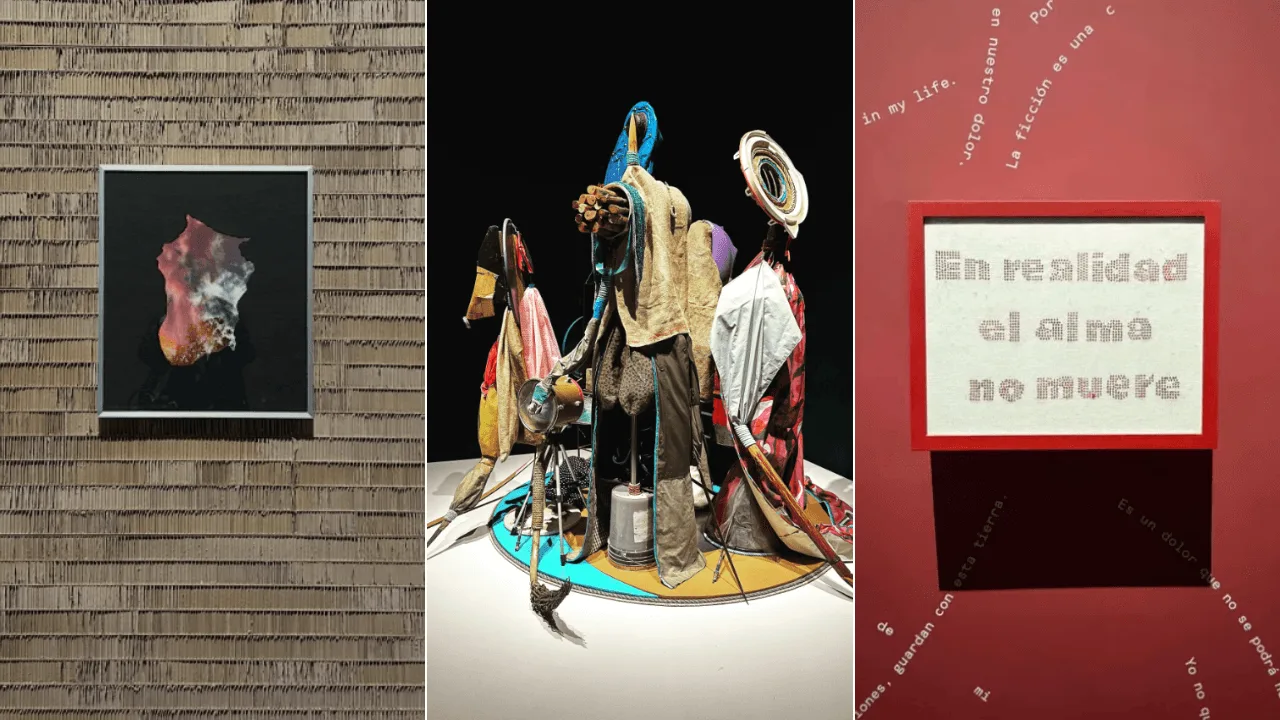
At the biennale. Lassalle-Morillo and her mother present Retiro (2019-2026). The work explores the family and maternal bond through a film and several embroideries. One reads "In reality, the soul does not die," reflecting on the connection between souls and giving thanks to her mother for giving her life and accompanying her creatively.
Exhibitions in 2026:
In Minor Keys, Venice Biennale 2026, their works are in the Arsenale
En Parábola/Conversations on Tragedy (Pt I & II), at Abrons Art Center, Nov. 6 through Jan. 3, 2027
Dancing in the Revolution, at MCA Chicago, April 14 through Sept. 20
Humid Traces, at Ford Foundation Gallery, New York City, Feb. 19 through June 20
Daniel Lind-Ramos. Born in Loíza in 1953, he is a visual artist known for his paintings and assembled sculptures made from materials tied to his surroundings, as well as interdisciplinary proposals with a performative character. His recognition includes a MacArthur Foundation "Genius" grant (2021) and a USA Artists Fellowship, along with support from the Joan Mitchell Foundation and the Pérez Art Museum.
How he defines his art. "My work has been a kind of search… I start by investigating painting, then I move away from painting as a genre and work with assemblage, always looking to find those keys and symbols that represent and visualize this Puerto Rican, Afro-Puerto Rican, regional, diasporic experience. That is what nourishes what I do," Lind-Ramos told Platea.
At the biennale. Lind-Ramos shows two of his sculptures. One is titled Talegas de la Memoria II (2025), pictured. "Both are installed and lit impeccably, giving them a prominent presence within the broad international context. His pieces project music and poetry in the midst of an environment marked by noise, lies and aggression," according to curator Dan Cameron.
Current exhibitions:
In Minor Keys, Venice Biennale 2026, their works are in the Arsenale
Lind-Ramos said that several of his pieces can be seen in museums including the Museo de Arte Contemporáneo in Santurce, the Miami Institute of Contemporary Art, the Pérez Art Museum Miami and the Metropolitan Museum of Art in New York, among others.
Since February, the plaza in front of Corporación Piñones se Integra (COPI) in Loíza has had one of his sculptures as a permanent installation honoring Loíza's cuisine.
The Venice Biennale: In Minor Keys
It was Kouoh who selected the title In Minor Keys for this edition of La Biennale di Venezia. It is expected to be an exhibition conceived as an intimate but powerful composition, focused on "the minor keys," those voices, experiences and practices that tend to exist at the margins but offer deep, shared resonances across geographies, cultures and histories.
The 111 invited participants are individual artists, collaborative duos, collectives and arts organizations from different regions and contexts, ranging from Salvador, Dakar, San Juan and Beirut to Paris, Nashville, Jerusalem and Gaza. Some have already died.
Selection process. The exhibition's curators and staff contact artists directly and extend a formal invitation after evaluating their work, having encountered it through another exhibition or contact and having requested a portfolio.
In addition to the main exhibition, there will be national pavilions with proposals from more than 60 countries, official collateral exhibitions and cultural activities around Venice.
Other Latin American artists in In Minor Keys
Carolina Caycedo: a Colombian artist based in Los Angeles and Caguas, Puerto Rico. She has mounted exhibitions on subjects related to Puerto Rico, including a work about Tinti Deyá, of Casa Pueblo, shown at the Vincent Price Art Museum in Los Angeles. She was also one of the artists in residence at Para la Naturaleza.
Álvaro Barrington, Venezuelan, living in London
Annalee Davis, artist from Barbados
Edouard Duval-Carrié, Haitian artist living in Miami
Leonilda González, Uruguayan artist
Ayrson Heráclito, from Brazil
Alfredo Jaar, from Chile
Lugar a dudas, Colombian collective
María Magdalena Campos-Pons, Cuban, living in Nashville
Guadalupe Maravilla, from El Salvador
Manuel Mathieu, from Haiti
Eustaquio Neves, from Brazil
Ebony G. Patterson, from Jamaica
Celia Vásquez Yui, from Peru
Editor's note: This article was first published on Feb. 26, 2026, and was updated on May 15 with additional information about the content of the artists' exhibitions at the Venice Biennale.
Cover photo: Works by Sofía Gallisá, Daniel Lind Ramos and Natalia Lassalle-Morillo at the 2026 Venice Biennale. (Photos via Instagram: @natalialassallem, @djbc1956 and @hatoreina)
This content was translated with the assistance of Artificial Intelligence (AI).