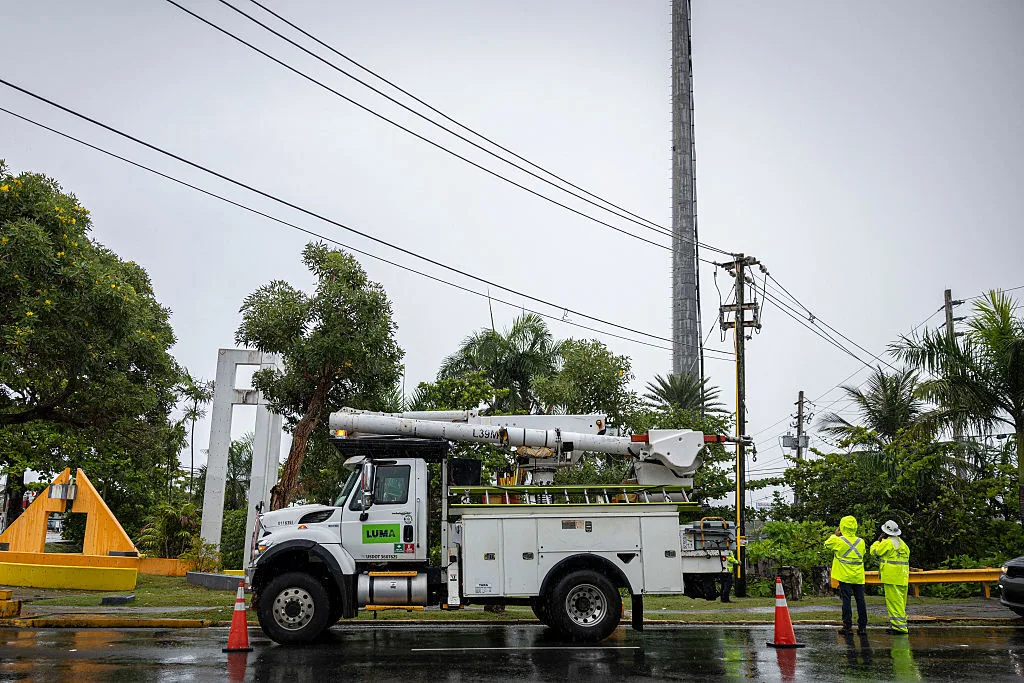
What's happening? In a 5-4 decision, the Puerto Rico Supreme Court voided the contract extension that has allowed LUMA Energy to operate the electricity transmission and distribution system since November 2022. LUMA has up to one year to complete its exit, under the supervision of the Court of First Instance.
In the 86-page opinion issued Wednesday, Nov. 25, Associate Justice Luis F. Estrella Martínez explained that the extension failed to meet legal requirements and introduced significant changes to the 2020 agreement.
Although the court voided only the 2022 extension, the decision effectively ends the original contracts, except for obligations related to the transition. The decision responds to the consolidated claims of the Autoridad de Energía Eléctrica (AEE), the Autoridad de Alianzas Público Privadas (AAPP), and Gov. Jenniffer González.
Why does it matter? A little more than five years after LUMA took over operations, Puerto Rico will see another change in the management of the electrical system. It is not yet known who will replace LUMA, how much the transition will cost, or how it will be paid for.
LUMA estimates that costs associated with the transition would total $1,327.3 million, including existing financial obligations.
Also yet to be seen is how LUMA's exit will affect electricity bills, the reconstruction of the electrical system, and the AEE's bankruptcy.
Why is the LUMA contract extension being voided?
For the Supreme Court majority, this was not a simple extension, but a substantial modification of the contract that required new approvals.
LUMA argued that the original contract allowed for the agreement to be extended, but the Supreme Court concluded that the extension eliminated previously agreed-upon conditions and mechanisms, including the expiration date.
The Supreme Court identified four grounds for voiding the extension:
1️⃣ It did not receive the votes required by law
The two public-interest representatives on the Board of Directors of the Autoridad para las Alianzas Público Privadas (AAPP), Eduardo Ferrer Ríos and Liza M. Ortiz-Camacho, abstained from voting on the extension in November 2022. The other three members voted in favor.
According to the Supreme Court, Ley 120-2018 required the affirmative vote of both representatives.
Al no votar afirmativamente, el documento no contó con los votos que requiere la Ley Núm. 120-2018, supra, para su validez. Por ello, procede que declaremos la nulidad de la Carta-Extensión.
2️⃣ It did not receive certification from the Negociado de Energía
The extension did not receive the Energy Compliance Certificate from the Negociado de Energía de Puerto Rico (NEPR), which certifies compliance with energy public policy and its regulations.
Ciertamente, el NEPR no emitió un Certificado de Cumplimiento de Energía para la Carta-Extensión. Esa inobservancia, por sí sola, basta para declarar la nulidad de la extensión del acuerdo suplementario.
3️⃣ It extended the contract indefinitely
The supplemental agreement established an interim period of 18 months, set to expire Nov. 30, 2022.
The extension eliminated that date and established two conditions for ending the interim period: that the AEE exit bankruptcy and that its debt adjustment plan be reasonably acceptable to LUMA.
The Supreme Court majority concluded that this conflicted with the deadlines set by Ley 29-2009 de Alianzas Público-Privadas.
Las condiciones que se intentaron instituir para regir el final del periodo intermedio abren la puerta a que la Alianza Público-Privada se administre de forma transitoria por un tiempo indefinido que, además, no fue refrendado por legislación. Esta extensión, sin límites temporales ciertos y determinados, es contraria a la ley.
4️⃣ It left the conclusion of the interim period in LUMA's hands
According to the Supreme Court, the extension allowed LUMA to decide on its own whether the main contract would take effect. The Civil Code prohibits the fulfillment of an obligation from depending solely on the decision of one of the parties.
Ello significa que estamos realmente ante una condición puramente potestativa del deudor, LUMA Energy, mediante la que esta tendría total libertad para decidir si está obligada o no. Esa es precisamente la circunstancia que nuestro ordenamiento civilista aborrece y, por ello, prohíbe expresamente.
The court also noted that accepting this change could make it easier for the Executive Branch to extend other partnership contracts in the future without respecting the protections established by law.
What effect does the decision have, and when must LUMA leave?
LUMA is not leaving immediately. The company, the AEE, and the AAPP must fulfill the transition obligations established in the original contract.
The parties have 10 days to request reconsideration of this decision.
When does LUMA leave? According to the ruling, the transition must be completed within a maximum of 12 months. That means LUMA must be out no later than November 2027.
Who will oversee the transition? Judge Anthony Cuevas Ramos, of the San Juan Court of First Instance, will oversee the process and handle pending claims between the parties.
What will LUMA be required to do during the transition?
According to the Supreme Court's decision, LUMA must:
Cease operations when the AAPP directs it to.
Submit reports on ongoing projects and provide access to programs, records, customer information and contracts.
Protect the equipment, materials and facilities of the electrical system.
Provide information to the government and access to programs, records, books, customer information, contracts and other items.
Retain senior staff, if the AAPP requests it, to advise the next operator and provide technical support. The possible retention of employees is contemplated.
Ensure a safe and efficient transition.
Who will replace LUMA?
The Supreme Court did not say who will replace LUMA or how the next operator will be chosen.
During the case, the Autoridad para las Alianzas Público-Privadas (AAPP) and the Autoridad de Energía Eléctrica (AEE) raised two options: that the AEE resume operations or that they be temporarily assigned to another entity. For her part, Gov. Jenniffer González ruled out returning the transmission and distribution system to government hands through the AEE.
The Fiscal Oversight Board pointed out that, under Puerto Rico's energy policy and the AEE's Fiscal Plan, operations must remain in the hands of a private operator.
Choosing a new operator could take time. According to an internal AAPP memo cited by dissenting Justice Ángel Colón Pérez, the process of selecting LUMA took nearly 18 months. The memo also warns that it is unknown whether there will be interested parties willing to submit proposals.
How much will LUMA's exit cost Puerto Rico?
The Supreme Court does not determine how much LUMA's exit will cost, how it will be financed, or whether the company is entitled to compensation.
The justices who disagreed with the ruling cited these estimates from LUMA:
$1,327.3 million: total estimated disbursements by LUMA, of which $726 million would correspond to "contractual line items that cannot be avoided," according to the dissenting opinion of Ángel Colón Pérez.
Among the disbursements, LUMA claims $143.3 million for contract termination, $347.1 million owed to suppliers and $588.3 million pending deposit into operational accounts. It also estimates transition costs of at least $9.8 million per month, according to the dissenting opinion of Rafael Martínez Torres.
Is LUMA entitled to a termination payment? The Supreme Court left open the question of whether LUMA has a right to a payment. It clarified that the main contract expired automatically and that this expiration is distinct from a contract termination.
Will LUMA have to return the money it has collected since 2022? No. The Supreme Court determined that returning payments received is not warranted because LUMA provided an essential service on a continuous basis.
Could Puerto Rico have to pay additional damages? Possibly, but that has not yet been determined.
What impact will this decision have on Puerto Ricans?
1️⃣ Possible impact on the electricity bill
The ruling does not change the bill or say how the transition will be paid for. In his dissenting opinion, Justice Rafael Martínez Torres warned that the costs of LUMA's exit could end up as an additional charge.
2️⃣ Continuity of electrical service
The Supreme Court ordered compliance with transition obligations so that service continues. LUMA argued that the government did not have an effective plan to replace it.
3️⃣ Reconstruction of the electrical system and federal funds
LUMA points out that the decision could make it harder to access federal funds and delay reconstruction of the electrical grid. It is not yet known whether there will be changes to FEMA funding.
4️⃣ Impact on the AEE's bankruptcy
According to the Fiscal Oversight Board, LUMA's exit could increase AEE's expenses and complicate the repayment of its debt.
5️⃣ Impact on private investment and the economy
The dissenting justices warned that the ruling could affect investor confidence. By contrast, Justice Roberto Feliberti Cintrón, who voted in favor, argued that economic consequences cannot take precedence over an analysis of the contract's legality.
LUMA Energy's reaction: "We are evaluating next steps"
In a statement, LUMA expressed its disagreement with the decision and said: "We are carefully evaluating all available legal alternatives."
The company argued that its priority is to protect the reliability of the electrical system and continuity of service.
The governor's reaction: "I fulfilled one of my commitments"
After learning of the decision, Gov. Jenniffer González called a press conference at La Fortaleza, where she said she would guarantee a "orderly transition."
The governor said she will appoint a "transition committee of people recognized in the energy field to help us piece together and make this a transparent, efficient transition." She will also meet next week with Fiscal Oversight Board (JSF) Executive Director Robert Mujica to "discuss the steps" that follow the Supreme Court's decision, since the board will need to give its approval.
She ruled out a return to the AEE. "We must transition to a private operator. This is not going back into the hands of the people of Puerto Rico," she said.
A process to select LUMA's replacement now begins. "(We have) one year to make this transition in an orderly way," the governor added, saying she will consider ways to lower electricity costs.
LUMA employees. The governor told them she needs their experience and good faith during the transition, leaving the door open for some to continue with whichever new company is selected.
This content was translated with the assistance of Artificial Intelligence (AI).