There are four aspects that consumers prioritize when going out to eat at a restaurant: cleanliness, staff friendliness, food flavor and ingredient quality. And although many have cut back on dining out given the current economic climate, they still want to go to restaurants, but they spend less and expect more for their money.
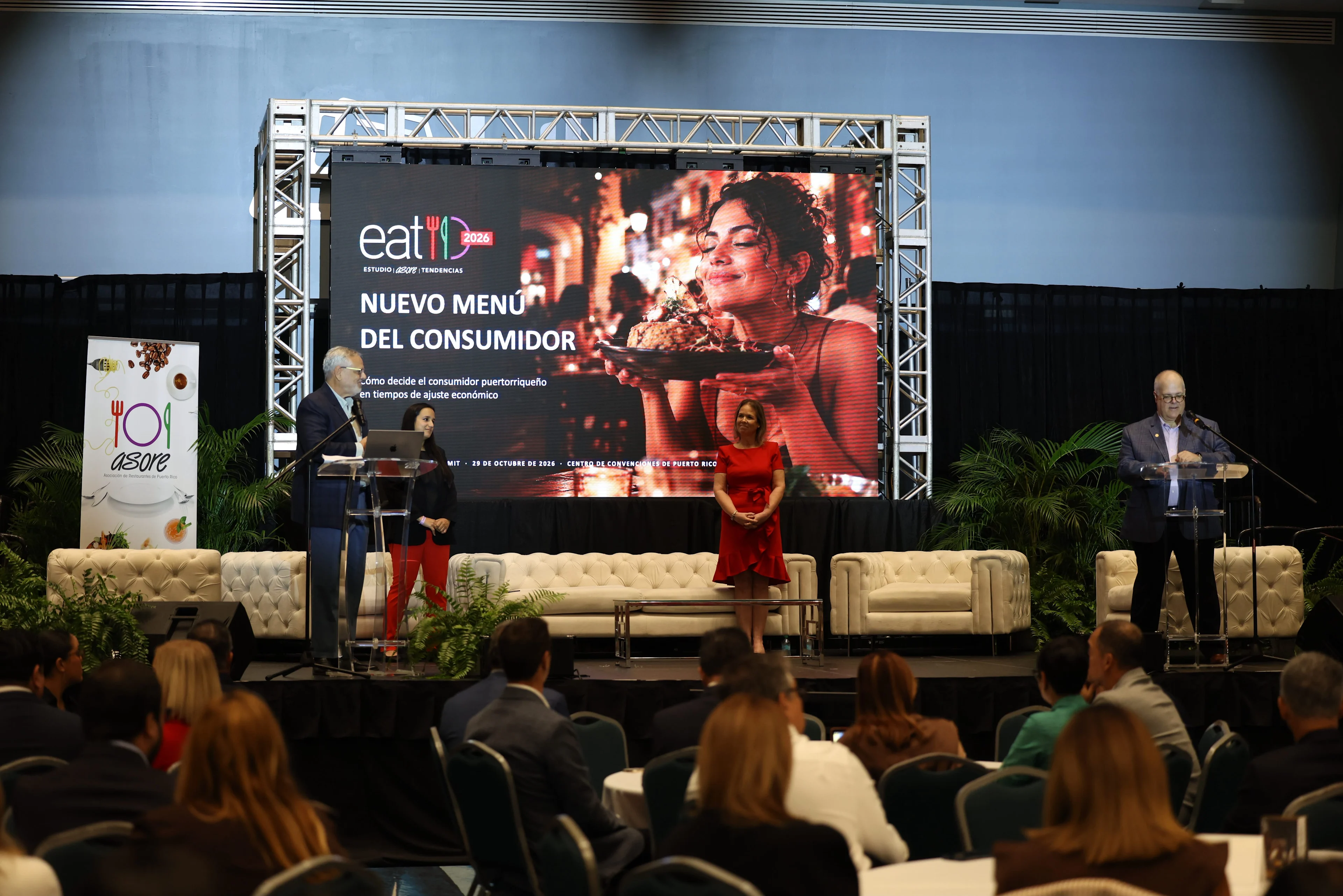
This is what the study "EAT 2026: Nuevo Menú del Consumidor" revealed. Developed by the Asociación de Restaurantes de Puerto Rico (ASORE) and produced by the firm Gaither, the study examines consumer habits, priorities and expectations around restaurants.
It was based on 1,023 surveys of adults ages 18 to 69, conducted between Aug. 14 and Sept. 25, 2026.
Why does it matter? The EAT study offers a clearer picture of how consumers think and what factors they weigh when going out to eat. It also presents options for restaurants to keep attracting diners by designing offerings that match their expectations and needs.
"The consumer is looking for consistent experiences that align with three factors: value, operational excellence and convenience," said economist Chantal Benet Arbona, vice president of Economic Intelligence and a member of the EAT Organizing Committee.
Now more than ever, restaurant offerings have to justify consumers' spending, the economist added.
Here is a summary of the EAT 2026 study results by segment and the opportunities they present for restaurants.
Consumers have not stopped going out, but every visit has to justify itself. Even with budgets tight, people want each meal out to be worth it.
The basics matter more than ever. From cleanliness and service to quality and value, these are the main factors driving their choices.
Convenience and trust are the new minimum expectations. If ordering, paying or receiving the food is complicated, the customer does not come back.
What does the consumer look for when going to a restaurant?
When choosing a restaurant, respondents said they prioritize:
Cleanliness - 96%
Staff friendliness - 96%
Food flavor - 95%
Ingredient quality - 93%
Value for money - 90%
Atmosphere - 90%
Speed of service - 84%
New dishes added regularly - 59%
"If I'm working harder to let go of every dollar because I'm tighter on money, the bar goes up. I'm going to demand more… When every dollar costs something, the experience has to be impeccable," said Felipe Flores, senior vice president of Marketing for Grupo Larrea, which operates five restaurant brands, and a member of the EAT Organizing Committee.
The results align with similar studies by the National Restaurant Association in the United States, where 96% of consumers also prioritize cleanliness, he added.
Opportunities for restaurants. For Flores, these results present several clear opportunities for restaurants: "Getting the basics right is what will win: cleanliness and good service."
He explained that restaurants can:
Monitor the visible experience and cleanliness, rather than competing on price alone.
Review staff behavior and consider offering training to improve service.
Protect the consistency, freshness and execution of the menu.
Communicate effectively about the quality of menu preparation, including highlighting the use of local and premium products.
This study lets us see that opportunities do not disappear when consumers adjust their spending. What can change are the conditions under which they decide to spend. For that reason, it is essential to know consumers better, design offerings that respond to different needs, communicate the value of your products, and take care of every detail of the experience.
Other consumer trends
🔎 Where they discover restaurants. 84% of consumers find places to eat through social media, 19% more than in 2025 (65%). That is followed by websites and search engines (53%, an increase of 26% compared to 2025) and local television (47%, a drop of 7%).
🧾 Preferred payment methods. 70% said they had used a debit card to pay for food, and 42% use it as their primary method. ATH Móvil was the second most used method (53%), followed by cash (48%), credit card (33%), Apple Pay (14%) and Google Pay (4%).
📔 Printed menus win out. 54% of respondents said they prefer a printed menu, while 40% are indifferent to whether the menu is printed or digital, and 4% prefer a QR code.
🥳 Looking for reasons to go out. 89% of respondents see going out to restaurants as an opportunity to socialize and share special occasions with family or friends.
😋 Eating out is still a pleasure. Although 80% of respondents said they could cut back on restaurant visits because of their finances, 70% said they enjoy going to a restaurant more than going to the supermarket, and another 70% consider eating out a better use of their free time than cooking. In addition, 58% consider restaurants essential in their lives.
🥗 Interest in healthier options is growing. 76% said they order healthier alternatives more than they did two years ago. This could be due to the rise in the use of weight-loss medications such as GLP-1s, said José Alfonso, executive director of The Research Office, the firm that conducted the EAT surveys from 2017 to 2025 and a member of the EAT organizing committee.
For Alfonso, the United States has seen a surge in menu changes driven by the use of GLP-1 medications, with diners seeking fewer carbohydrates, more protein and smaller portions. "We in Puerto Rico are still behind in addressing this," he said, but it could be an opportunity to "create menus that align with that population."
🥤 Takeout. 41% of respondents used delivery in the past month, while 32% do not use the service. However, 45% said they had used direct delivery from the restaurant, ahead of Uber Eats (44%) or DoorDash (34%). What they want is better packaging to keep food at the right temperature (88%) and for orders to arrive exactly as requested (87%).
Restaurants are a core part of life in Puerto Rico... But there is a tangle of emotions where the restaurant operator really has to buckle down to deliver what the consumer is looking for right now, which is more justification than ever before.
The favorites
Independent restaurants led preferences among casual dining options (37%). Local pizzerias dominated their category with 40%, ahead of other chains.
Perception of the economy and changes in restaurant spending
Economy and household spending. 92% of respondents rate Puerto Rico's economy as fair or poor, while 71% said their personal expenses are higher than a year ago.
Restaurant visits. 79% of respondents said they could reduce their restaurant visits given their financial situation.
Meanwhile, 45% regularly bring food prepared at home for lunch, and 87% consider that option more economical than buying food at a restaurant. Among those who bring lunch from home, 73% cite savings as their main reason.
Monthly restaurant spending. Average monthly spending at restaurants fell 11% from the previous survey to the current one, dropping from $633 per month in 2025 to $566 per month in 2026.
Respondents also reduced their visits to fast-food restaurants by 7% in the past month (from 93% in 2025 to 86% in 2026), going from an average of 7.6 visits per month last year to 5.7 visits per month this year.
Rising tabs. While average monthly spending at restaurants is falling, average checks across all restaurant categories increased:
Quick service (fast food): from $23 in 2025 to $26 in 2026
Casual: $49 in 2025 to $72 in 2026
Family: $54 in 2025 to $75 in 2026
Fine dining: $111 in 2025 to $119 in 2026
Chinchorros: $28 in 2025 to $41 in 2026
Other tabs: pizzerias $32, bakeries $18, cafeterias $17
This content was translated with the assistance of Artificial Intelligence (AI).