Reviewing menus, adjusting portions, and cutting offerings and hours are some of the measures that multiple restaurant and food business owners in Puerto Rico have had to take in response to power outages and rising electricity bills in 2026, according to several experts and businesses consulted by Platea.
While most are trying not to pass the cost on to their customers, some have had to raise their prices as well, and they are bracing for the October bill, which will be higher than the last one.
Why does it matter? This impact of rising bills and service interruptions is not limited to the roughly 4,900 restaurants in Puerto Rico; it extends to the entire food production and distribution chain, from farmers and fishermen to suppliers and consumers, pointed out Madelaine Vázquez, executive director of the Academia Puertorriqueña de Gastronomía (APUGA).
"Maybe that restaurant wasn't affected by the energy situation, but it is affected when its producer can't deliver the product because they lost it from having no power… So the whole chain is affected," Vázquez told Platea.
The impact we rarely see. All of this also goes beyond the economic; there is an emotional dimension that is sometimes overlooked, "the frustration and exhaustion this generates," Vázquez said.
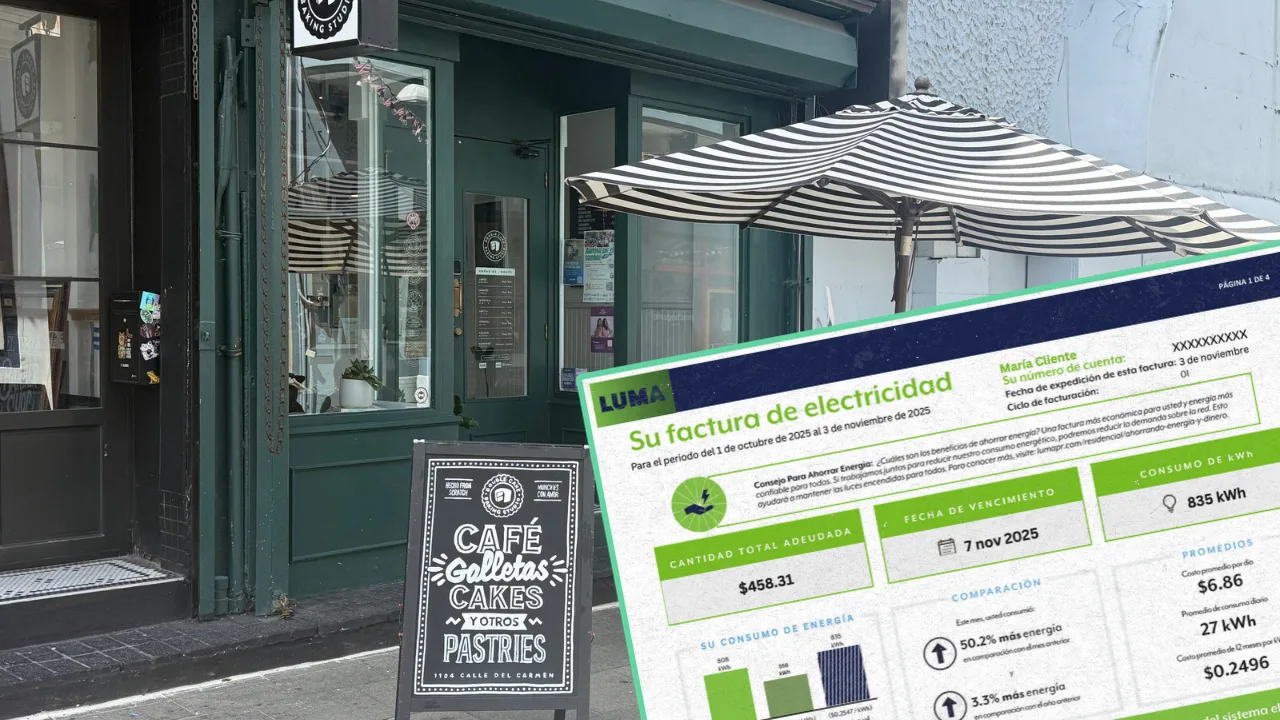
"I try not to let it affect me as much emotionally as before, because waking up in the morning to: Yare, there's no power, what do we do? It's really heavy," said Yaritza Lozano, owner of Double Cake in Río Piedras, in an interview with Platea.
How much have electricity costs risen for businesses?
That question has different answers.
The average cost per kilowatt-hour (kWh) for commercial customers increased 13% between January and September, from 26.20 to 29.62 cents per kWh, according to data provided by LUMA Energy to Platea.
During that period, however, there was a spike in June, when the average cost reached 34.84 cents per kWh, 33% more than in January and the third-highest monthly level since 1999.
This figure reflects the average cost per kWh for the commercial class, not the increase in each business's bill, which also depends on how much electricity it consumes.
Los comercios pagan 13% más por la luz que en enero
Así cambió en 2026 el costo promedio de cada kilovatio hora para casas, comercios e industrias, según datos de LUMA Energy.
Todos los datos
Centavos por kWh. Mientras más oscura la celda, más alto el costo.
Fuente: datos de LUMA Energy a Platea. Es el costo promedio por tipo de cliente, no el aumento en la factura de un negocio en particular.
This is how the average cost per kilowatt-hour (kWh) has changed in 2026, according to data provided by LUMA to Platea.
For the October-to-December quarter, the Negociado de Energía (NEPR) approved an adjustment that raises 17.1% the bills of small and midsize businesses, according to the Sept. 30 resolution. A small business consuming 1,200 kWh per month goes from paying $371.82 to $435.24.
The experience of restaurants and food businesses
An analysis by the Asociación de Restaurantes de Puerto Rico (ASORE) found that electricity costs for restaurants have risen between 40% and 45% during 2026, not counting the new October adjustment.
According to its president, Sonia Navarro, the sector started the year with an increase of roughly 20% and experienced another rise of around 20% to 25% in the middle of the year.
Navarro illustrated the impact with bills from establishments that previously ran between $13,000 and $15,000 a month and are now approaching $20,000, despite using more efficient equipment.
Other impacts. According to projections from the Centro Unido de Detallistas (CUD), rising electricity costs and unreliable service could lead to the closure of more than 12,000 small and midsize businesses, which would represent a potential loss of nearly 70,000 jobs.
We spoke with several business owners in the Río Piedras area to find out how they have adapted to service interruptions and whether they have seen an impact on their electricity bills.
1. Laura Pérez, owner of Mucho Gusto
Since 2020, when his ice cream shop Mucho Gusto was in Trujillo Alto and had not yet moved to the Del Carmen alley in Río Piedras, Pérez acquired a generator that has helped prevent inventory losses. However, he pointed out that "not having lost inventory doesn't mean we haven't had losses."
When service is interrupted, about six times a month on average according to Pérez, many businesses in Río Piedras close, which reduces foot traffic to the ice cream shop and, in turn, its sales. Outages can also interrupt ice cream production, forcing staff to repeat processes and driving up labor costs.
How much did his bill go up? Pérez gave the example that, if his bill used to run $900 to $1,000, he is now paying between $1,400 and $1,500. "The highest payment we've had recently is 55% higher," he said. On top of that, there is the money he spends on diesel for the generator when the power goes out.
"We end up paying to replace that fuel, and on top of that we're still paying for the service, and the bill comes out the same anyway," he said.
What steps has he taken?
He hired a maintenance service to keep his generator running.
He consolidated his inventory and production to keep fewer pieces of equipment running at once.
He recently raised his prices because he could no longer keep absorbing all the costs.
"It's a percentage that is not sustainable for us, first to keep absorbing as a business and second, to decide to pass on to the customer, because how much more can you pay for a scoop of ice cream or a pint of ice cream? There's a limit to that," Pérez said.
2. Kevin Ríos, supervisor at BOBET's Bakehouse
This artisan bakery and pastry shop has seen its electricity bill rise by "hundreds of dollars," Ríos said. Because it depends on power-hungry equipment such as ovens and griddles, both electricity costs and service interruptions pose a challenge.
"We have unfortunately had to raise our prices to cover the electricity costs," he said.
What steps have they taken?
Price adjustments.
They are exploring options to acquire a generator and a water cistern.
They have brought in new customers and are focused on offering more products during the high season, between Thanksgiving and Christmas.
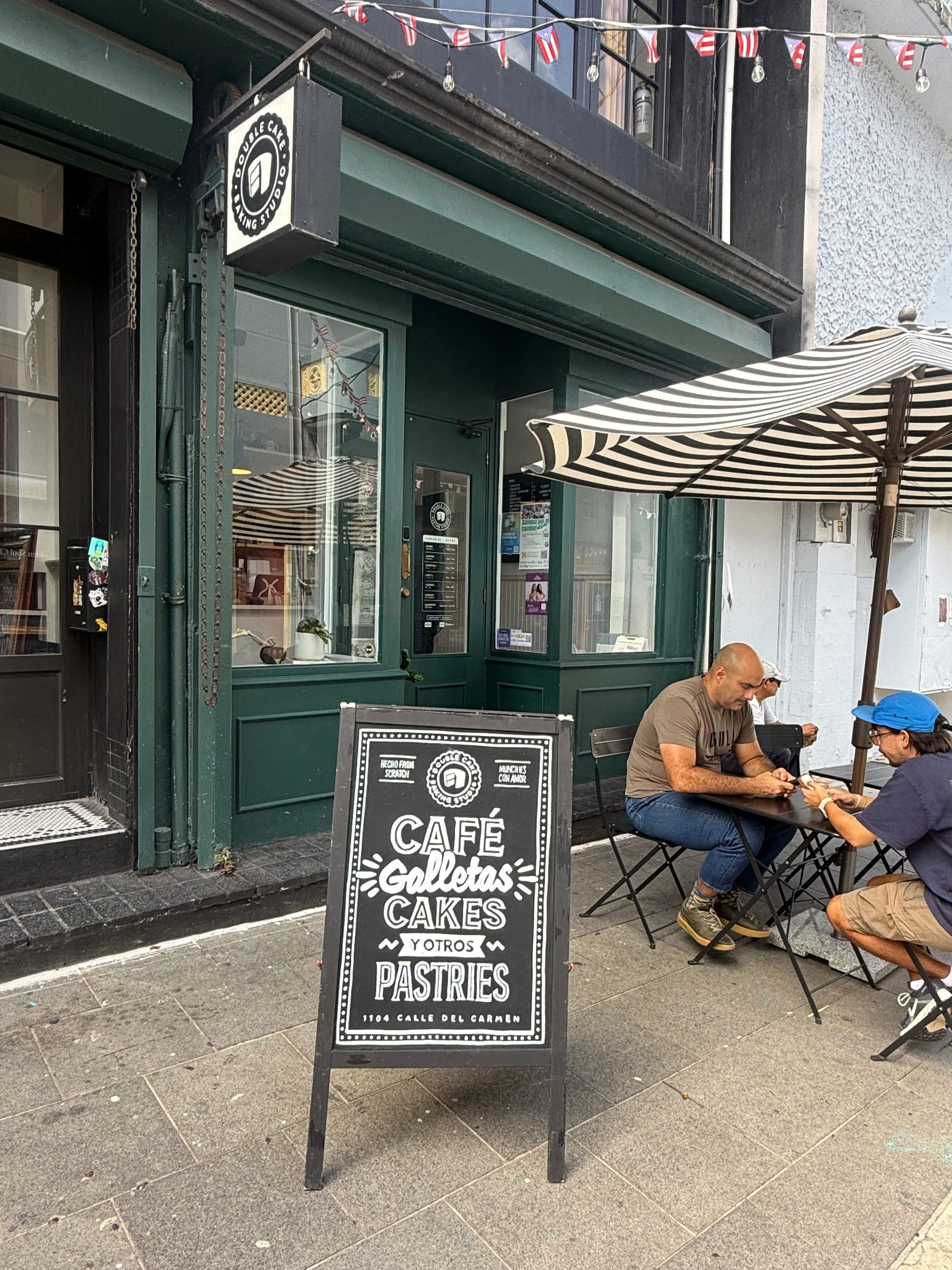
3. Yalitza Lozano, owner of Double Cake
Power outages at this pastry shop have forced them to halt production and close the business. That affects not only sales but also employees' schedules, Lozano said.
"Recently, we were getting quotes on equipment to have a little more resilience on the energy side, but those are things we can't afford right now," Lozano said. "(When the power goes out) we have to close, nothing gets made, nothing gets sold, and my employees are left without work."
What steps has she taken?
She reorganized work schedules.
She developed protocols for deciding how to respond during outages.
She is evaluating possible price increases.
She got quotes on backup equipment, but cannot yet afford it and does not have adequate space for some of it.
Sharing their experiences
Other business owners have used social media to point out the changes they have seen in their electricity bills.
From $4,000 to $24,000. Entrepreneur Sheilys Falcón, who owns restaurant franchises including Sabor Frappé, La Pachanga and Shanga Smash, used her TikTok account to report that the bill at one of her locations went from $4,000 to $24,000 a month.
From $600 to $3,900. Another business owner who raised the issue on social media was Cristian Rivera, owner of El Laboratorio Car Care in Bayamón. According to the interview he gave Telemundo, his monthly bill went from around $600 to nearly $4,000.
Other responses to electricity costs in the food industry
ASORE president Sonia Navarro pointed out that many restaurants have absorbed energy costs and have instead chosen other types of measures to reduce the impact on consumers or employees significantly. Among them:
Reducing menu offerings. "Maybe I had 50 dishes to choose from; now I have 30 and I specialize in what I do best so I don't lose product," Navarro said.
Adjustments to hours and staff. "I've seen restaurants taking on a large part of the costs at the operational level, opening hours, closing hours, adjustments in labor, in what is manpower," she said.
For her part, the executive director of APUGA warned that raising prices is not a simple solution either, since consumers face their own electricity and water bills, which can influence their decisions about going out to eat.
Seeking alternatives. Navarro noted that ASORE asked the Legislature months ago for a period of at least "24 months without increases" for the food industry, so that the economic impact of the rate hikes on different sectors could be assessed.
They also met with the Negociado de Energía to explore the possibility of energy credits or a moratorium on electricity rate increases. "The response we got was that we weren't necessarily going to see the increase, but that's not what happened. That was in the summer, and in September we ended the quarter with an additional 20%," she said.
In the meantime, the challenge for business owners is finding a balance between absorbing the increases, keeping their operations running and offering prices their customers can afford.
Energy solutions for small businesses
In response to the energy situation, the CUD convened the Encuentro Multisectorial: Soluciones Energéticas para las PyMEs with the goal of finding alternatives for this sector, beyond restaurants. Participants included ASORE, the Cámara de Comercio, Colmena66, FIDeCOOL, the Alianza Municipal de Servicios Integrados (AMSI), the Colegio de Contadores Públicos Autorizados de Puerto Rico and YESS!.
Here are some of the measures presented:
Eliminating "la crudita", as the crude oil tax is known, which under Law 1 of 2015 went from $9.25 to $15.50 per barrel of petroleum.
Evaluating the temporary use of government reserves to reduce electricity costs.
Identifying credit and incentive mechanisms for small businesses through available agencies and funds.
On infrastructure, evaluating the creation of additional fuel storage capacity, the renewal of the contract with AES and the diversification of energy generation sources, including maritime alternatives, modular nuclear energy and renewable sources.
The possibility of developing energy cooperatives through microgrids and of using landfill land for generation projects under cooperative models.
Promoting greater transparency in energy project contracts.
Conducting specific analyses on electricity demand and costs by economic sector.
Developing educational initiatives to help small businesses adopt better energy efficiency practices.
This crisis does not distinguish between sectors. It affects restaurants, retail businesses, service companies and family-owned businesses that support thousands of jobs in Puerto Rico. For that reason, organizations with different perspectives have joined forces to present alternatives and demand that this situation be addressed with the urgency it deserves.
The organizations are in the process of meeting with leaders of the Asamblea Legislativa, the Junta de Supervisión Fiscal and La Fortaleza, with the goal of presenting the proposed solutions and pursuing concrete actions that would drive a reduction in energy costs for the benefit of small businesses.
This content was translated with the assistance of Artificial Intelligence (AI).