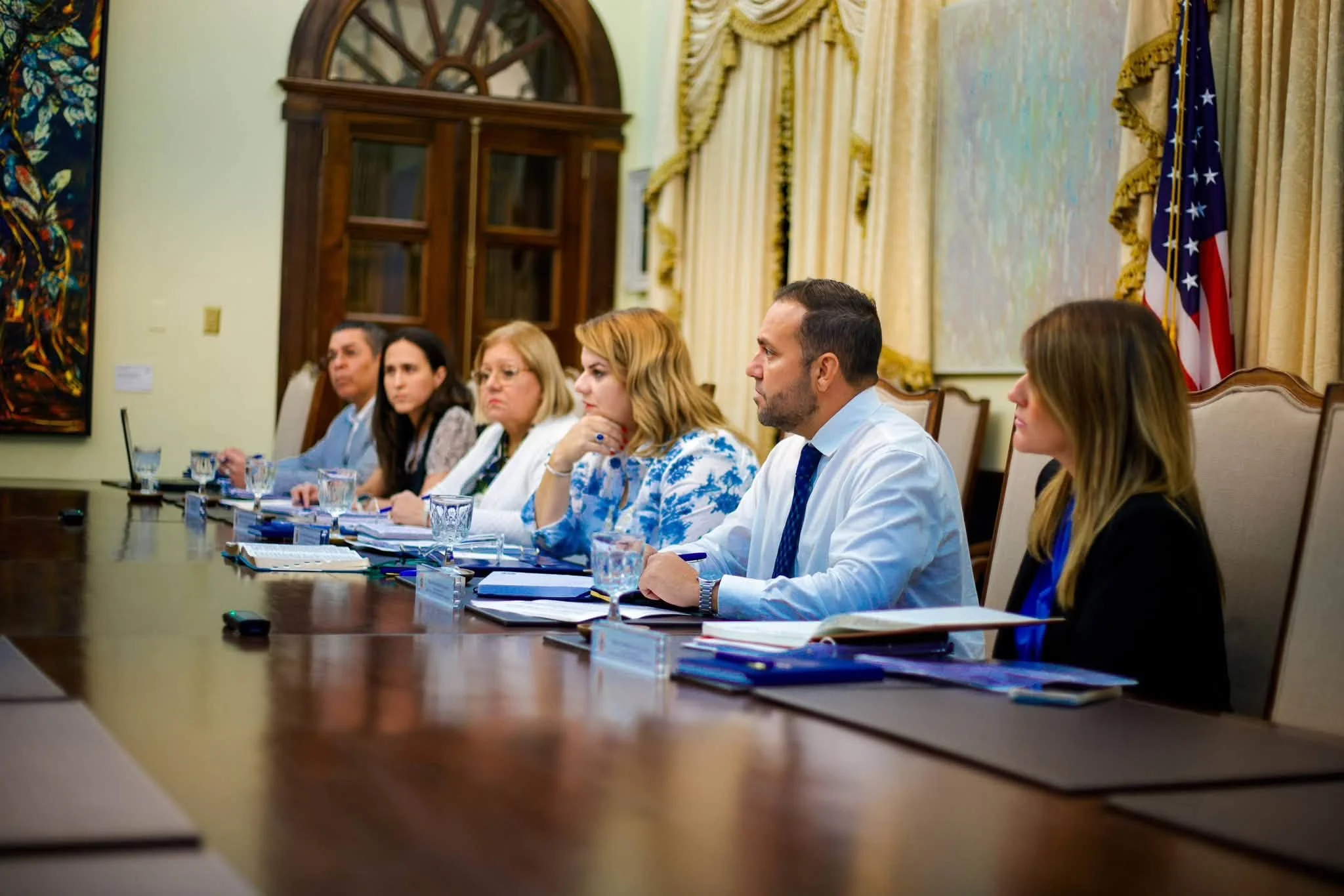
What's happening? Gov. Jenniffer González announced a series of measures aimed at providing relief to consumers and businesses facing higher electricity and fuel costs, including a new energy assistance program for small and midsize businesses (pymes) and a request for a temporary exemption from the Sales and Use Tax (IVU).
The government also introduced legislation to create a program to facilitate the installation of solar systems, batteries and electric vehicle charging stations at commercial properties.
Here is what the measures are and how they affect you.
IVU exemption on prepared food requested
The governor will submit to the JSF a request for a temporary IVU exemption on prepared food at restaurants and food establishments during November and December, coinciding with Thanksgiving and the holiday season.
Currently, prepared food at businesses certified by Hacienda pays a reduced IVU rate of 7%, but alcoholic and carbonated beverages, candy and baked goods pay the full IVU rate of 11.5%.
New federal funds announced to modernize energy infrastructure
The governor announced that the federal Department of Energy (DOE) allocated $6,338,082 to Puerto Rico as part of a new federal investment to modernize energy infrastructure, strengthen grid reliability and help reduce electricity costs.
The allocation is part of a DOE program called the Grid Resilience State and Tribal Formula Grant, directed at states, territories and tribes to make improvements to critical energy infrastructure, prevent service interruptions, improve grid performance and address growing electricity demand.
For pymes: New energy assistance program
The Department of Economic Development and Commerce (DDEC) identified $3 million for an energy assistance initiative that would benefit 1,000 pymes. It is one of the agency's efforts to promote energy efficiency and address high electricity costs.
As of now, the DDEC's website does not contain information on how to apply.
For pymes: Credit for government tenants in Guaynabo, Ponce and Mayagüez
The DDEC will also issue a credit to its tenants in Guaynabo, Ponce and Mayagüez for the increase in electricity costs. The credit covers the months of September and October.
Only businesses that rent buildings from the DDEC would benefit, so they should contact the agency directly to find out how the credit would work.
For businesses: Bill filed to facilitate installation of efficient equipment
The governor announced that she introduced an administration bill to create the Commercial Property Assessed Clean Energy (C-PACE) program, a financing mechanism that would make it easier for the commercial sector to install solar systems, batteries and electric vehicle charging stations.
The measure,House Bill 1377 or Senate Bill 1405, was introduced Aug. 19, according to the Sistema Único de Trámite Legislativo (SUTRA), and recreates a program of the same name that exists in more than 37 states, according to the bill's statement of motives. It is not a special government fund to install electrical systems.
How does it work? The C-PACE program would allow owners of commercial properties and other eligible properties to access low-cost, long-term private financing for permanent improvements, such as installing solar panels and batteries. Electric vehicle charging stations are not yet detailed in the bill.
Who lends the money? Private financial institutions, such as banks, that agree on the loan terms with the property owner.
How is it repaid? Through a voluntary special assessment on the property, established by contract with the municipality. The private lender would handle collecting payments, and the property would serve as collateral, all under oversight by the Autoridad de Alianzas Público Privadas (AAPP).
What is the benefit? Business owners could make improvements without having to pay the full upfront cost, with the potential to lower their electricity bills and strengthen their operations against outages and emergencies.
For families: Programa de Climatización de Hogares
For families, the administrator noted that the Programa de Climatización de Hogares (WAP) exists, for which the DDEC identified $18 million. Through it, appliances are replaced with lower-consumption equipment to improve the energy efficiency of participating homes.
So far, the program has reached 359 homes. In addition, 8,000 applications have been received, of which 5,000 have already been approved, according to officials.
How to apply? At the time this article was published, we found no active link on the DDEC website to apply online: https://www.desarrollo.pr.gov/programa-de-energia/wap. It only carried the notice: "The applicant applies to the Program through the link on the DDEC page on the dates established in DDEC Public Notices and print media."
Orientation date: next Friday, Oct. 30, at Plaza Las Américas, San Juan:
This content was translated with the assistance of Artificial Intelligence (AI).