From legal support to the creation of spaces for refuge and solidarity, various women and community leaders are taking up the defense of the migrant population to protect their rights.
,
Recent immigration policies put in place by U.S. President Donald Trump have generated fear and vulnerability among Puerto Rico's migrant population. In the middle of that uncertainty, pastor Nilka Marrero has transformed Iglesia Metodista San Pablo, in Barrio Obrero, into a sanctuary. There, the migrant community receives not only spiritual support but also access to food, legal advice, and a solidarity network prepared to protect those who have been marginalized.
"We provide everything from legal services to access to education for children. We created community dining programs, and every Tuesday we go to the Conservatorio de Música, where we have identified students who need us to overcome food insecurity. We offer workshops on both physical and mental health. This is what is called a focal point in the community, where everyone knows it exists and everyone is welcome," the pastor said.
Nilka Marrero, pastor of Iglesia Metodista San Pablo.
During the interview with La Península, several people came in to help themselves to cookies and coffee at breakfast, while exchanging comments and talking about their daily lives. That coming and going made the space feel welcoming and reflected the everyday interaction and sense of community that defines the place. "Don't leave, get your coffee," was one of the phrases that stood out most.
The church has built connections with the American Civil Liberties Union (ACLU) to provide attorneys who work on regularizing immigration status.
"We have made photocopies of their documents and given them copies to have as a backup in case the originals are lost. We are drawing up custody powers of attorney with the mothers, many of whom cannot work, so that there is someone here who can care for their children if they are arrested," Marrero said. "We are also working on the paperwork for the children's passports, so they can be reunited over there (in their home country) if that turns out to be the situation."
Pastor Marrero pointed out the cost and difficulties associated with these processes, since many of the migrant mothers are unemployed and face high expenses.
Nilka Marrero and a dining program volunteer preparing lunch for the community.
Some people do not dare leave their homes, so the church has also visited them to offer barbershop services. It has also paid for some people's mobile phones so they do not lose contact with their attorneys, and has formed alliances with Comuna Caribe and other organizations to respond to raids.
"This is a moment to raise a voice of protest. The sad thing about Puerto Rico is that we forgot that, at the beginning of the last century, our brothers from the Dominican Republic came here and we went there to work the sugarcane. And that fraternity and that love have been torn apart by people who do not understand that our Caribbean cultural and social context is different," Marrero pointed out.
"Obviously, I can give you the gospel message, but I will speak from the standpoint of the rights violations that we must keep denouncing. We women have right now this calling and the ability to move this world. If we are going to protect, we have to form those circles of love to simply create a barrier around those who are the poorest and most unprotected," she said.
A teacher who answers that calling through education
María Cruz Alicea has dedicated her life to teaching English. After her teaching career with the Departamento de Educación, she moved from Caguas to San Juan in 1992 and watched her students change: many of her new pupils were children of immigrants. In 2016, she decided to offer tutoring outside her working hours to strengthen the English of young people and adults.
"I have helped people from the Dominican Republic, which is the largest population, but also from China, Argentina, Venezuela, Colombia, Peru, Ecuador, Brazil, Mexico, Panama, and others. I help them become aware of how important it is to obtain citizenship, because that way we can strengthen their rights and not limit their opportunities for study and work," Alicea said.
Now retired, Alicea continues to teach migrants at Casa Dominicana, also in Barrio Obrero. Like Alicea, various organizations led mainly by women have supported the migrant population in Santurce for years.
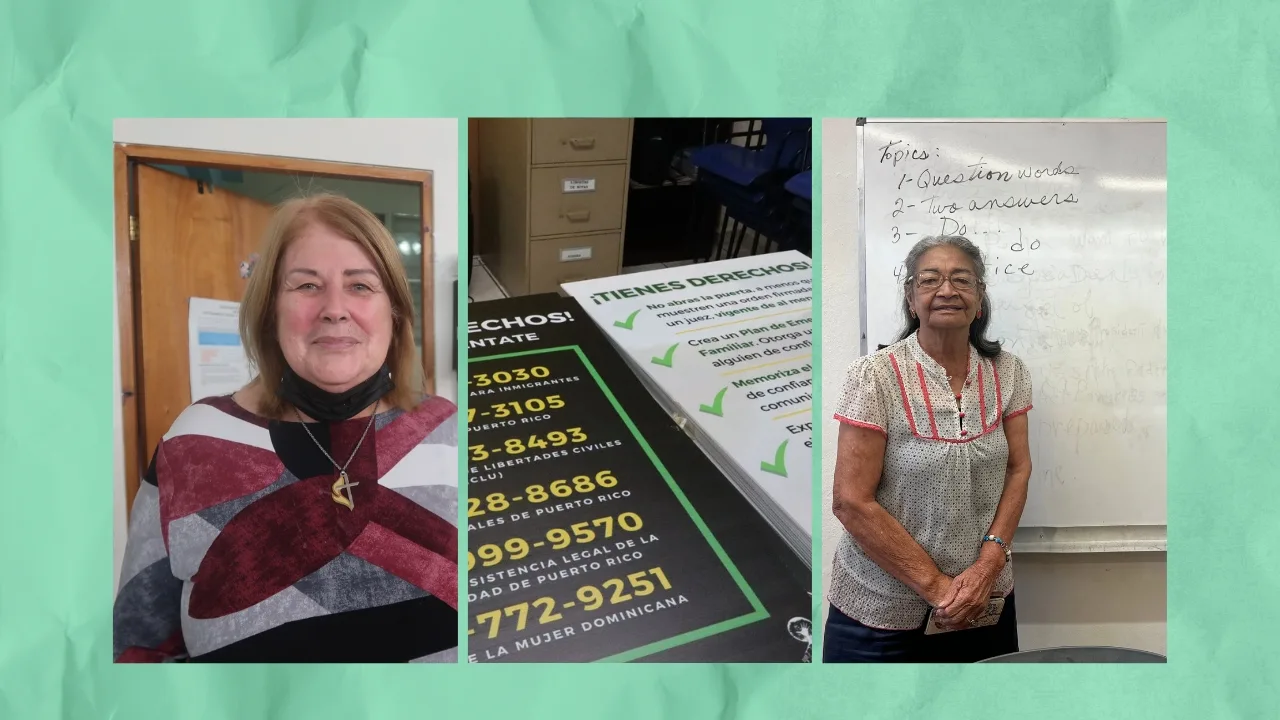
Professor María S. Cruz Alicea of Casa Dominicana.
On Jan. 26, officers from Immigration and Customs Enforcement (ICE) carried out the first operation in Barrio Obrero, one of the Santurce sub-barrios with the largest immigrant population, with the goal of deporting undocumented people. After that, efforts needed to be stepped up.
One initiative came from the Junta Comunitaria del G-8, a nonprofit that brings together community leaders from the neighborhoods around Caño Martín Peña and is led by Lucy Cruz Rivera. The G-8 distributed bulletins and created informational posters, which they placed in public spaces to inform migrants of their rights in the event of a detention.
Posters created by the G8. Photo provided by Diego Vega Martínez.
This content was translated with the assistance of Artificial Intelligence (AI).