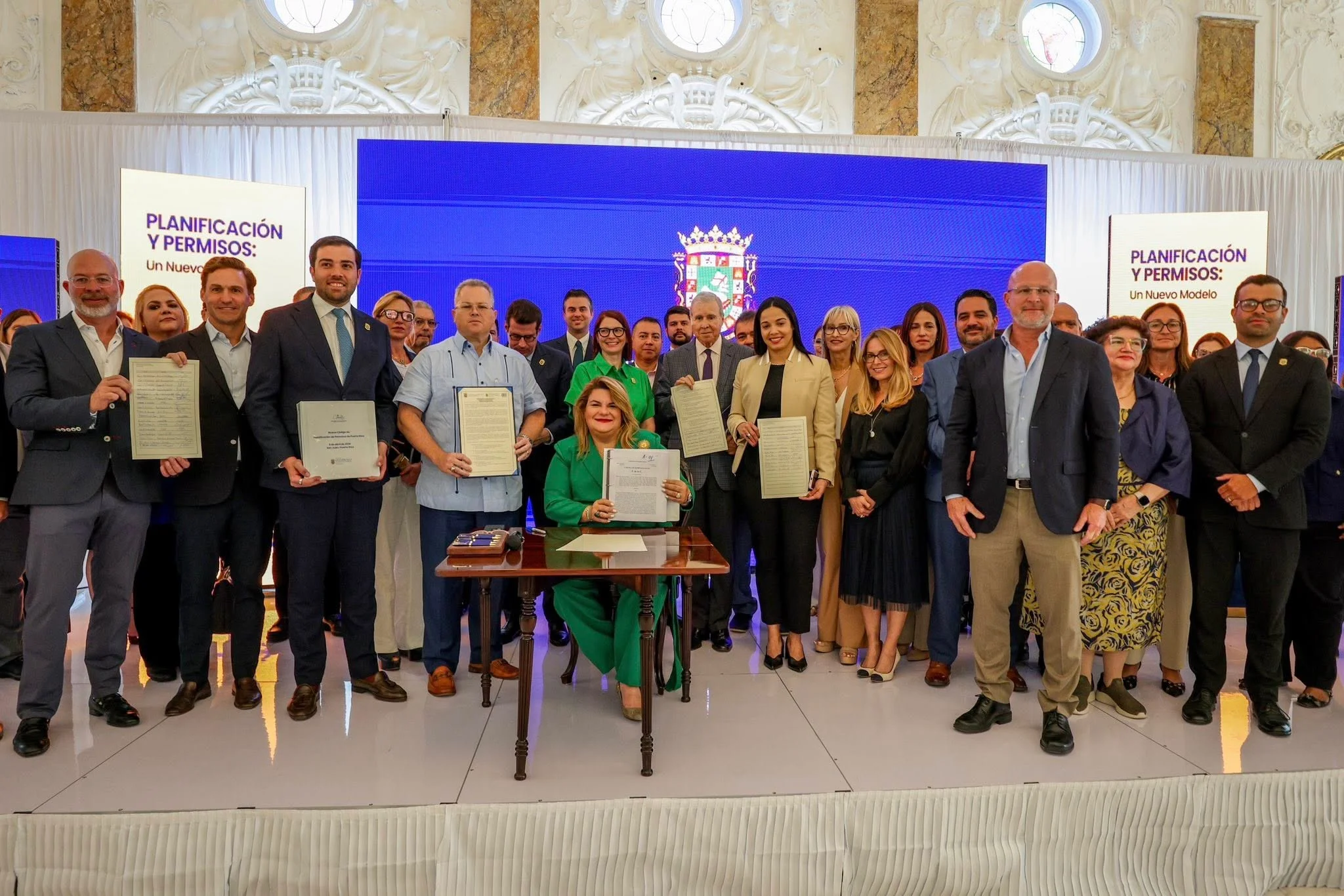
What's happening? After more than 13 months of evaluation and development with the private sector, the government presented a new Planning and Permits Code on Wednesday, a 819-page document filed with the Legislature that proposes consolidating 72 laws under a single regulatory framework, repealing 14 statutes, amending 29 and harmonizing another 29 special laws.
Why does it matter? Difficulties with the permitting system are among the most recurring complaints from business owners and developers in Puerto Rico.
The diagnosis presented in December by the Working Group, created after the signing of OE-2025-002, confirmed a system paralyzed by a legal framework fragmented across nearly a hundred instruments, including 45 different laws, and described it as "extremely slow, burdensome and inefficient."
What changes does the Code propose?
A single permit-issuing agency. The current Oficina de Gerencia de Permisos (OGPe) would become the Oficina Central de Permisos (OCP) and would be the only entity authorized to issue permits and licenses in the Government of Puerto Rico.
Transformation of the Junta de Planificación. The Junta de Planificación would be renamed the Junta de Planificación y Urbanismo, with an exclusive focus on land-use planning and public policy.
A single regulation. The Code calls for the creation of a Reglamento Único that would consolidate all permit requirements into a single regulatory body, with indefinite validity and periodic partial revisions.
Special categories. Categories such as the Proyecto de Impacto Socioeconómico Prioritario would be created, aimed at critical infrastructure, energy, housing, tourism and federally funded projects, with an expedited review process.
Permiso Único Automático. This mechanism would be established for low-risk small and midsize businesses, and the Permiso Único Incidental would be consolidated within the Construction Permit to avoid delays after the main approval.
The impact on small business owners
The centralization of procedures proposed under the new code would allow compliance with the established deadlines for processing applications:
if the application is certified by a licensed professional and meets all requirements, a response would arrive within two business days;
without that certification, the deadline rises to 30 days;
and if the case requires a more in-depth review, variances or a public hearing, between 120 and 180 days.
At a press conference with Sebastián Negrón, secretary of the Departamento de Desarrollo Económico (DDEC), and Verónica Ferraiuoli, government efficiency coordinator, the governor cited the case of a business owner who spent 440 days and 14 transactions across five different agencies to open an ice cream franchise, and another permitting case involving a house destroyed by Hurricane María that took 577 days.
If the government does not respond on time, the applicant can escalate the case to an appeals board or go to court.
Florida and Texas as models
The permitting models in Texas and Florida served as the basis for the Code's proposals.
"Texas for land-use planning and Florida in terms of economic development," the governor said at a press conference with Sebastián Negrón, secretary of the Departamento de Desarrollo Económico (DDEC), and Verónica Ferraiuoli, government efficiency coordinator.
What happens now? The Code has already been filed as Proyecto de Administración 114, and now moves to the Legislature for review. The Legislature already has 19 bills before it to reform the permitting system.
González Colón expressed her hope that the proposal be approved before the close of the legislative session on June 30, to open the way for the development of regulations and for "this same year it takes effect." For his part, Negrón pointed out that the effective implementation of the new system could take up to a year.
The presentation of the Code had the preliminary support of:
Centro Unido de Detallistas.
Cámara de Comercio
Colegio de Ingenieros y Agrimensores
Asociación de Constructores de Puerto Rico
Asociación de Industriales de Puerto Rico
This content was translated with the assistance of Artificial Intelligence (AI).