Puerto Rico reached 5,019 restaurants and food establishments in 2026, a 25% increase since 2020. The industry generates more than 73,000 jobs, 40% more than six years ago.
That growth coexists with profitability challenges: 35% of owners surveyed are considering closing at least one of their locations between 2026 and 2027, given rising operating costs, shrinking margins and fewer customers.
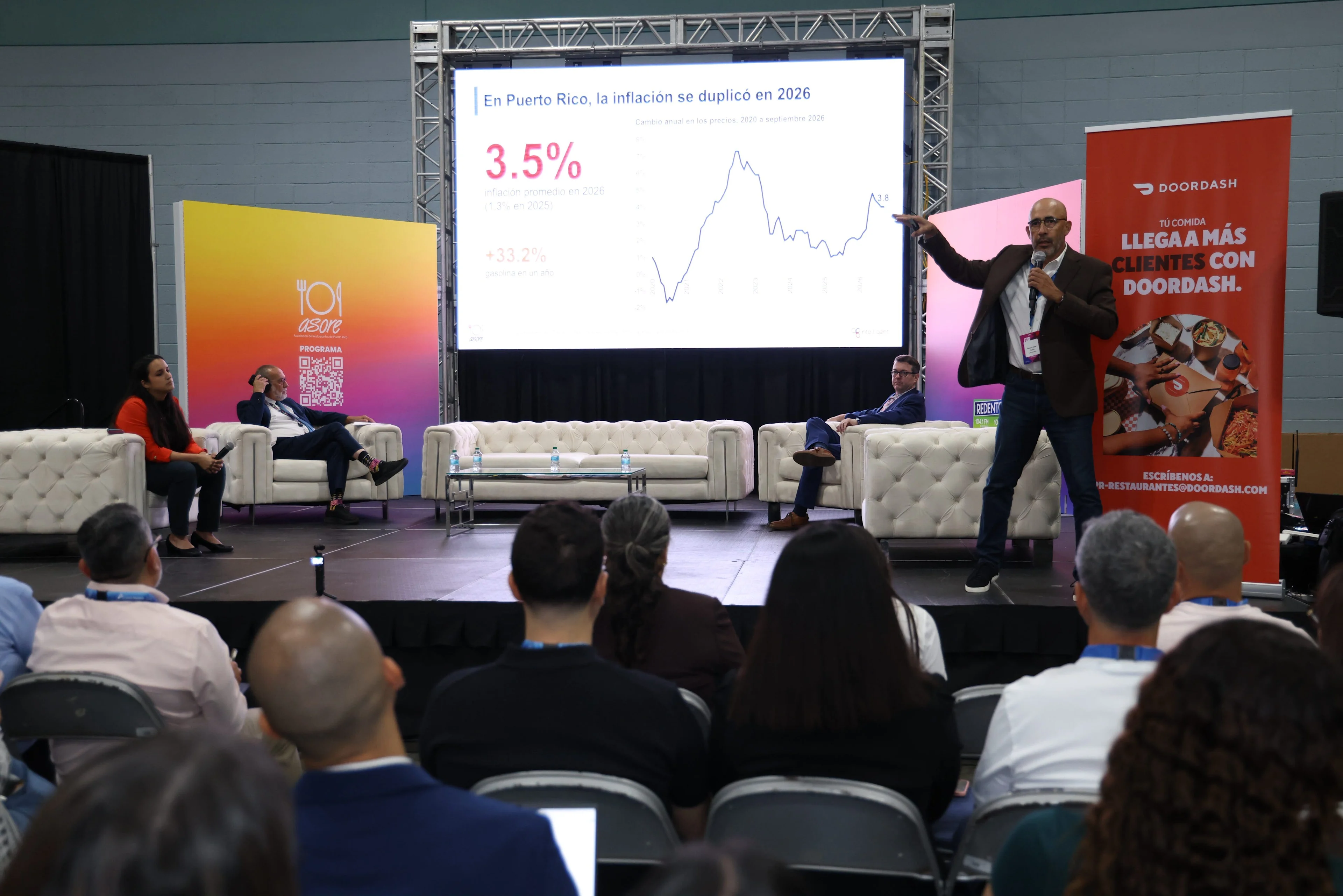
The data come from the study Proyecciones 2026, commissioned by the Asociación de Restaurantes (ASORE) and prepared by the firm Inteligencia Económica, based on surveys of representatives from 898 establishments conducted between Sept. 15 and Oct. 14.
Why does it matter? The growth in establishments and jobs since 2020 shows the industry's contribution, while the survey results help explain the adjustments businesses need to stay viable. Some 95.7% of respondents reported higher operating costs than in 2025, and 57.4% saw fewer customers.
ASORE president Sonia Navarro anticipated that restaurants may prioritize diversifying their revenue through delivery services, catering, special events and lunch offerings, with less emphasis on opening new locations.
"You're going to see fewer expansions, less knocking down walls, but more opening of channels," said ASORE president Sonia Navarro, during the presentation of the study at the ASORE Restaurant Show in San Juan.
Jobs and sales in the restaurant industry
Jobs. The restaurant industry generates approximately 73,309 jobs in 2026, 40.8% more than in 2020, equivalent to 21,255 additional jobs. Compared with 2025, employment fell 0.9%.
The industry's activity also supports 36,700 indirect and induced jobs. Adding those to direct employment, its total impact is around 110,000 jobs in Puerto Rico.
Higher wages. The average wage in the industry rose 4.9% between 2024 and 2025. During that period, the average for chefs went from $35,780 to $41,480; for bartenders, from $24,910 to $28,160; for servers, from $27,940 to $29,690; and for fast-food cooks, from $21,500 to $25,130.
Chantal Benet Arbona, vice president of Inteligencia Económica, attributed the wage increase to the implementation of the minimum wage increase in 2024. For his part, Gustavo Vélez pointed out that the statewide wage rose, on average, to $16 per hour.
Sales up. Restaurant sales increased from $340 million in January to $379 million in July. However, sales volume and customer traffic did not rise; what increased was "nominal sales," Benet Arbona explained, also pointing out a 3.3% increase in the price of food away from home.
Open new sales channels.
Offer shorter, more specialized menus.
Adjust operating hours.
Develop lunch offerings.
Special menus for those seeking healthy alternatives or smaller portions (in response to the rise in GLP-1 medication use).
Seasonal special events to attract customers.
Offer seasonal catering services.
What restaurant owners are saying
The Proyecciones 2026 study captures owners' perceptions of the economy, based on the interviews and not necessarily on each restaurant's specific data.
Interest in more local product. All participating restaurants indicated they use some local product, and 40% expressed interest in increasing their use of it. Some 76.1% noted that local product accounts for less than 12% of what they use.
The main barriers to increasing the use of local product are availability (73.8%) and price (64.3%).
Fast foods sell more. Some 70% of quick-service restaurants (fast foods) said they sold more than in 2025, the only segment that saw increases. Fine dining restaurants showed the steepest decline, with 80% reporting lower sales.
Fewer sales. Some 46.8% of respondents said they sold less in the first half of 2026 than in the second half of 2025, the highest figure since the survey began in 2020. However, 38% said they sold more, and another 15% said they saw no change.
Customer traffic. A total of 57.4% of restaurants said they received fewer diners than in 2025, attributing this to lower foot traffic (72.7%), higher menu prices (54.5%) and more competition (36.4%).
Profit margins. The share of surveyed restaurants reporting profit margins below 8% fell from 77% in the second half of 2025 to 66% in the current survey. Even with that decline, roughly two in three participants still operate below that threshold, which is considered low in the industry. A total of 17% of respondents said they are operating at a loss.
Costs. A total of 95.7% have higher costs than in 2025, and 46.8% have costs that are more than 10% higher. Water has emerged as a new pressure point amid the drought, appearing in the top 3 for 29.8% of respondents.
Electricity, the biggest cost. A total of 51.1% of respondents said electricity is their greatest cost pressure. Food came next, cited by 19%; labor, by 12.8%; and taxes, by 8.5%.
Jobs. A total of 72.1% of respondents have open positions, while 52.2% have reduced staff or frozen hiring. Benet Arbona pointed out that most have low staff turnover.
Lower alcohol sales. A total of 36.1% of respondents reported a drop in alcohol sales. Reasons cited include less disposable income (67.6%) and lower consumption among young people (41.2%).
Distributors. A total of 40% of distributors reported higher sales, the lowest share since 2023. A total of 60% said they have not passed on a fuel surcharge, despite rising costs and a fleet that costs them 10% more. A total of 40% raised their minimum order cost.
A total of 60% of distributors cut costs to attract customers, and electricity is among their main expenses.
The debt is "half" of what it was in 2016, when the Fiscal Oversight and Management Board (JSF) arrived and "the debt could not be paid."
"Employment is at its highest level, unemployment has fallen to historic lows. The labor participation rate has increased."
"Tourism has doubled: from 3 million we are close to 7 million tourists."
Vélez closed with a projection that depends on external and internal factors: "My hypothesis is that if the war ends and oil prices fall, if tariffs stabilize and internally we can implement an agenda addressing the issues that affect the merchants' economy, this will get back on track. And this supported by the nearly $40 billion that are parked to finance reconstruction."
External factors to watch: the conflict with Iran and the price of oil; tariffs; higher interest rates; and cuts to federal funds.
Internal factors to watch: the cost of electricity; the cost of living; adjustments in consumer spending; and operational and payroll costs.
This content was translated with the assistance of Artificial Intelligence (AI).