What's happening? The North Coast aqueduct system was activated in the early hours of Friday and tank filling has begun, following repairs carried out on the system this week after a breakdown in the Manatí area last Sunday, said Luis Reinaldo González Delgado, president of the Autoridad de Acueductos y Alcantarillados (AAA).
The emergency prompted the deployment of multiple water distribution points across the 16 affected municipalities, as well as the activation of the National Guard on Wednesday to assist with both the repairs and the distribution of water to the 190,000 customers served by the system.
"Throughout today we have been filling the tanks gradually, in order to avoid pressure surges that could cause additional damage to the lines. We understand that having water service is what our people want most, so we are working with the urgency the situation requires, while also ensuring a controlled and safe restoration of drinking water service."
Luis González Delgado, executive president of the AAA, in a statement on October 24
Why does it matter? This means that, starting Friday afternoon, water service should be gradually restored to the 16 municipalities in the north and center of the island that have experienced interruptions or outages since last Sunday and have been drawing on water distribution points set up across the country.
The first municipalities to have water will be Arecibo, Manatí, Hatillo and Barceloneta, the official said, as they are closest to the start of the aqueduct. For the remaining municipalities (Vega Alta, Dorado, Morovis, Vega Baja, Caguas, Gurabo, Juncos, San Juan, Trujillo Alto, Carolina, Loíza, Bayamón and Guaynabo), restoration of service could take longer.
The water distribution points will remain available until drinking water service is fully restored in the affected municipalities, the AAA said.
⏱️ 48 to 76 hours estimated repair time
👷 200+ employees in crews working around the clock
🚱 16 municipalities affected
👪 190,000 customers with service interruptions (representing more than 1 million people)
🏗️ 4th break in 25 years in this system
💰 $250,000 in initial repair costs
⌛ 25 years is the approximate age of this system, which is designed to last about 50 years
What caused the breakdown and how were repairs carried out?
The AAA reported that the breakdown was caused by a rupture in a 72-inch-diameter aqueduct line, a water transmission and treatment system that serves approximately 1.6 million people across a stretch of municipalities running from Arecibo to Juncos.
The rupture was caused by an air bubble that became trapped in the pipe due to changes in water pressure and, with no way to escape, broke it at a curved section.
Possible cause. "We are linking it to an event involving a loss of electrical service provided by LUMA at the raw water intake on Monday, October 13, a holiday. We were out of operation at that raw water intake for several hours. That throws the system off balance. When power returns and we start pumping, it can cause fluctuations in pressure, and if there is a weak point, as there was in this case at that curve, the rupture occurs," the AAA's executive president told Telemundo.
Repairs. The breakdown occurred on Sunday, but it was not until Tuesday morning that repair work began with the "drying" of the pipe, a process that involves stopping the flow of water to excavate, assess what happened and determine the repairs needed. The estimated work time was 48 to 76 hours from the start of drying.
On Tuesday night, a decision was made to temporarily shut off the flow of water (from the Planta Antonio Santiago Vázquez), and repairs began in the early hours of Wednesday.
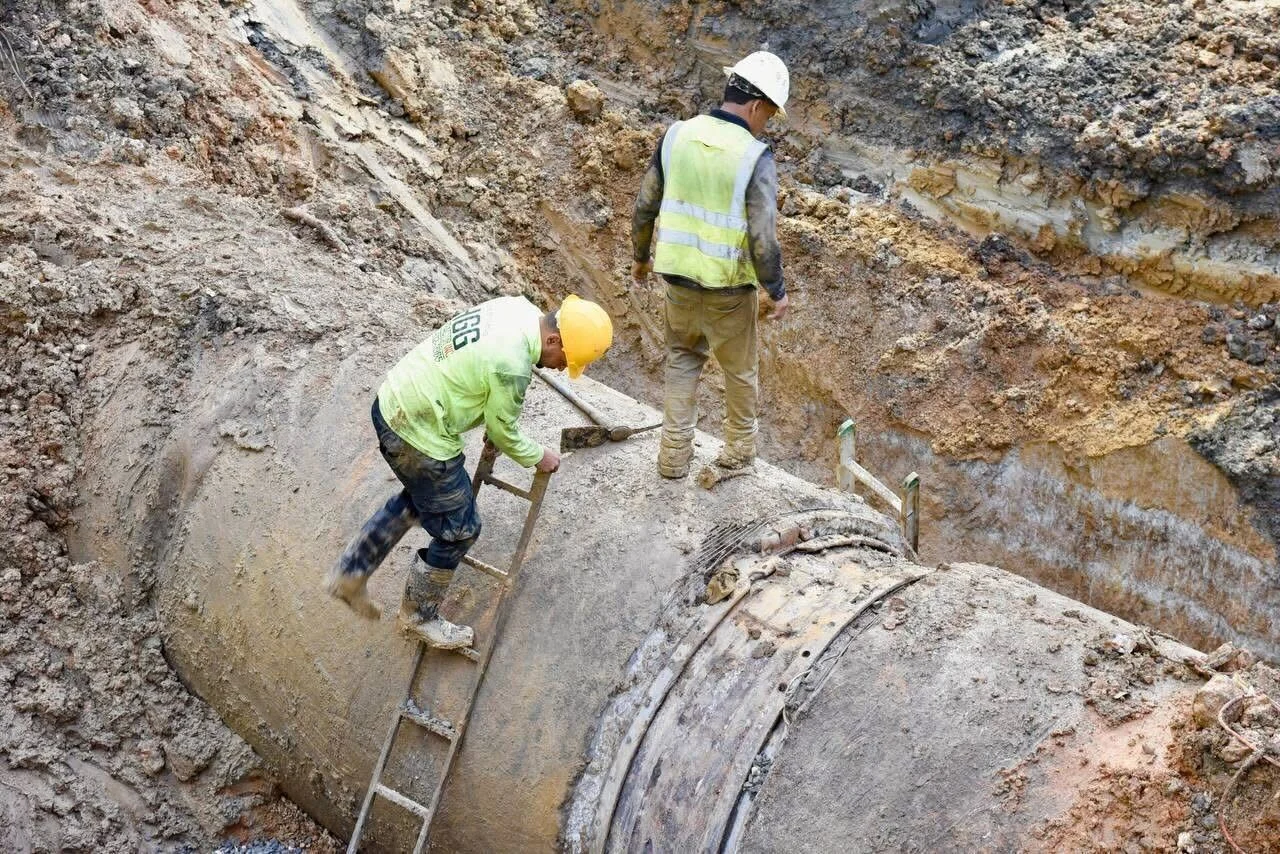
"What is being done involves a break in the metal portion of the rings of the supertube. So all the concrete covering part of that metal ring has to be broken away in order to weld it." Gov. Jenniffer González explained on Wednesday, after visiting the work site in Manatí.
Repairs to the North Coast aqueduct
The break in the Costa Norte aqueduct, which runs from Arecibo to Juncos, is the fourth to occur in 25 years, the government said. See some images of the repair process provided by the AAA.
Between Wednesday and Thursday, "crews worked on welding the pipe all the way around, including the bottom section, considered the most complex part of the process because of its depth and technical conditions. In addition, the structure was reinforced to strengthen the line and prevent future breaks in this stretch of the system," the AAA said.
The area was then sealed with concrete to stabilize the ground and protect the repair, a step that was completed Friday morning.
AAA staff then supervised the process of filling the distribution tanks, an essential step before water could be sent through the main network.
Cost will not be passed on to customers
The governor assured that the cost of repairs will not be passed on to subscribers, though she acknowledged that "this fix costs a lot of money." She said that, at the time, the estimated expenditure was $250,000, "but we have to account for everything until the end of the road."
"There was nothing strange here, there was an explosion, a break in one of these pipes. It is not going to be passed on to the customer. On the contrary, all the resources we need to invest are being invested so that water can be restored to people as soon as possible," said González, who insisted that the break "was not predictable."
On top of the repairs, additional crews were activated around the clock all week, an outside company was hired to assist in the process, and oases were organized in the 16 municipalities.
Available oases
Because of the emergency, the AAA began an interagency coordination effort that includes communication with the Municipal Emergency Management Offices (OMME) to establish oasis points where residents can go if they experience outages. It was reported that 108 tanker trucks were distributed across the affected towns, in addition to municipal initiatives to address the situation.
See the oases available as reported by the AAA, municipalities and government:
OMME de Barceloneta: 8 trucks
OMME de Carolina: 6 trucks
OMME de Ciales: 2 trucks
OMME de Dorado: 9 trucks
OMME de Loíza: 2 trucks
OMME de Manatí: 9 trucks
OMME de Morovis: 1 truck
OMME de Vega Alta: 8 trucks
OMME de Vega Baja: 8 trucks
Bayamón:
On PR-829 sector Collores Santa Olaya (AAA)
On PR-2 marginal de Hato Tejas (AAA)
Carr 174, across from Urb. San Agustín.
Carr. 829, km 10.3, Sector Collores, next to the Nuestra Señora de la Monserrate church.
Carr. 830, km 4.9, at the Gallera Cerro Gordo next to the García sector.
Carr. 174, km 10.7, next to the Cuartel Municipal La Morenita.
Carr. 174 km 11.2, sector Los Atanasio, (former Guaraguao Auto Parts)
Reparto Valencia, Ave. Orquídea, across from the El Diamante cafeteria.
Carr. 872, between Hogar CREA and Laboratorio Teresita.
Carr. 864, across from the baseball park and the Virgilio Dávila school.
Carr 862, km 2.6, Urb. Victoria Heights.
In the parking lot of the Coliseo Rubén Rodriguez next to the northern aquifer.
Caguas:
Across from the Ciudad Jardín development
San José development, at the entrance
San Antonio barrio community center
La Barra sector, next to the pump station
Centro de Bellas Artes de Caguas
San Pedro development, Río Cañas barrio
Guaynabo:
On PR-835 expressway, end of Mamey, La Ceiba parking lot
On PR-842, intersection with Camino Los Romeros, Caimito
On PR-834, across from Juanillo Fuentes school, Bo. Santa Rosa
On PR-833, at the Petra Collazo multiple services center, Camino del Parque
OMME: 8 trucks
Gurabo:
Trampolín Park shopping center, barrio Navarro
Urbanización Veredas en Barrio Navarro
Urbanización Reina de los Ángeles and urbanización Santa Bárbara
Baseball field in Barrio Jaguas
Sector La Agrícola
Sector Villa Marina
Juncos:
Residencial Narciso Barrona
Former Roberto Silva Morales school
Pedro Rivera Molina school, barrio Valenciano
Urbanización Portales de Juncos
Parking lot at Mariano Meaux park
Residencial Antulio López
Barrio Los Lirios, former El Flamboyán location crossroads
Manatí:
Barrio Laguna (park)
Barrio Boquillas (across from urbanización Brisas de Mar Chiquita and services office)
Barrio Polvorín (Head Start)
Barrio Cantito (Parcelas La Luisa, services offices and sector La Esperanza across from the beach gate)
Barrio Tierras Nuevas (Cruz Rosa Rivas school foundation)
Acrópolis
Urbanización Mónaco III (court)
Barrio Pugnado (court and services office)
Villa Amalia (court)
Barrio Palo Alto (lot at km 1.08)
Parcelas Márquez (services office)
Urbanización Luchetti (park)
Barrio Campo Alegre (library)
Barrio Guayaney (park)
Juan A. Sánchez Dávila school
Cantera (Head Start)
San Juan:
Eduardo Conde Street at San Jorge
Monteflores condominium, Violeta and Del Valle streets
San Jorge Avenue across from San Mateo church
Borinquén Avenue across from plaza Barceló, barrio Obrero
Olimpo Street at Miramar Street
Loíza Street at Las Américas, across from Barbosa park
Miramar at the end of Fernández Juncos Avenue
Ponce de León Avenue across from the Centro de Bellas Artes de Santurce
Borinquén Avenue at Rexach Avenue
Francia Street at Guayama Street in Hato Rey
Eduardo Conde Avenue, entrance to residencial Las Margaritas
Roberto H. Todd Avenue at Fernández Juncos Avenue
Across from residencial Luis Llorens Torres
Cervantes Street in Condado
Magdalena Avenue in Condado
Miramar Housing for Elderly
700 Miramar
Residencial San Agustín - Old San Juan
Across from Plaza Colón - Old San Juan
Across from La Perla entrance - Old San Juan
Plaza del Quinto Centenario across from the Totem - Old San Juan
El Capitolio - Old San Juan
Norzagaray Street - Old San Juan
OMME Puerto Nuevo: 2 trucks
Toa Baja:
PR-2 highway, barrio Candelario service road
Urbanización Altagracia
PR-863 highway, barrio Pájaros
This content was translated with the assistance of Artificial Intelligence (AI).