Every pothole on our roads tells a story; Janice Quevedo turns them into mirrors that invite us to look at ourselves directly.
For Puerto Ricans, the phrase "mancha de plátano" is deeply familiar. It is a symbol of Puerto Rican identity that runs close to the surface in our blood, culture and way of life.
Architect and designer Janice Quevedo has given physical form to her interpretation of this invisible mark through two distinct art series: Boquetes (2021) and Mancha de plátano (2025).
Both collections, produced under her label Estudio Santos, a name that honors her maternal surname, use hand-cut recycled mirrors, but each tells a different story about the Puerto Rican experience.
Two series, two views of Puerto Rico
Boquetes (2021): The first series grew out of an everyday observation. In the irregular shapes a tire makes when it hits a pothole, the ku-dún of each impact, Quevedo found unique forms worth documenting.
Through these mirrors cut in the shape of potholes, the designer invites reflection on how urban decay has become normalized in daily life.
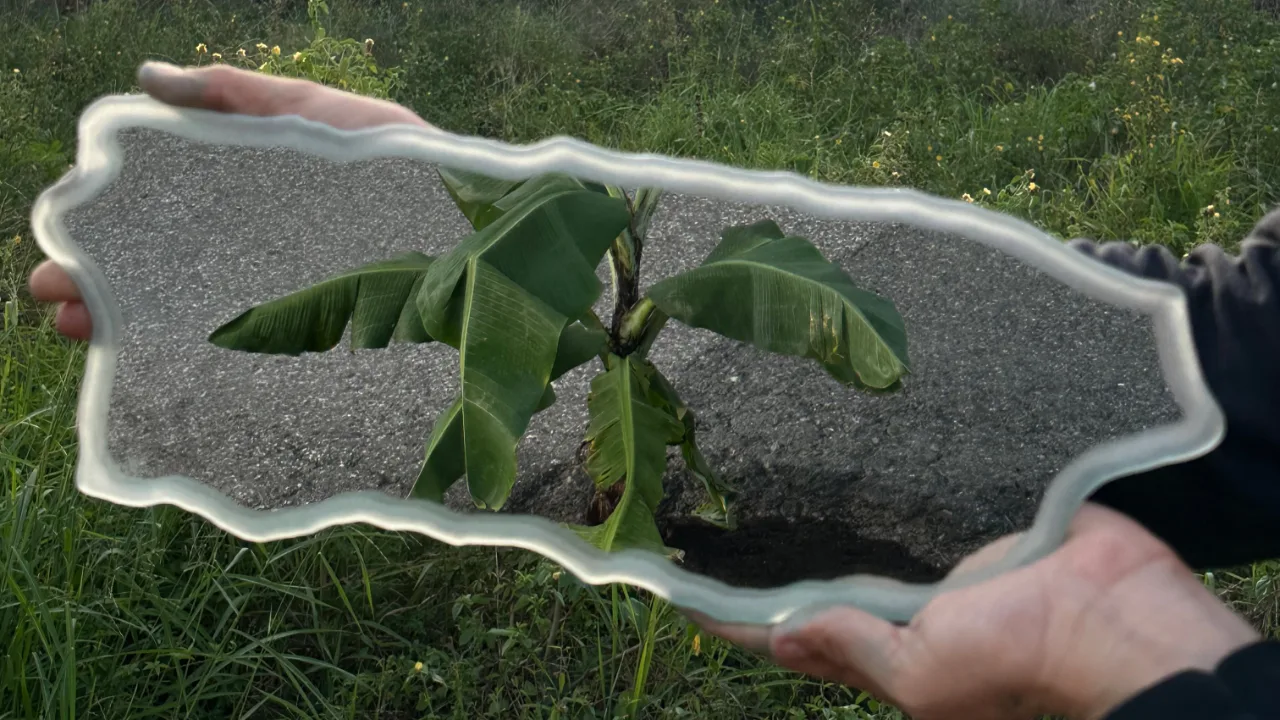
Mancha de plátano (2025): The more recent series draws its inspiration from an act of creative protest that attracted media attention. In 2021, residents of the barrio El Guarico in Corozal planted plantain trees in the potholes that were blocking traffic and damaging vehicles, turning those failures into an improvised grove that, according to Quevedo, perfectly captures the essence of Puerto Rican "buscársela."
This communal resilience resonated with Quevedo when she read the news reports in 2023. To give that ingenuity a physical form, the artist cuts the mirrors into the silhouette of Puerto Rico, creating "a work that wants to underscore the great ingenuity of Puerto Ricans, that solution inexplicable to others but natural to us".
"Being Puerto Rican is buscársela, it's how we can survive in the face of injustice and every stumble you constantly have to navigate to survive on the Island," the architect said.
The philosophy behind the mirror
For Quevedo, working with mirrors goes beyond aesthetics. Her approach is grounded in phenomenology, making the intangible tangible. It is a study of what cannot be seen but is present in our everyday reality.
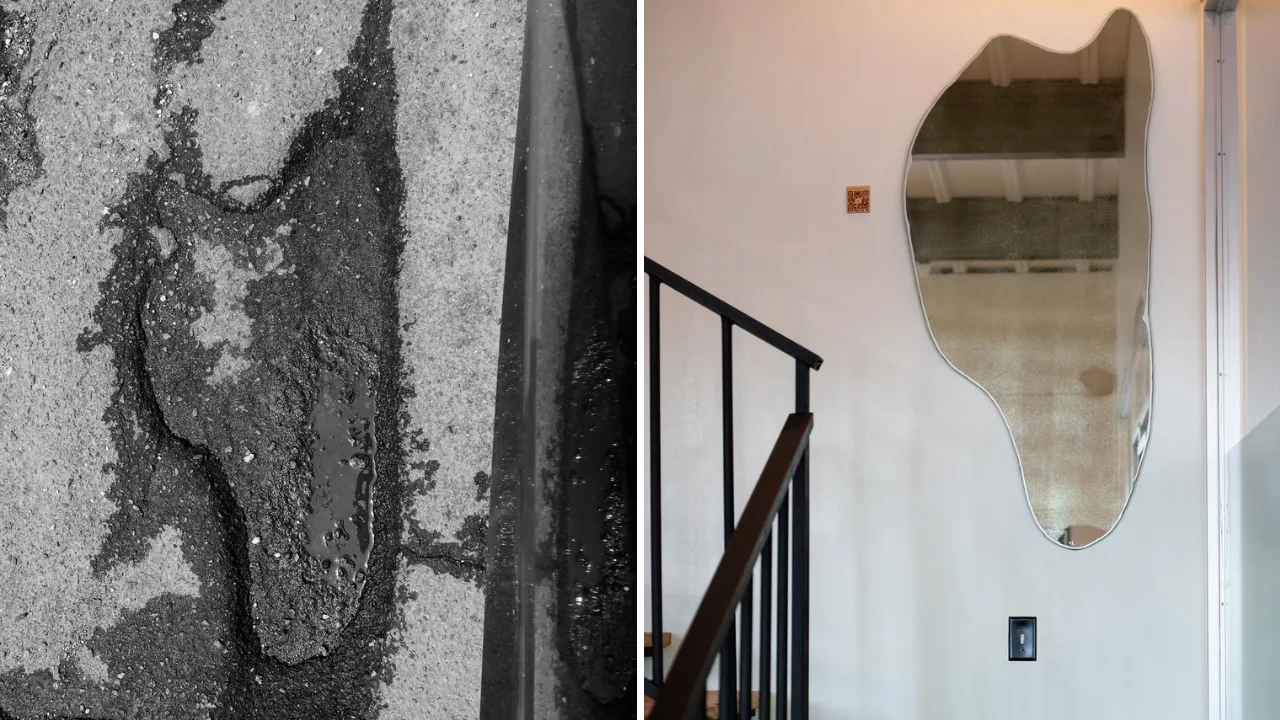
"It [the mirror] is an extended gaze that invites us to stimulate collective memory, to remember that as Puerto Ricans, we have been living through these same situations for years. They repeat, they return, but we are still here," the designer added.
The process of "forming" Puerto Rico
Whether recreating potholes or the silhouette of the island, Quevedo's process begins with salvage.
The mirrors come from multiple sources: some she finds abandoned on the street, others arrive as donations, and many she rescues from buildings about to be demolished.
The process of cleaning and preparing the mirrors. (Video provided by Janice Quevedo.)
Quevedo then cleans them and checks that the materials have few scratches and imperfections before giving them a second life through her art.
Cutting the glass with precision to create the silhouette of Puerto Rico. (Video provided by Janice Quevedo.)
The art of stopping and looking
Documenting these potholes has become an integral part of Quevedo's creative process. As she drives along the island's roads, she is constantly observing these accidental urban forms.
"I look at it, it seems like a unique shape to me, so I stop, I find a safe spot, I pull into a little corner and I go document it", she explained about her working method.
He takes measurements and photographs, notes the location and coordinates, analyzes how many cars pass over the pothole in their daily commute, and adds this data to his digital file.
Quevedo said she is excited by the challenge of working with the raw shapes of the potholes, "a shape I had never seen and didn't know was possible," referring specifically to recreating those contours in glass.
This series has been shown at spaces including:
Galería Km 0.2 (2021)
Azucena (2021)
Embajada Gallery (2022)
Espacio Odeon in Bogotá, Colombia (2022)
Galería Recinto Cerra (2023)
Casa Archivo (2024)
Café Studio (2025)
Where to find the work
At the Museo de Arte y Diseño de Miramar (MADMI), in San Juan, you can find “Los boquetes del pueblo”, a mirror mural from the Boquetes series that has been part of the museum's permanent collection since February of this year.
Although the Mancha de plátano collection has not yet been formally exhibited, you can come across some pieces in the community of La Perla, in Old San Juan:
Bringing the art to your space
Quevedo takes custom commissions to meet the specific dimensions a client requires. The mirrors can also include lights for a backlighting effect.
Among her future plans, she wants to create "a new series where anyone who is interested can get the mirror of whichever ones are presented, in different sizes" on her website.
For quotes, you can reach the designer and architect through Instagram or by email: estudiosnts@gmail.com.
This content was translated with the assistance of Artificial Intelligence (AI).