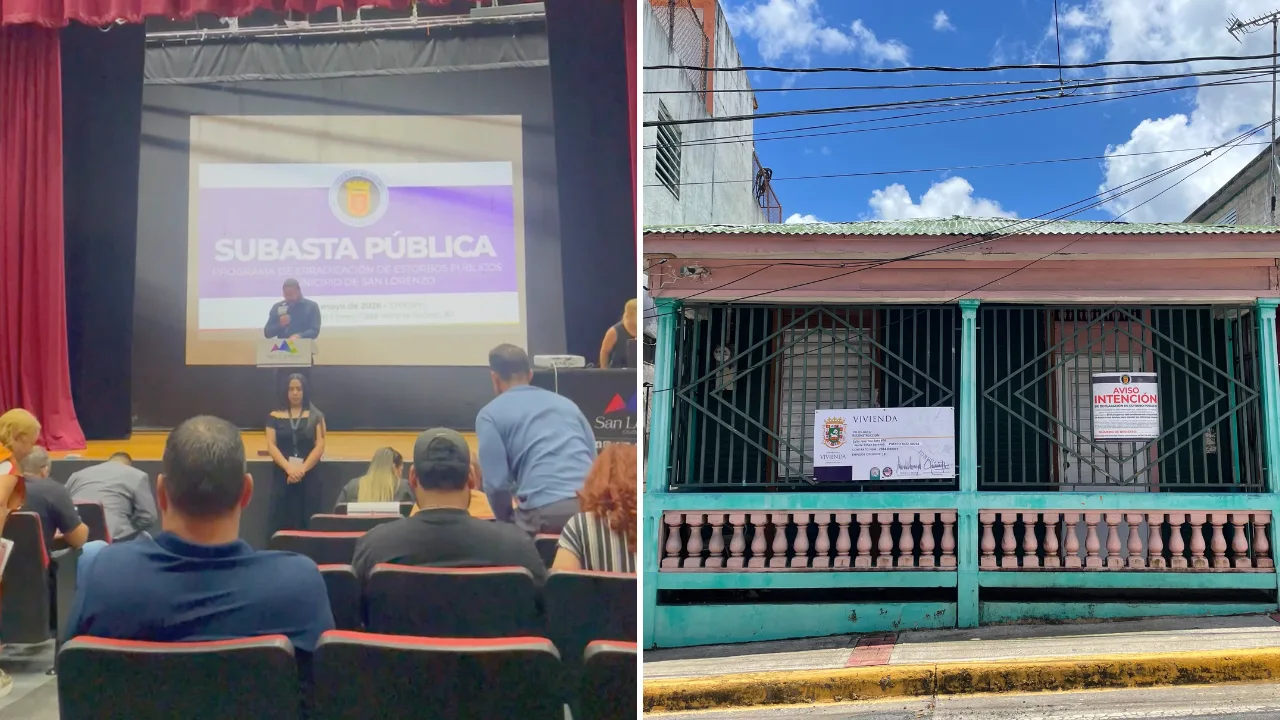
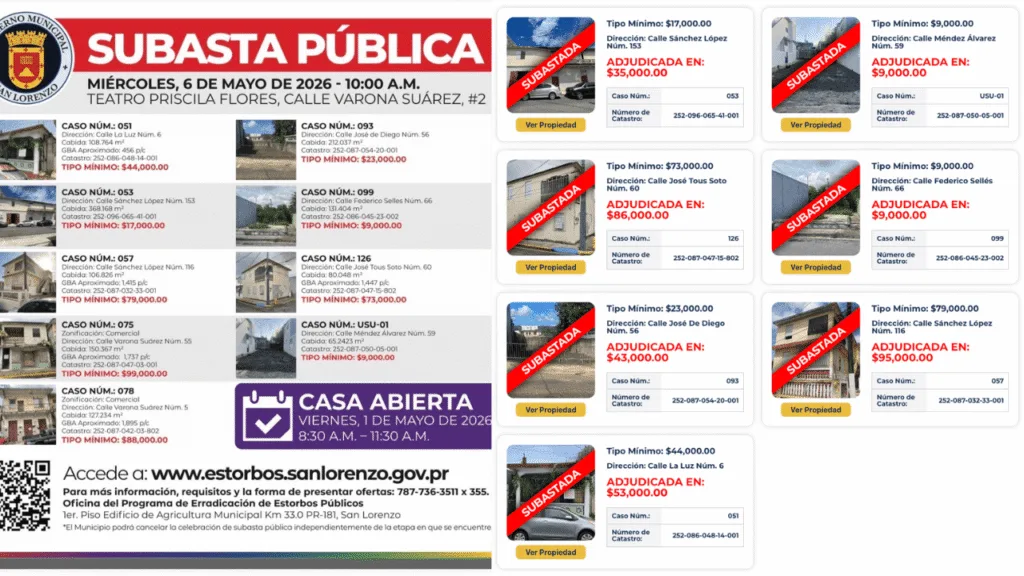
What's happening? The Municipality of San Lorenzo held its second live public-nuisance auction on Wednesday, May 6, at which seven of the nine available properties were bid on and five of them sold above the opening price, ranging from $9,000 to $95,000.
All were sold to Puerto Rican bidders, including individuals, investors and corporations, and only one of them acquired two properties (the rest acquired only one). Four of the bidders interviewed by Platea said they had a positive experience with the process.
Why does it matter? With a public auction process that lasted just 19 minutes, San Lorenzo aims to serve as a model for other municipalities in handling public nuisances through this format. The municipality is preparing for a third auction, possibly within the next two months, at which another five to 10 properties declared public nuisances will be available for bidding.
"It was simpler than the first (auction). We were more prepared than the first time. In this one, participation was a little lower — I assume a lot of people's curiosity was already satisfied by the first one", Rafael Malavé Poupart, director of San Lorenzo's Public Nuisance Eradication Program, told Platea. He added that the Municipality of Isabela, which had observers at the auction, could be the next to follow its example.
What happens to unsold properties?
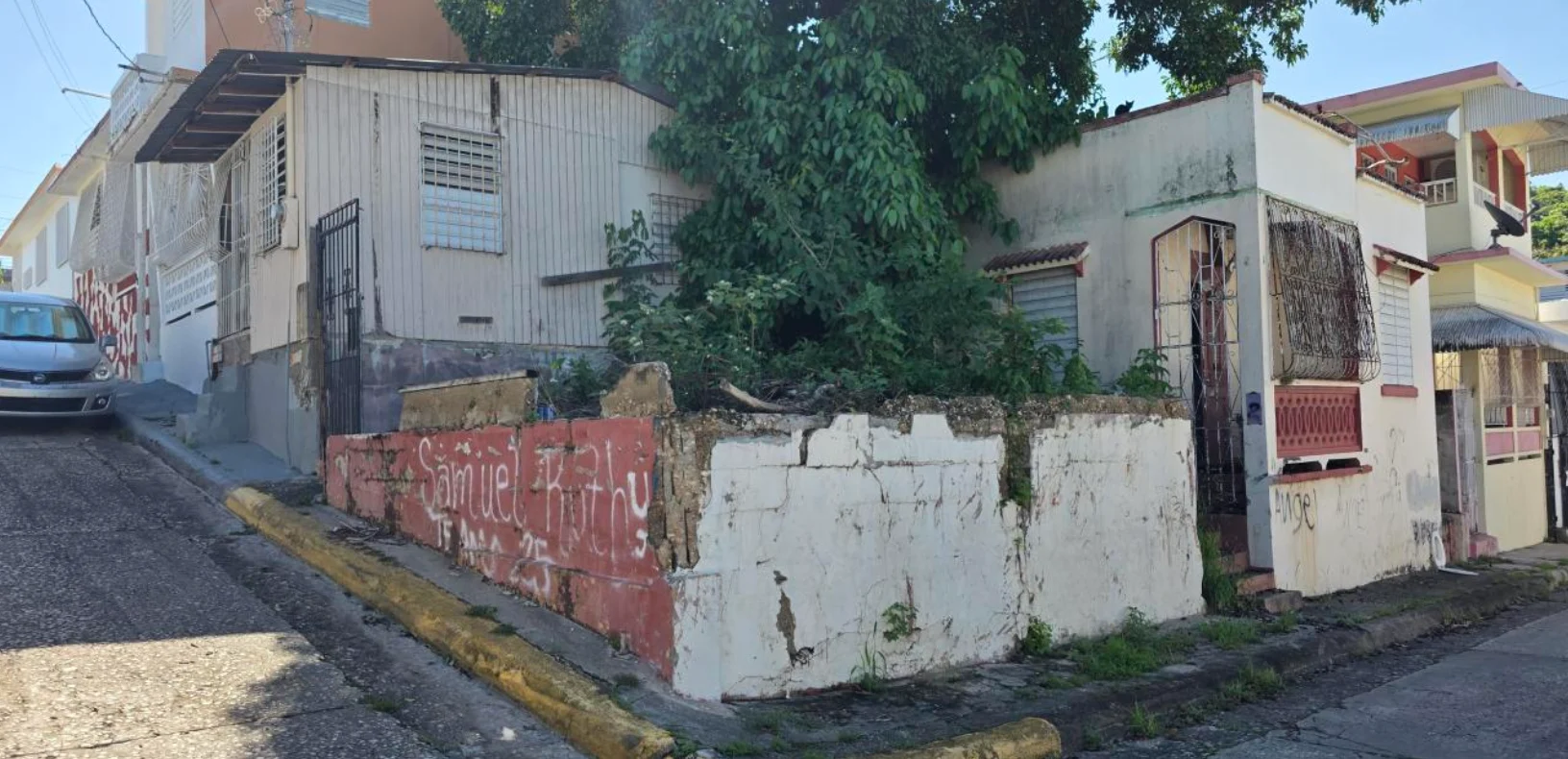
The two properties that drew no interest from bidders now enter a municipal review process and could be demolished or added to an open inventory, possibly at a discount, to be sold later to interested buyers, Malavé Poupart explained.
"The municipality now decides how to handle them. I don't think they'll go back to auction; they would be available in an open inventory," the official said, estimating that this "should move fairly quickly."
🏚️ 7 out of 9 properties awarded (with a purchase contract) at the auction
⏱️ 19 minutes was how long the process lasted, from the opening of proceedings to the close of all bidding
💵 $9,000 was the price of the cheapest property (a lot) awarded
💰 $95,000 was the price of the most expensive property awarded
Who are some of the bidders?
This second auction drew 11 participants, compared with more than 20 at the first, and, according to Malavé Poupart, "I understand they are all from Puerto Rico," among individuals, investors and corporations.
Here is what four of the six bidders who purchased properties had to say (one of them took two properties, for a total of seven sold):
Katiana Pastrana, Gurabo
"It's the first time I've participated in an auction (of this type). I had seen the properties — I didn't make it to the open house, but I did visit the houses from the outside, I looked at the public-nuisance photos and I got informed before coming… with investors who work in the auction business in different municipalities," Pastrana told Platea.
As a 24-year-old investor, Pastrana acquired a property together with two partners with the goal of turning it into a livable space and selling it. "Give this home to a family," she said. Her expectation is to build an investment firm, with this property as the first of many.
The property was case #057, a two-story property that opened at $79,000 and sold for $95,000. Pastrana estimated it will cost them another "$30,000 or $40,000" to repair and that they will eventually be able to recover the investment on the sale, with the expectation that it reaches at least $200,000.
The money to invest came from a solar panel business they run together, "a very lucrative business," she said.
Ángel Rivera, Bayamón
"We are brokers and we also have a corporation through which we buy and sell properties," Rivera told Platea. This is the second time he has participated in the auction, and at each one he bid on a different property. "(It's a process that is) completely transparent, very easy and straightforward," he added.
At the first auction, he acquired a property for the corporation that is currently being rehabilitated. At this second auction, he bought one of the lots that sold for $9,000, the lowest price at this auction, and because no one bid against him, he paid that lowest price.
"We acquired a piece of land and we would be willing to work out some kind of deal with anyone who needs it. The basic goal here is to benefit the town, some family, some neighbor who needs it for parking or something like that, or to build a property from scratch. So, pro market," he said.
Frank Muñoz, San Lorenzo
Muñoz attended to accompany his mother-in-law, who was the bidder on case #093, a vacant lot that started at $23,000 and was awarded for $43,000. The purpose is to build "a house for her," he said.
"The process started at around $23,000. My mother-in-law liked the bidding process. It took her to $43,000 in the sale… We had one (other bidder) who was aggressive. That's why we had to push the sale price up," Muñoz said.
Edward Morán Díaz, Caguas
"My plan for these properties is to renovate them and be able to give them to other families who need them," Morán Díaz told Platea, having taken two of the properties sold at this auction.
He is one of the contractors who buys, repairs and sells houses. "We've done that quite a few times," he said.
On the auction process, he said it "is good because sometimes we buy houses we can't see. These we were able to see, look them over, arrive at numbers that work for the renovation so we can sell them and handle everything properly, and we landed on exactly the right numbers."
What happens after bidding on one of these properties?
After a property is awarded at auction, prospective buyers move to another room, where municipal employees take their information, collect the $5,000 cashier's check required to participate in the process, and have them sign a contract committing to pay the remaining balance within a maximum of 120 days and to make the repairs needed to resolve the public nuisance within one year.
If the balance is not paid within 120 days, "they lose the deposit" and the municipality takes the property back, the director of the Programa de Erradicación de Estorbos Públicos explained.
If the property is not repaired within one year, "the municipality can exercise the right of conventional retraction. That means that if within one year the person has not met the requirement of bringing the house to habitable condition, the municipality can invoke the retraction, the money is returned to the person, and the property would then become available on the market again," Malavé Poupart said.
This content was translated with the assistance of Artificial Intelligence (AI).