What's happening? Sweet potato is gaining ground in Puerto Rico. It is the fifth highest-earning crop in the starchy staples category, generating $921,000 in fiscal year 2023, and over the past decade it has seen increases in both local production and consumption.
Increasingly present in restaurants, food trucks and homes, the crop stands out for its versatility, nutritional value and short production cycle. That growth, however, is happening in a market where most demand is still met by imports, which creates both challenges and opportunities for local farmers.
Why does it matter? Sweet potato is not only part of Puerto Rico's food history since the Taíno era; today it also represents an opportunity to strengthen local food production.
In a context where sweet potato consumption has risen more than 50% over the past decade, the crop offers advantages such as short production cycles and long shelf life, positioning it as a viable option for diversifying agriculture.
Two local farmers explain how they see the market and what the path forward might look like, including the possibility of diversifying into value-added products and developing research to support new sweet potato production.
La subestación de Lajas de la Estación Experimental Agrícola sells cuttings of four types of sweet potato (Canol, Canolia, Camuy and Yellow Jersey). Orders must be placed in advance and require a minimum of 5 pounds of cuttings.
Desde Mi Huerto also carries Canol sweet potato cuttings and seeds.
🍠 To buy:
Cajita Local includes local sweet potatoes in its fresh produce box.
These are some markets with local produce where you might find them.
Check these seven farms with delivery that may carry local sweet potatoes.
The numbers: Sweet potato production in Puerto Rico
Local sweet potato production tripled between fiscal years 2013 and 2023, rising from 4,270 quintals to 13,934 quintals (+226%), according to data from the Departamento de Agricultura (DA). With ups and downs over the years and a production peak of 17,662 quintals in fiscal year 2017, the most significant increase came between fiscal years 2022 and 2023, with growth of 268% and a rise in production of more than 10,000 quintals.
However, imports have also risen steadily between fiscal years 2013 and 2023, going from 151,199 quintals to 204,598 quintals (+35.3%), with an increase of more than 19,000 quintals between 2022 and 2023 alone (+10.7%).
Agricultural data
Sweet potato production in Puerto Rico
And what is exported · Fiscal years 2013–2023
Local production 2023
13,934 qq
vs. 204,598 qq imported
Local share
6.4%
of total available for consumption
Local production
Imports
Exports
· 1 quintal = 100 pounds
Hover over the chart to see the breakdown by year Tap each year to see the breakdown · Tap outside to close
Source: Departamento de Agricultura de Puerto Rico, data provided to Platea · Figures in quintals (qq)
Trade balance. Over 10 years, local production went from representing 2.75% to 6.4% of sweet potatoes available for consumption, which shows the potential for growth.
Sweet potato consumption rose from 4.32 pounds per capita in fiscal year 2013 to 6.79 pounds per capita in 2023, an increase of 57.2%, with a 16% rise in the last year of available data alone.
💰 $921,000 in gross agricultural income in fiscal year 2023
🍠 13,934 quintales of sweet potato produced in fiscal year 2023
🛬 204,598 quintales imported in fiscal year 2023
🛫 959 quintales exported in fiscal year 2023
🍽️ 6.79 pounds of per capita consumption (sweet potato per person)
Challenges and opportunities in sweet potato production in Puerto Rico
With local production on the rise, sweet potato cultivation offers opportunities for local farmers. Two farmers share how they see production and what could be done to improve it.
Opportunities:
1️⃣ It grows quickly (4 months), without fertilizers, and can be produced year-round.
"Sweet potato is the shortest-cycle crop in the starchy staples family. Every four months we have a harvest," said farmer Joel Vázquez Serrano, president of Hacienda Casandra Inc., in Arecibo. In his case, he tries to plant monthly so he has production throughout the year.
Also, compared with fruit and vegetable crops, "sweet potato is not as demanding (of fertilizers)," said agronomist Joel Vega, of Cooperativa Agrícola G8, in Santa Isabel.
2️⃣ Several types of sweet potato can be grown in Puerto Rico.
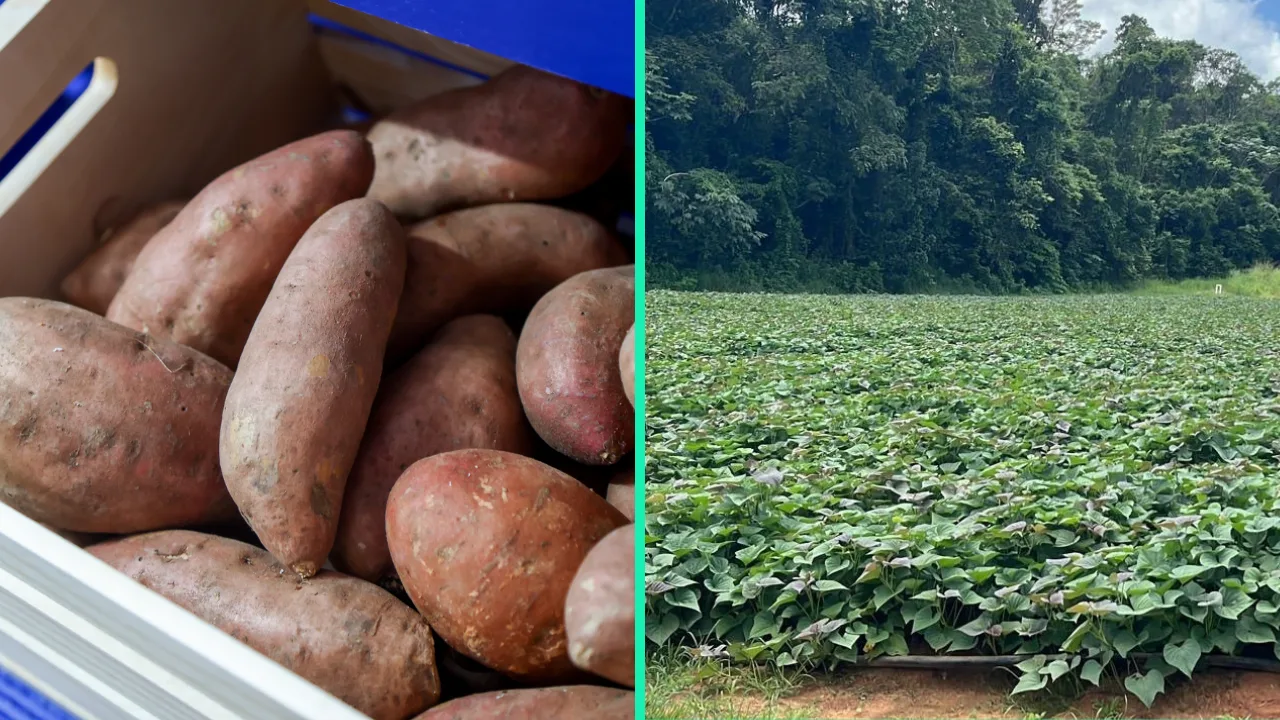
The most common varieties are the Canol sweet potato (light skin, yellow flesh) and the Tifey sweet potato (purple skin, white flesh), but Puerto Rico also grows the Murasaki and Okinawa varieties, Japanese sweet potatoes recognized for their purple skin and flesh.
3️⃣ Sweet potatoes can last months when stored properly.
Especially if they are fresh local products. "If you buy them and put them in the refrigerator, they last six months," Vázquez Serrano said. If you slice them and freeze them, they can last even longer.
4️⃣ They are highly nutritious, even for people with diabetes.
A baked, unpeeled sweet potato can provide 156% of the daily value of vitamin A (1,403 micrograms of retinol activity equivalents, or mcg) that a person needs to maintain healthy eyes and skin, according to the Guía de Bolsillo de la Batata from UPR in Mayagüez.
Sweet potatoes are also recommended over regular potatoes for people with diabetes because they have a lower glycemic index (they do not raise blood sugar).
5️⃣ Any recipe you make with potato, you can make with sweet potato.
"We have made sweet potato gnocchi, sweet potato flour," Vázquez Serrano said, referring to the versatility of this starchy crop.
6️⃣ There is steady local demand for the product.
Vega said he has had no trouble selling sweet potatoes to small retailers, supermarkets, local distributors and restaurants, especially BBQ-style spots and roasted sweet potato food trucks. "Moving the product is never a problem; the problem can be the price," he said.
7️⃣ There is potential to develop value-added products.
From chips and sweet potato candy to frozen sweet potatoes and beverages, it is a crop with potential for developing value-added products, Vázquez Serrano said.
Plantains: $56.2 million
Bananas: $26.3 million
Yams: $3.9 million
Yautía: $1.4 million
Sweet potatoes: $921,000
Celery: $609,000
Yuca: $392,000
Malangas: $306,000
Breadfruit: $32,000
Total starchy crop revenue: $90.2 million
Source: Gross agricultural income of Puerto Rico, fiscal year 2022-2023 data, provided to Platea by the Department of Agriculture
Challenges:
1️⃣ Sweet potatoes have a low price, leaving farmers with minimal profit.
"There has been no increase in price for 13 years," Vázquez Serrano said, referring to the time he has been running his farm, during which he has seen no changes in the Agriculture Department's prices for sweet potatoes. "My profit is minimal, almost nothing," he said.
Vega agreed and added: "The price can be a limiting factor. You have to sell cheap, but you're not going to stop selling it."
2️⃣ It is difficult to compete with imported sweet potatoes and their prices.
"We are always competing with the price of the imported product… Their prices kill us because they don't cover production costs," Vega said.
Vázquez Serrano added, regarding importers, that "their production costs are not the same as ours."
3️⃣ Keeping the crop free of pests is costly.
Because there is no pesticide approved by the federal Agriculture Department (USDA), farmers must rely on organic products to control pests. "That means production costs are higher," Vázquez Serrano said.
4️⃣ Weed control can be difficult and costly.
"Weed control is an uphill battle with sweet potatoes," Vega said. There is machinery that can do it, but it is expensive and out of reach for small producers. For Vega, acquiring that kind of technology and sharing it by region could be an opportunity.
He also said there are not many scientific studies on weed control, another area that could be researched and would be helpful to farmers.
5️⃣ The harvest process can take days because of weather and curing time.
Sweet potatoes must be harvested on sunny days, so rain can delay the work, Vega said.
After harvesting, the sweet potatoes must be left for three or four days in wooden crates with controlled temperature and humidity for the curing process. This prevents rotting, Vázquez Serrano explained.
"In the wooden crates, the starch converts to sugar as the temperature changes, which is why it tastes sweeter… It gets washed and treated with a fungicide to prevent mold, because we're a tropical country. Then it's dried and packed," he noted. "It's a tedious process, but the product holds up."
Two farms in two towns, united by a love of agriculture
Vázquez Serrano and Vega don't know each other, but they share a love of Puerto Rican farmland and a passion for feeding their country. Their operations overlap in sweet potatoes, and both lease their land from the Autoridad de Tierras, which falls under the DA, but the farms are located in the north and south of the Island and have different focuses.
Hacienda Casandra in Arecibo
In 2013, when Vázquez Serrano was 27, he leased 60 cuerdas of land in the Miraflores barrio of Arecibo and founded Hacienda Casandra Inc., a name drawn from Greek mythology and the goddess who foresaw the destruction of Troy.

"You heard at the time that young people weren't interested in agriculture, and I was passionate about it. By doing what I do, by giving that push to the land, I'm doing more for this country."
Joel Vázquez Serrano, president of Hacienda Casandra in Arecibo
Vázquez Serrano studied General Sciences at UPR Río Piedras and worked in the pharmaceutical industry before committing fully to farming.
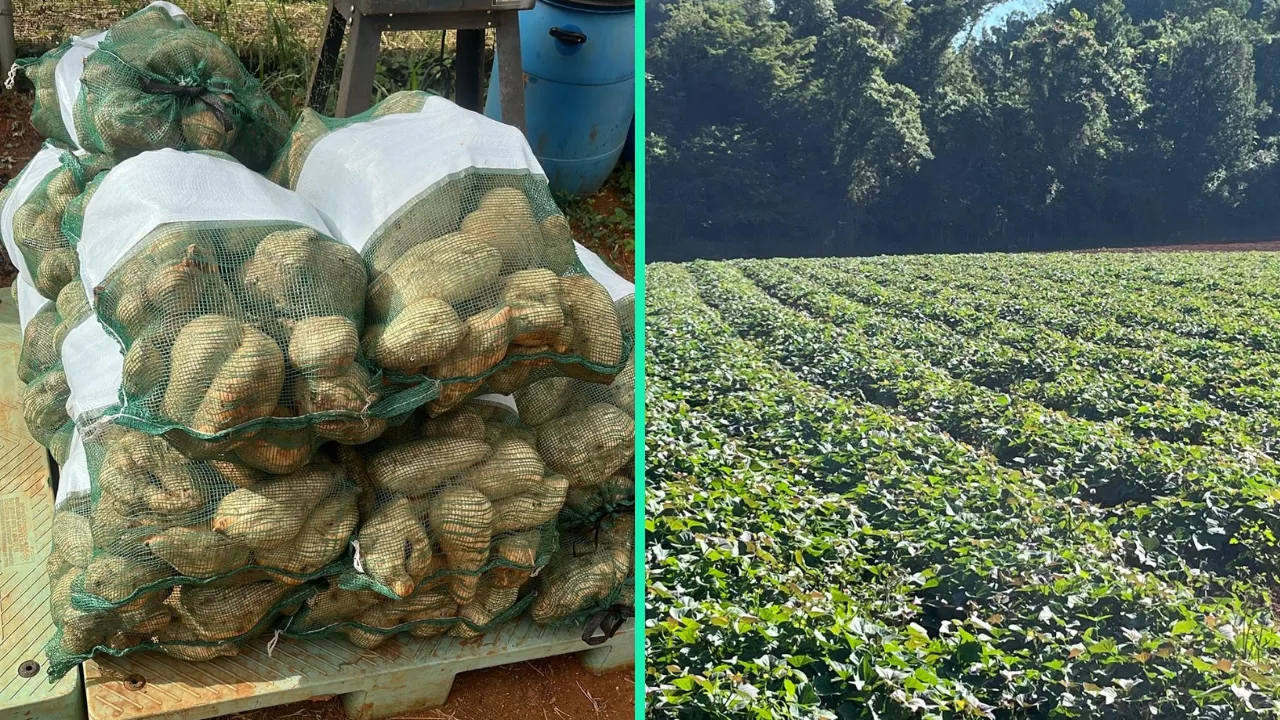
Together with his father Samuel, his sister Berenice and a few other collaborators, he cultivates eight cuerdas of Canol sweet potatoes, which yields about 60 quintales per month, a figure below what he had before Hurricane María (2017), when they were producing more than 2,000 quintales.
"We had more than 200,000 pounds of sweet potatoes (2,000 quintales), it was all a loss… We had to rebuild that seed bank from scratch to be able to produce sweet potatoes again," he explained about the challenge the hurricane posed.
Today he rounds out his operation with sheep raised for meat and other vegetables on the rest of the farm, though he holds a second job to supplement his income. He is working on developing other products in order to make a good living from farming.
Where to buyIn addition to selling through its Facebook page, Hacienda Casandra supplies sweet potatoes to Cajita Local, an initiative by Ciales farmer Stephanie Rodríguez that offers local agricultural products through one-time purchases or monthly subscriptions, with deliveries in Hato Rey, Bayamón, Caguas and other parts of the Island.
Cooperativa Agrícola G8 in Santa Isabel
In the south of the Island, on the site of the former Finca Gargiulo, eight farmers joined together in 2022 to create Cooperativa Agrícola G8, each with 100 cuerdas (800 cuerdas in total) of land leased jointly from the Autoridad de Tierras. Each member grows what they choose, but they share storage and packing facilities, Vega, an agronomist from UPR Mayagüez, told Platea.
"Each person operates on their own farm, but all eight of us share the storage, packing and distribution facilities. We share all the project's costs… The merchandise is marketed through the cooperative's facilities," said Vega about the project, which receives exemptions from the DA and support from the cooperative system.
"When we combine all the products from the different members we handle, it comes to approximately 10 million pounds of products that stay in the local agricultural market," he added.
Last year, Vega planted 6-8 cuerdas of three types of sweet potato: Canol, Tifey and Murasaki. This year, his plan is to have 5-6 cuerdas of the crop in an effort to keep it available year-round.
Its main crop, however, is squash, with 48-50 cuerdas planted. Tomatoes, cucumbers, eggplants and pineapples follow, with 10-12 cuerdas planted of each. The farm also grows butternut squash for export to the United States in winter. Production is possible thanks to 30 employees, he said.
He distributes the sweet potatoes to various stores, but if he does not have enough product, he can rely on other farmers in the cooperative.
Cover photo: Sweet potato photo by Michael Nagle/Bloomberg via Getty Images; sweet potato production at Hacienda Casandra in Arecibo, photo provided by Joel Vázquez Serrano, president of the farm.
This content was translated with the assistance of Artificial Intelligence (AI).