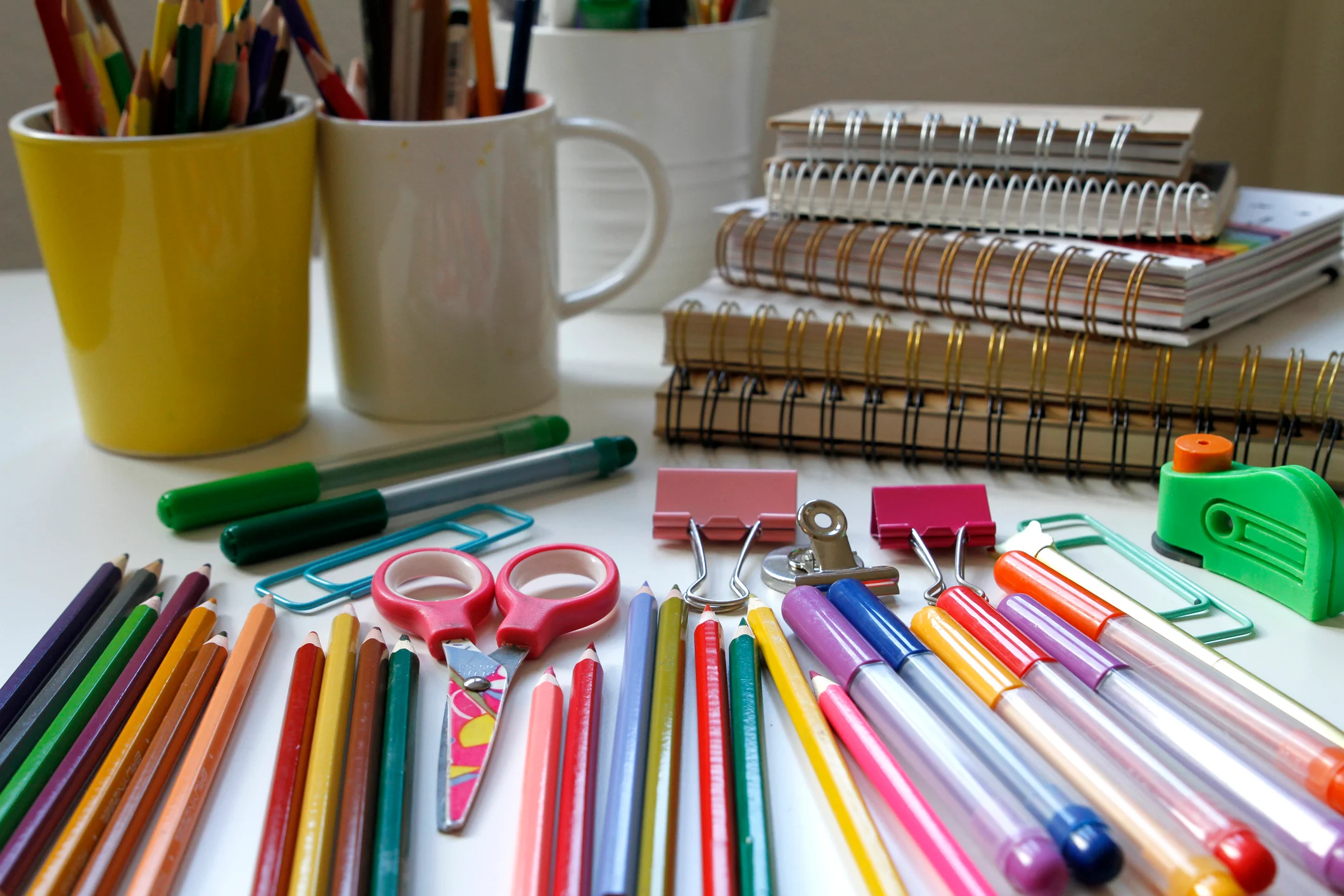
According to interviews with 11 teachers, personal spending to set up classrooms ranges from $50 to $1,000, or even more, over the course of the school year.
,
What's happening? On Aug. 8, public school teachers in Puerto Rico begin their duties, while students start classes on Aug. 13.
To understand how teachers prepare for the return to the classroom, we visited a school supply donation event where Platea had the opportunity to interview 11 teachers.
Among them, spending ranges from $50 to $1,000 to get their classrooms ready for the start of school.
The highest spenders among those interviewed tend to be Special Education teachers, who go out of their way to find new and eye-catching materials to ensure a better educational experience for their students. In Puerto Rico, about 40% of the student population receives Special Education services.
A special case. Teachers at schools and educational programs within the Department of Correction and Rehabilitation (DCR), which also fall under the Department of Education (DE), may spend even more, since the percentage of funding they receive is smaller and they have vocational programs that require the purchase of materials and equipment.
It's not just materials. The teachers agreed that expenses are not limited to the start of the school year but continue throughout it, especially for special events organized for students.
Why does it matter? To run just over 800 schools, the DE holds one of the largest budgets in the Puerto Rico government: $5,205 million, of which $3,044 million comes from the general fund.
For fiscal year 2025-26 alone, Secretary of Education Eliezer Ramos announced that, in July, a budget of $1,700 million was allocated under the Schoolwide model for principals to use in acquiring materials, services and resources.
Although the agency's efforts are aimed at having school principals determine their own needs, many teachers agree that the funds are not always spent on the materials that are actually needed.
🏫 What did the teachers tell us?
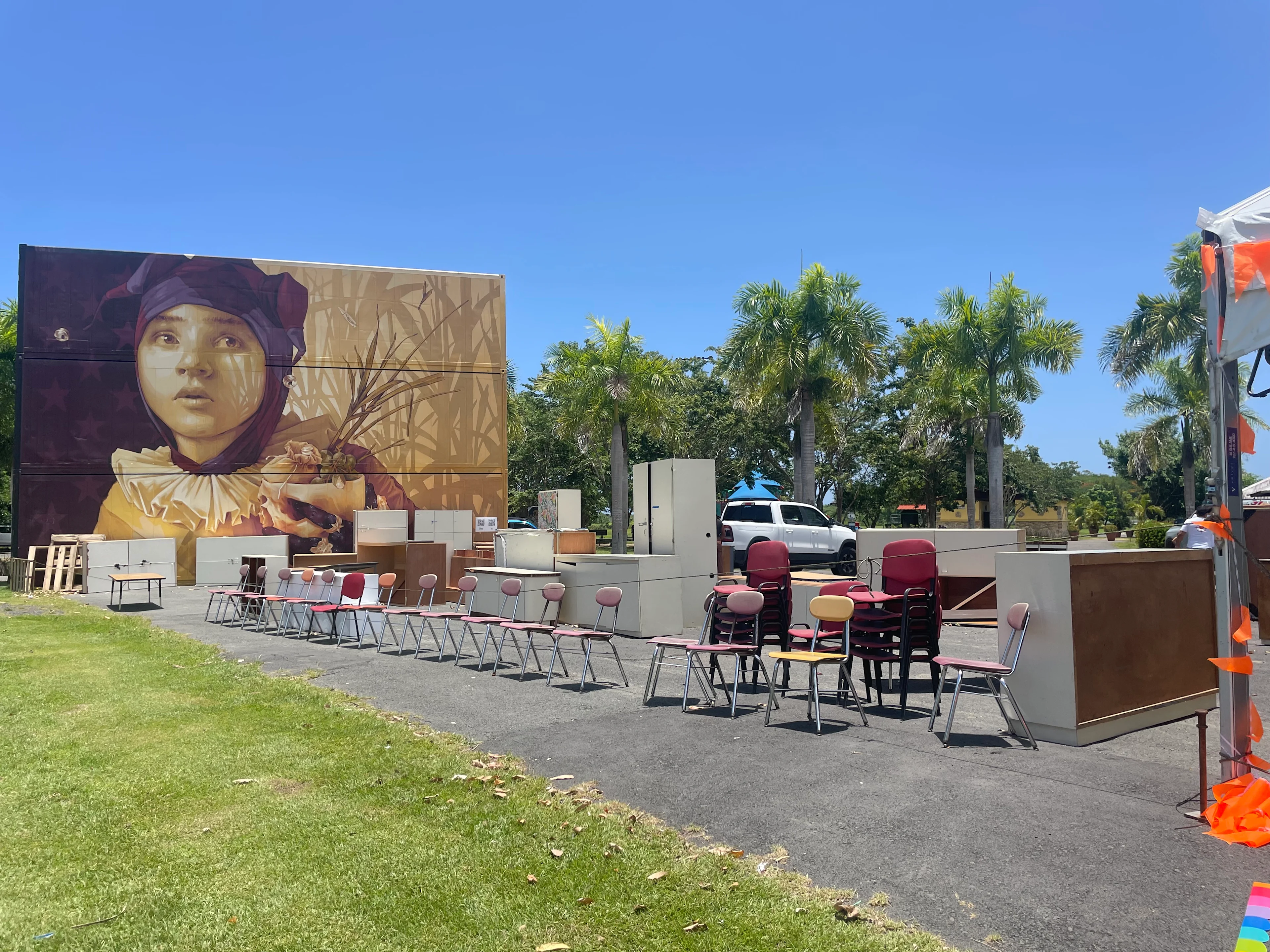
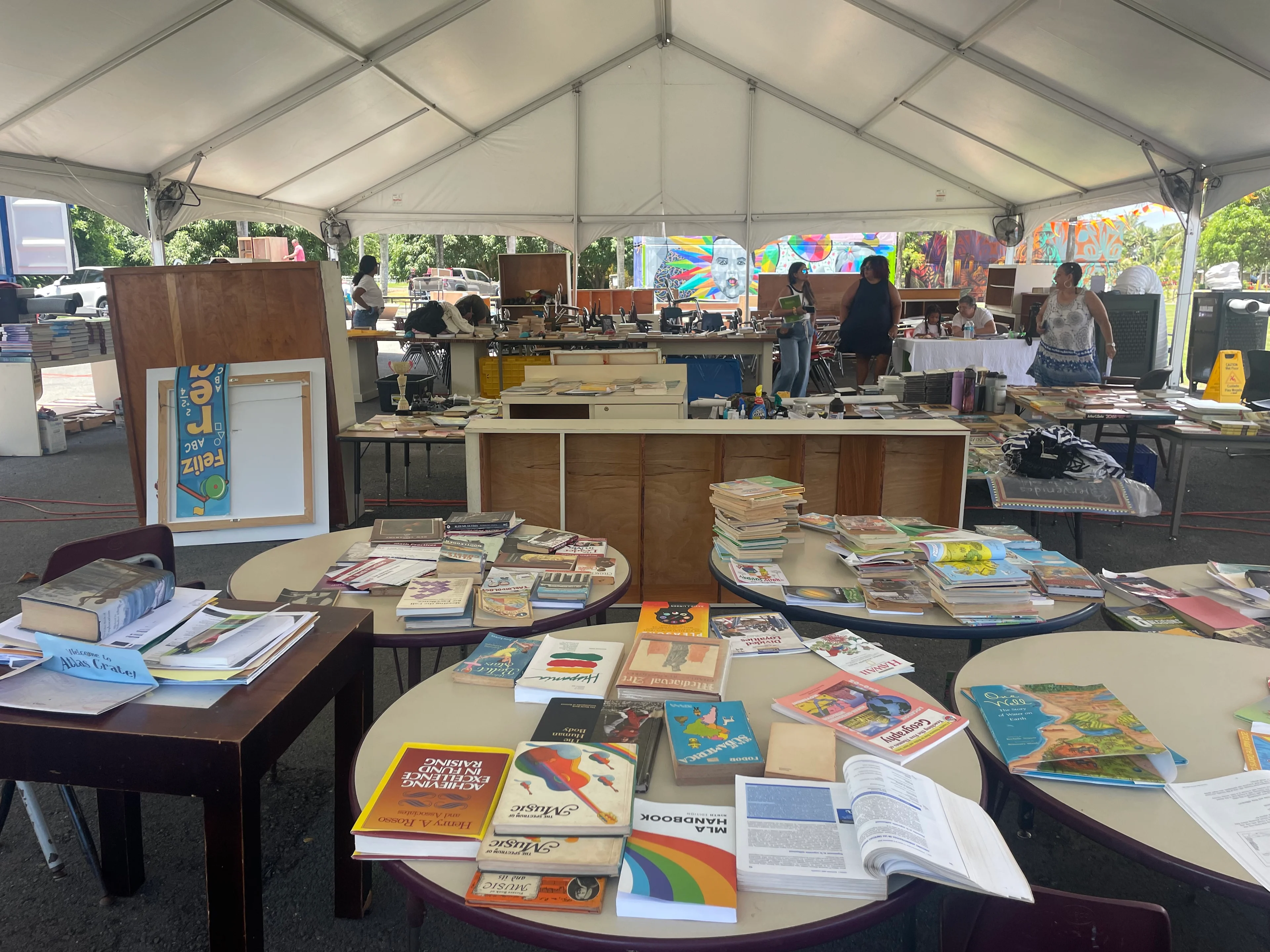
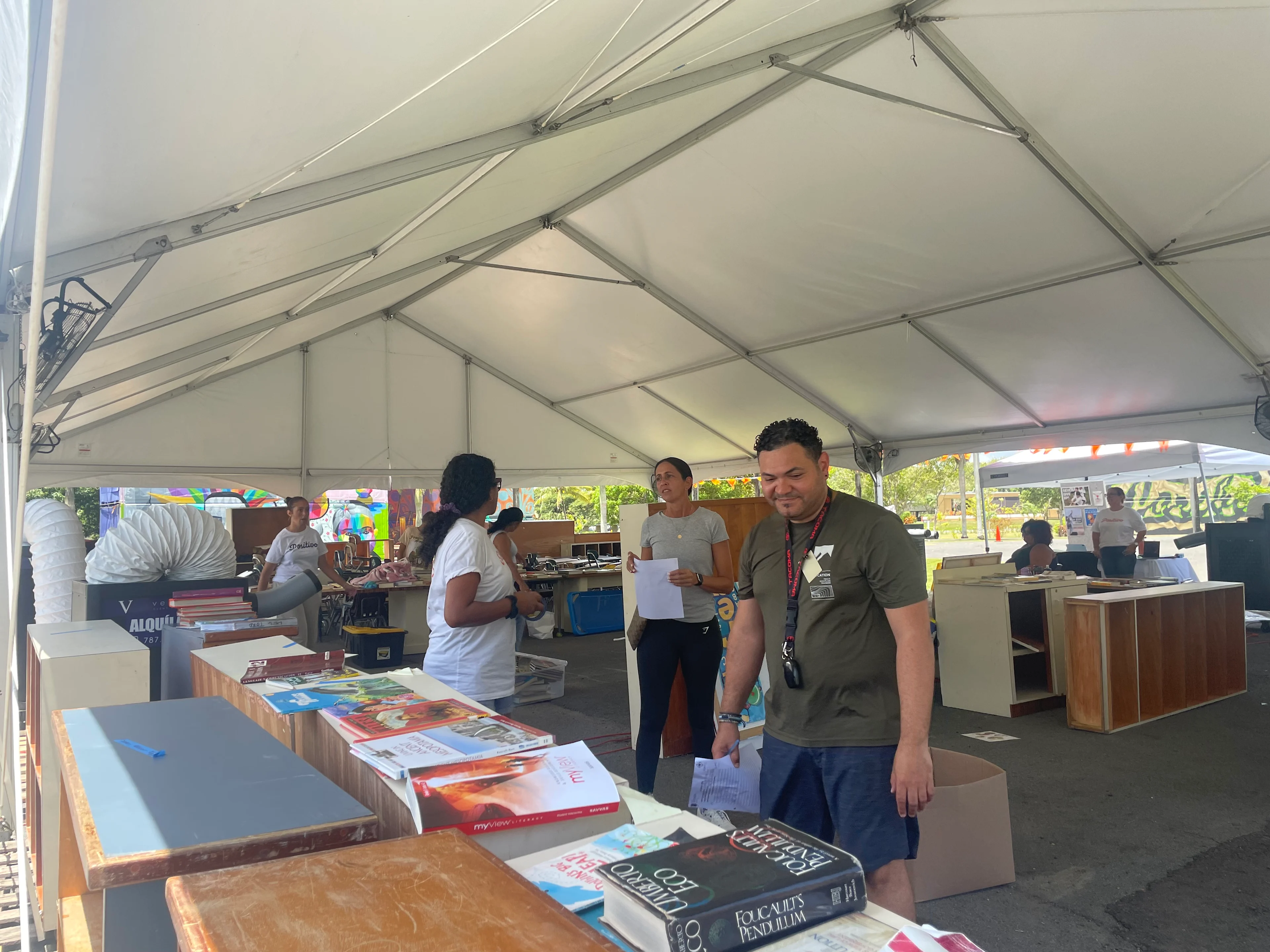
We interviewed the 11 teachers while they were taking part in the event "El Aula Libre, La Tiendita Gratis de Maestras", organized by the nonprofit IslandCorps and held at the Parque Agroturístico de Dorado.
Over the course of one week, the organization distributed nearly six containers filled with school furniture and materials, donated by Saint John's School, to about 300 educators who came from towns across the Island, said Lulú Mayorga, director of IslandCorps, to Platea.
The educators were glad to have access to cabinets, shelves, chairs and other materials that are sometimes missing from their classrooms.
Here is what each teacher told us, from the one who spends the most at the start of the school year to the one who spends the least. Most acknowledged that expenses are not limited to the beginning of the year but continue throughout it.
👩🏫 Giodalys Román, Special Education teacher
School: Fernando Callejo, in Manatí (high school level)
Spending: ~$1,000
What she spends it on: Printer, ink, educational materials, air conditioning removal
Román was one of the teachers who had spent the most money ahead of the start of classes and said: "I'm pretty close to $1,000." The spending has gone mainly to "electronic equipment," and, although the school has printers, she said she bought her own color printer because her students with functional diversity need visually appealing, colorful materials.
She also spent on a scanner and on removing the air conditioning unit from her classroom.
From the donation event, Román took five pieces of furniture, bookshelves and small plastic bins for supplies. For her, what schools need most is not just materials but "the correct distribution" of them.
📝 What does she recommend to the DE? "Not all schools serve the same population, not all schools have the same needs. So I think that maybe personalizing that search for what we're missing before the school year starts, and being able to distribute those funds correctly with the right and necessary purchases," Román said.
👩🏫 Katherine Kortright Rivera, Physical Education teacher
School: Héctor M. Ruiz Martínez, in Barceloneta (middle school level)
Spending: +$1,000 over the whole year
What she spends it on: sports activities, awards, competitions and special events, sports equipment
Kortright Rivera took 15 chairs and three tables from the donation event for a teachers' area the school is setting up to accommodate a growing staff.
"Between the activities you do, the ribbons for the awards, sometimes taking students out to lunch at special competitions, I'm talking about $1,000… Even though you ask for donations, you always end up putting in more," said the teacher, who noted that this spending happens throughout the year.
📝 What does she recommend to the DE? "I've been asking for elastic bands for years, and they're part of my lesson planning. They never arrive. (I would recommend) that if we're requesting equipment, they give it to us, not what they assume we're going to use," Kortright Rivera said. She believes they should listen to teachers more: "I think they would save money."
💰 $1.7 billion budget allocated to schools: Funds are distributed through the Schoolwide model, which consolidates state and federal funds, so that principals can acquire materials, services and resources, in accordance with the Documento de Elegibilidad Escolar (DEE).
📅 Funds allocated since July: DE Secretary Eliezer Ramos said this is the first time schools have had the funds since early July, so they can begin the year "with greater preparation, administrative agility and focus on student well-being."
🏫 Basic supply package delivered to each school: It consists of school and sports materials, toner cartridges, cleaning supplies and essential items for school operations, above all to help teachers in the instructional process. It represented an investment of $3 million and was delivered to "100% of schools" on June 28.
💳 Institutional purchase card (P-Card) for each school principal: This is intended to allow them to acquire their materials "with greater agility" and "according to their particular needs."
💵 Additional funds for the Special Education Program: Within the Schoolwide model, an allocation of $372.6 million goes to this program, which aims to eliminate administrative barriers to the assignment of funds.
"We want our educators to arrive at their classrooms focused on teaching, without worrying about a lack of materials. This early delivery is part of the commitment we have to an organized, functional school centered on teaching," Ramos Parés said.
👩🏫 Magdaliz Morales Febus, Special Education teacher, Route 2 Autism
School: Mercedes Rosado, in Naranjito
Spending: $800
What she spends it on: school supplies, decorations, food for special events
Morales Febus was one of dozens of volunteers at the IslandCorps event. She said teachers are investing "all year" in "giving our students the best," especially when they know the needs of many of the families.
Although she found it hard to put a number on her spending, she said it would be "more or less around $800 for all the materials to decorate a classroom. Not counting the candy we give the kids as a welcome, because I'm an over-the-top kind of teacher. I like to give the kids a lot of love and make them feel loved, because it's their second home."
📝 What does she recommend to the DE? "My recommendation, from the heart, is to always keep in mind that in addition to having a regular curriculum, we have special education, which is a population with a lot of needs. Inclusion is necessary," she said.
👩🏫 Milagros Serrano Ocasio, Special Education teacher at the preschool level
School: Andrés C. González, in Bayamón (elementary and middle school levels)
Spending: between $400 and $700
What she spends it on: educational materials, special classroom furniture, decorations
Serrano Ocasio was happy to take part in the donation event because she knows that "teachers have a lot of needs." She took mostly shelving units, since she had been given a classroom with none of that furniture, which is essential for organizing books, educational materials and students' belongings.
"Easily, $400, $500, $600, up to $700 goes out the door because I buy everything. I really do buy rugs, I buy furniture, I buy everything I see they need. In the end, I'll use it all year and I know they'll get good use out of it, and I don't measure, I don't measure how much I spend," said the teacher, who last year drove to Isabela to buy a used changing table because she had seven students in diapers and had not been provided a space to change them.
The educator explained that, in her case, furniture must be adapted for children with special needs, must have no sharp edges, the classroom must have rugs, and other adjustments must be made.
📝 What does she recommend to the DE? "Not only the principals, but the staff (of the DE): go to the school and see what that classroom needs before opening it… My dream (is to have) a dream classroom, a classroom that has everything according to the child's needs," said Serrano Ocasio.
👩🏫 Elba Colón, Social Studies teacher (seventh grade)
School: Héctor M. Ruiz, in Barceloneta (middle school level)
Spending: between $300 and $500
What she spends it on: school supplies, uniforms, classroom decorations
Colón took two desks, a chair and a shelf for her classroom from the donation event. Even though she had furniture, "it needed a little love," she acknowledged.
The teacher said that what she spends on Back to School increases every year because "the cost of living has gone up." For her, "between supplies, uniforms, (spending) over $300, $500, approximately. That's without adding the decorations to set up the classroom."
📝 What does she recommend to the DE? "That they set aside a budget so that we, the teachers, can make that kind of purchase (of supplies) … We are the ones who know what we need inside the classrooms," the educator said. She also argued that, "besides upgrading technology equipment," there is a need for books and for bringing educational experiences to students, such as visits to the most important places in the country. "If it weren't for that experience in the classroom, they don't have the knowledge."
👩🏫 Sandra Cordero, Office Systems teacher in the Business Administration Program
School: Centro de Detención Bayamón 1,072 (school inside a penal institution)
Spending: already at $220, but she spends much more
What she spends it on: paint, school supplies, internet, technology
Cordero took tables and chairs for herself and her colleagues who teach at the Centro de Detención de Bayamón, a program that belongs to the DE but receives less funding than regular schools.
In her case, she said the things she most often lacks are books, photocopiers and electronic equipment (such as computers), and that her expenses include paying for internet in order to teach a better class.
When asked how much she spent at the start of the school year, she said: "Right now I'm at $220. That's counting paint."
The teacher also provides pencils, pens and notebooks to her students, who, given their circumstances, sometimes cannot buy them.
"I'm the one who spends the least, but I have teachers (in other programs) like barbering, baking and pastry, cosmetology, high fashion, who spend the most because we're talking about razors, materials for making pastries," said Cordero, who estimated that these colleagues can spend "from $3,000 to $4,000" on a single purchase for their courses.
📝 What would she recommend to the DE? "In the case of vocational programs, that they increase the (budget) percentage allocated to the programs, to the correctional schools," the educator said, also calling for increased funding for programs that allow inmates to complete their high school diploma.
What is the importance of education in prisons? "Learning matters, whether they get out (of prison) or not. If they go out and work in what they learned, they have the knowledge and the foundation," said Cordero. "We are preparing them so that, when they get out, they can be self-employed, because we know that when they get out, people will look down on them simply because they have a criminal record."
👩🏫 María González Cardona, Special Education teacher, preschool level
School: Carmen Casasus Marti, in Añasco (elementary level)
Spending: +$300
What she spends it on: decorations, educational and sensory materials
González Cardona took wardrobes and bookshelves from the donation event because she needed to furnish her new classroom, having recently transferred to the school in Añasco.
"When I move schools, I'm starting over again, creating new areas, new spaces, in a different classroom… but teachers spend a lot of money over the course of the year, a lot of money out of their own pockets setting up the classroom for the benefit of students, on decorations every year, on things that are functional and practical and modern to make the class more innovative," the teacher said.
On her expenses this year, she said that on decoration alone she has already spent close to $300. She is waiting for the classroom to be handed over to her to see "what I'm missing so I can then keep building out that classroom to make it functional."
📝 What would she recommend to the DE? "(That they create more) initiatives like this one (IslandCorps's), perhaps bringing in the private sector, making available materials that are discarded from other places," since they could be useful to teachers and other nonprofits, the educator said.
IslandCorps is a nonprofit organization founded by Puerto Rican Lulú Mayorga, who grew up in the United States after her family lost their home in Hurricane Hugo (1989), but always dreamed of returning.
After completing an internship with the Puerto Rico government in 2010 while in college, she decided to found an organization that would serve Puerto Rican communities. That is how IslandCorps came about. It initially did a range of volunteer work and later focused on schools. Shortly after, Mayorga moved to Puerto Rico.
In 2017, after Hurricane María, they adopted the Mateo Hernández school in Isabela and helped with donations and volunteer work. Since then, they have adopted other schools, bringing donations and educational initiatives to each.
Four years ago, they launched the "El Aula Libre" event, made possible through donations of materials and school furniture from private schools such as Saint John's School and from mobility companies such as Dueñas Trailers. This year, they distributed six containers of materials from 86 classrooms to more than 300 teachers, with 137 volunteers carrying out the work.
"I came to Puerto Rico to serve and to help," Mayorga told Platea. "We want to improve the health of children and young people. We are public health professionals and we saw that there was a very great need inside the classrooms," she added.
Mayorga explained that materials not donated at the event, along with other materials they receive, will be distributed to other Caribbean islands, including the Dominican Republic, the British and U.S. Virgin Islands, Jamaica, Haiti and Cuba.
👩🏫 Elizabeth Rodríguez Pérez, Special Education teacher
School: Francisco Roque Muñoz, in Naranjito (elementary level)
Spending: $100-$150 every two weeks
What she spends it on: educational materials, decoration
Rodríguez Pérez obtained two desks, shelving units, a wardrobe and five chairs in donations for her school, and her plan was to share them with other teachers.
"All year long I'm buying things, whatever I see that I can use. I teach three classes: language acquisition, science and math, and everything I see related to those classes, I incorporate it… Every two weeks, I can tell you that I can go over, no matter how simple the things are, it always goes past $100," she said about her spending on school materials.
📝 What does she suggest to the DE? "I would suggest to the new secretary that those funds reach the schools so that the equipment, the materials, reach the classrooms, which is really what we need most," the educator said. She also said it is necessary for DE staff to "come to the schools and see the needs."
👩🏫 Maribel González Huerta, Special Education teacher
School: Trina Padilla de Sanz or Academia Deportiva Arecibeña, in Arecibo (vocational high school level)
Spending: +$200
What she spends it on: paint, decoration, instructional materials
Accompanied by one of her fellow teachers, González Huerta took tables, shelving units, filing cabinets and bookshelves for her school.
"Every year we sometimes invest in paint, in decoration, in whiteboards, in instructional materials for the children. As an estimate, right now I couldn't give you a specific number, but we always invest," the educator said. When asked whether those expenses would exceed $200, she said possibly, especially because of the cost of paint.
📝 What does she recommend to the DE? "My recommendation as a teacher is that they visit the schools before the school year begins. We could be talking June, July, late May, that they visit the schools. Every school has different needs," she said.
👩🏫 Rosimar Ocasio, Special Education teacher
School: Charles E. Miner, in Caguas (elementary level)
Spending: +$100
What she spends it on: paint, decoration, educational materials
Ocasio left the donation event with tables, shelving units, a special desk and decorating materials.
"This year I invested in touching up the paint in the classroom and that comes out of my own funds," the teacher said. "I don't think there's an amount that describes it because throughout the year you give prizes, you change the decorations, things come up, even workshops with colleagues where we decide to have a snack and something as simple as that means you have to bring something," she added about expenses over the course of the year.
When asked whether she goes over $100, she said yes. "What happens is that the Department will cover some things, but maybe it's not what you want this year," she pointed out.
📝 What does he recommend to the DE? "I understand that initiatives like this one (for donations) are important — you should always look around, because maybe your school needs something you can find here," the educator said. She added that schools can also donate items they no longer need.
👨🏫 Luis Asencio, Social Studies teacher
School: Joaquín Quirindongo Morel, in Vega Baja (high school level)
Spending: $50-$60
What he spends it on: classroom supplies, clothing
Asencio went to the donations event to look for materials he could use in the school's youth cooperative store.
"I prefer not to spend and to use whatever the school offers me, but sometimes you find yourself having to buy what you can. But first I wait for the school to supply what I need, and then I figure out what (I need to buy). Roughly, (I spend) about $50, $60 to start," the teacher said.
The educator explained that, just as students invest in clothing for the start of the school year, this is something teachers do as well.
📝 What does he recommend to the DE? "Sometimes the person in charge of making purchases isn't the right one, I'm saying that in general terms… They don't see the real need. When you point out, 'I need this,' and it never arrives," said Asencio, who recommended that DE staff "get out there and move around, and go into the classrooms."
This content was translated with the assistance of Artificial Intelligence (AI).